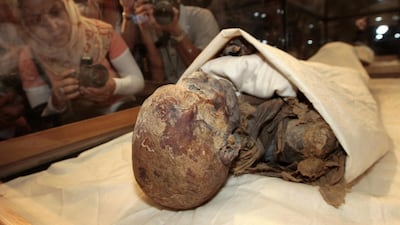

A gruesome trade in mummified human body parts, including heads, is putting collectors and even postal workers at risk, new research suggests.
People who handle remains could be exposed to hazardous chemicals used as preservatives and to microorganisms that thrive in decaying material, according to the study.
The buying and selling of body parts, often through social media sites, has been described as “shocking” and disrespectful to the dead, who are unlikely to have consented to their remains being traded.

In a paper in the International Journal of Cultural Property, researchers analysed scores of online posts advertising items for sale. They identified what they branded “the real mummy’s curse” – the dangers posed by handling or storing human body parts, including hands and feet.
Fungal spores
The mummy's curse refers to the belief that anyone opening an ancient Egyptian tomb will be cursed with bad luck, and the new research suggests a scientific basis for the myth.
Previous work by a researcher at Cairo University cited in the paper identified fungal spores in mummified remains that “could lead to inflammation of the respiratory tract, infections, and fever”.
The paper notes that most of those who opened the Krakow tomb of a 15th-century King of Poland, King Casimir IV Jagiellon, in the 1970s died, probably because they inhaled fungal spores.
“In addition, it is believed that a severe form of aspergillosis may have contributed to Lord Carnarvon’s death, possibly resulting from inhaling Aspergillus spores in Tutankhamun’s tomb,” said the study, referring to the English aristocrat who bankrolled the excavation of the pharaoh's tomb in Egypt in the 1920s.
“In these cases, fungal spores lay dormant for hundreds of years, and once disturbed they became airborne and dangerous to human health.”
The study is titled The real mummy’s curse: Health risks associated with the sale and trade of mummified remains.
Kirsty Squires, a professor of human bioarchaeology at the University of Staffordshire in the UK and joint first author of the study, said mummified remains harboured fungal spores, yeast and bacteria.
Yet by analysing online posts, the researchers found that such material was often stored openly, putting anyone nearby at risk.
“It impacts on the health of people handling [material] or if they’re around the rooms [where material is kept] for a prolonged period,” Prof Squires said.
Not handled with care
The other joint first author, Dr Damien Huffer, of Adelaide University in Australia, said the researchers were not surprised to have identified hazards linked to mummified body parts.
“Diverse mummification or preservation processes have used a range of organic and inorganic substances to dry, smoke or preserve tissue that would usually decay,” he said.
“The greater surprise was to identify examples of actively bio-deteriorating remains on the market, or being displayed or held without proper protection.”
He said it was unclear whether the trade had grown as it was difficult to estimate the size of a sector that mostly operated online.

“Prices and frequency of sales posts within the broader human remains trade have fluctuated over the years, and the ‘niche’ market for mummified remains is one part of it,” he said.
The other authors of the study are Dr Dario Piombino-Mascali, of Vilnius University in Lithuania and the University of Salento in Italy, and Dr Clara Urzì, a microbiologist at the University of Messina in Italy.
Prof Squires said the trade raised “serious ethical concerns”, adding that individuals should not own body parts because they “were once a living person”.
“[The trade] is seen as completely unethical, particularly because consent wasn’t given by the deceased when they were alive or by their kin,” she said. “On the whole it’s a very shocking trade – that this can go on so openly. It’s just not regulated.”
While body parts are advertised for sale on sites, including Facebook and Instagram, Prof Squires said it was often unclear where they originated. Some may be from ancient Egypt, although others appear to be more recent.
Body parts may have been deliberately mummified or they may have undergone spontaneous mummification, in which they dry out naturally.
A bill going through the UK Houses of Parliament could outlaw the sale, purchase and advertising of human body parts.
When presenting the bill in February, Bell Ribeiro-Addy, a Labour MP, outlined “truly stomach-churning” details of the trade.

Hansard, the official record of parliamentary proceedings, quoted her as saying that sales have included a child’s shrunken head, skulls with hair and soft tissue attached, and human bones.
There had been reports of shops offering “lucky dip” bags of bones and selling foetal hearts, lungs and slices of brain in jars.
“There is a substantial market for decorative objects made from human remains,” Ms Ribeiro-Addy told fellow MPs.
“One could purchase a wind chime made from a human skull cap with ribs and clavicles, a candlestick made from stacked human vertebrate, a human finger crucifix pendant … or even wallets fashioned from human leather, and all of that is entirely legal.”
The researchers say there should be restrictions on the local sale of human remains, and on buyers and sellers who import or export material via global postal services.
They called for mummified remains to be stored and displayed in controlled environmental conditions.
“Shipments suspected or discovered to contain human remains … must be inspected or handled with full PPE [personal protective equipment],” Dr Huffer said.
Researchers said postal services could review their customs declaration codes to prevent sellers from concealing material by using vague or irrelevant codes and ensure more shipments were flagged for inspection.