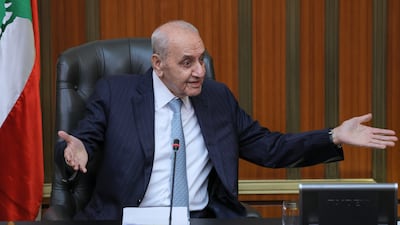

Lebanon's parliament has passed a controversial general amnesty law in a bid to ease severe prison overcrowding, despite the withdrawal of two of the largest parties from the chamber ahead of the vote.
Even for crimes not covered by the bill, prisoners will still be able to benefit from reduced sentences.
Among the crimes excluded from the amnesty are terrorism offences, whether committed against civilians or the army, premeditated murder and rape.

For crimes not covered by the amnesty, sentences will be reduced under the law’s provisions: life imprisonment to 18 years, death sentences to 28 years and other prison terms by a third.

Lebanon's current prison population is about 8,500 but capacity is only 4,500.
While the bill was being discussed in the committee stages in the months leading up to the vote, it threatened to further upset Lebanon's already delicate sectarian tensions.
Hezbollah and the Free Patriotic Movement objected to Defence Minister Michel Menassa being blocked by Prime Minister Nawaf Salam from addressing parliament to give the Lebanese Army's opinion on the amnesty law. Mr Menassa is himself a retired army general.
Even Deputy Speaker Elias Bou Saab said it was "a mistake" that the Defence Minister was unable to speak.
Among the inmates who could be released or have their sentences reduced are the so-called Islamist detainees – 146 Sunnis largely accused or convicted of fighting and killing members of the army.
Perhaps the most contentious of those prisoners is the radical cleric Ahmad Al Assir, who was sentenced to death over deadly clashes between his supporters and the army in 2013. However, he is undergoing a retrial and on Tuesday parliament formally approved the abolition of the death penalty.
The abolition of the death penalty is retroactive, meaning existing death sentences are converted to life in prison. It is understood this was why the two bills were deliberately sequenced, with the death penalty abolition vote taking place before the amnesty law.
Imad Hout, a Sunni legislator who supported the bill, said 79 of the so-called Islamists will be released. After the legislation was passed, videos quickly emerged online of inmates at Roumieh, Lebanon's largest and most overcrowded jail, cheering at the news.
'National achievement'
The law specifically states it was introduced due to “the chronic delay in issuing criminal judgments, and what has affected the essence and objectives of justice”.
Walid Baarini, a Sunni MP from Akkar, described the law's adoption as a “national achievement” that he hoped “restores the meaning of justice”.
MPs sympathetic to the plight of the Islamist detainees and supporters of Al Assir argue they were victims of a judicial system – particularly the military court – that was too influenced by Hezbollah or its allies such as the former Syrian dictator Bashar Al Assad.
But critics say people such as Al Assir are among Lebanon's most dangerous men and are guilty of spilling the army's blood.
Some detainees are still waiting to face trial but have already been held for longer than the maximum prison term they could face if convicted.
Among those also set to be released are mid-level drug dealers, who are largely Shiite and originally from the Bekaa Valley.

“The Minister of Defence was not allowed to speak – this occurred several times, not just today," a Hezbollah official told The National, explaining the withdrawal of their MPs.
"Concerning the prisoners and the amnesty law, we discussed this with the Sunni MPs and already reached an agreement, so we have a positive view of it. The main issue is the Minister of Defence," they added.
The Christian-led FPM was founded by former president and army commander, Michel Aoun.
Justifying the walkout, FPM MP Salim Aoun said: “The Minister of Defence had been prevented from presenting the position of the army and his ministry.”
On Tuesday when the debate started, Mr Salam had insisted there was no need for the Defence Minister to speak because he was addressing the parliament and speaking on behalf of the government. Mr Salam said the army's position had already been stated at the committee stage.
The law did, however, receive the support of the FPM's main Christian rival, parliament's largest party, the Lebanese Forces.