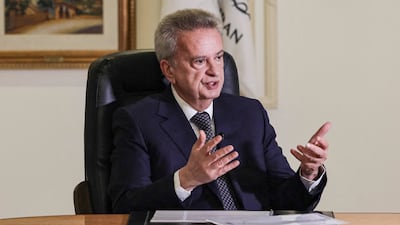

The Salameh Papers: Special report into allegations against former Lebanon banking chief
Lebanon's former Central Bank governor Riad Salameh on Monday refused to comply with a judge's order that he should be moved from the notorious Roumieh prison to a hospital for medical tests.
The Attorney General at the Court of Cassation Ahmed Rami Al Hajj ordered Mr Salameh's transfer for a “routine medical examination” and not because of a deterioration in his health, Lebanon's National News Agency said.

However, the embattled former bank chief, who is accused of financial wrongdoing, refused to undergo a medical examination at the Dahr El Bechak government hospital, including an electrocardiogram and respiratory tests.
His lawyers claimed that Mr Salameh's health had deteriorated over the weekend due to his detention and urged that he be readmitted to a hospital.
Mr Salameh was arrested on Friday at Bhannes Hospital, north of the capital Beirut, after failing to appear before a judge for questioning a day earlier. He had been summoned for questioning on Thursday by Samaranda Nassar of the Court of Cassation. The questioning concerned a complaint filed by the current governor of Lebanon's central bank, Karim Souaid.
“He's in Roumieh prison,” a judicial source had earlier said on Monday morning before. “Concerning his health conditions, the examining doctor deemed it was not serious enough for him to stay at the hospital; that's why he was moved to Roumieh. It's only a matter of blood pressure, that's it,” they added, referring to the original decision to transfer Mr Salameh from Bhannes Hospital to Roumieh.
Roumieh is Lebanon's largest prison and overlooks Beirut from its eastern suburbs. Rights groups have regularly criticised its overcrowded and squalid conditions.
Mr Salameh was indicted in July last year and released on $20 million bail.
In a statement issued through their lawyers, his family said that the 76-year-old needed to be kept “under intensive medical supervision” and that his health status was unstable.
They also said Mr Salameh had complied with the judicial investigation into him, and that not keeping him under constant medical supervision harms the investigation itself.
For three decades, Mr Salameh was one of the country’s most influential people and had even been touted as a potential presidential candidate. However, his arrest in September 2024 for embezzling public funds, forgery, illicit enrichment and money laundering revealed a side to a man who was once lauded as the guardian of the country's financial sector.
He has become a figure of ridicule in Lebanon following a 2019 economic crisis, the effects of which reverberate today. That crisis was blamed on decades of financial mismanagement and corruption among the Lebanese elite, including Mr Salameh.
The crisis saw the local currency plummet in value by more than 95 per cent on the parallel dollar market, while informal capital controls implemented by the banks meant vast numbers of depositors were locked out of their savings – a situation that continues.
According to Lebanon’s National Human Rights Commission, Roumieh was originally intended to house about 1,300 inmates but currently holds just over 4,000. Government estimates put its official maximum capacity at 3,000.
Human Rights Watch reported in 2023 that conditions had “dangerously deteriorated” following the 2019 crisis, with severe overcrowding and poor health care. Inmates held there run from low-level offenders to those convicted or accused of the most serious crimes, including murder and terrorism.
One reason for the overcrowding is that many of the inmates are still awaiting trial. The current government, which came to power at the start of 2025, has sought to ease overcrowding by sending some Syrian inmates back to their home country to serve out their sentences – but the number is small compared to the total population.