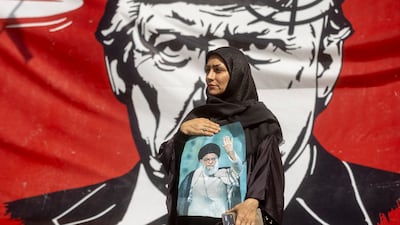
US President Donald Trump has warned that Democratic politicians could cut funding for the war against Iran when they take control of Congress in January, possibly turning what he described as a military victory into a defeat.
Mr Trump told the New York Post that the American military campaign was funded until the end of January and questioned how Democrats could justify ending it.
“I don’t know how they could do that politically, because we have a win. We can put that war to bed anytime we want,” he said.
Mr Trump admitted his military options could become more limited when Democrats assume control of Congress. He also said Israel's goal of regime change in Iran was “probably doable”, but stressed it was not his own objective.
“I just don’t want them to have a nuclear weapon. I was never for or against regime change, that was never a criteria for me,” he said.
The comments highlight a potential political constraint on the US campaign even as Mr Trump insists Washington has achieved its military objectives. Democrats have already discussed using congressional spending legislation to restrict funding for offensive operations against Iran.
Meanwhile, Iran’s Islamic Revolutionary Guard Corps claimed two more oil tankers exploded and caught fire after striking naval mines while attempting to cross the Strait of Hormuz.
The IRGC Navy said the incidents occurred in the early hours of Wednesday, affecting two tankers off the southern and eastern coasts of the strategic waterway.
In a statement carried by its affiliated Sepah News channel, it said the vessels had attempted to use a “false route” through the strait. “Naval mines did not allow them to pass, causing massive explosions and fires,” it said.
The claims have not been independently verified. International maritime agencies have described unidentified projectiles, rather than confirmed mine strikes, in reports of other recent tanker incidents.
'Iran's economy is under water'
The developments come as Iran faces mounting pressure from a US naval blockade that has halted its oil exports, compounding the effects of international sanctions and the war.
But Tehran is also seeking to demonstrate that the blockade has not left it unable to sustain domestic supplies.
Iranian Vice President Mohammadreza Aref said on Wednesday that increased cargo unloading and customs clearance at border crossings outside the country's southern ports showed Iran had no concern about the naval blockade.
“Our stocks of essential goods are in good shape, and a plan must be drawn up to prevent their prices from rising for at least three months,” he said.
Mr Aref described stocks of essential and strategic goods as being at very good levels and said goods remained widely available in markets. He also urged manufacturers who had raised their prices to bring them down.
His remarks offered a contrasting picture to reports of mounting economic pressure in the country. Statistical data show inflation reached 88.7 per cent in October, while fuel shortages have prompted electricity cuts, and supplies of motor oil and tyres have slumped.
US Treasury Secretary Scott Bessent said on Monday that “Iran's economy is under water, and its leaders are panicking”, as Washington announced fresh sanctions aimed at Iranian financial networks.
Tehran has increasingly threatened to use military force to break the blockade.
Parliament Speaker Mohammad Bagher Ghalibaf said Iran would pursue military means in the near future, while regime-linked media outlets have advocated sending a tanker convoy to China under military escort.
Such an operation could bring Iranian vessels into direct confrontation with US forces enforcing the blockade. Reports that dozens of tankers were preparing to sail from Kharg Island, Iran's main oil export terminal, fuelled speculation about an imminent attempt.
State broadcaster Irib denied on Monday that a convoy had set sail, but insisted Tehran had other ways to challenge the blockade.
Diplomatic efforts are also continuing, with Sheikh Mohammed bin Abdulrahman, Qatar's Prime Minister and Foreign Minister, completing a visit to Washington.
Qatar has played a mediating role in efforts to contain the confrontation, although the immediate prospects for a diplomatic breakthrough remain unclear.