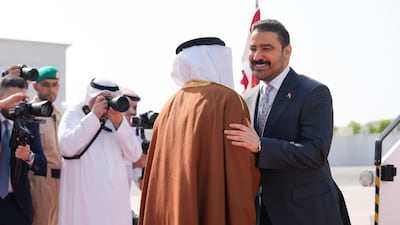

Iraqi Prime Minister Ali Al Zaidi held talks in the Bahraini capital Manama on Wednesday on the first visit to the kingdom by a leader of post-2003 Iraq.
Mr Al Zaidi said he was visiting Bahrain to “revive the historic relationship between the two countries,” saying work was taking place to boost ties in economic and political fields.
Iraq and Bahrain share “a common security” and should take a common approach to regional issues, giving priority to “the language of dialogue, to establish peace and end tension,” Mr Al Zaidi's office said. He invited King Hamad to visit Iraq.

King Hamad said the visit would “open new horizons for the relationship between the two countries,” and affirmed his country’s support for the Iraqi government. He also stressed the importance of working to achieve security and stability.
Mr Al Zaidi expressed Iraq's keenness to “expand areas of co-operation and partnership between the two countries, in various economic, political and social sectors”, his office said.
The talks aim to improve co-operation in several fields in a way that “contributes to achieving the common interests of the two brotherly peoples”, it said.
Mr Al Zaidi was received by Crown Prince and Prime Minister Salman bin Hamad Al Khalifa, with whom he jointly chaired talks. He is also scheduled to meet King Hamad.
For his part, Prince Salman expressed his happiness at Mr Al Zaidi’s visit, describing it as historic, the Iraqi statement said. He said it would be “an important launch for more co-operation and building economic partnerships”, describing Iraq as having a pivotal role in the region.
He also underlined Iraq’s efforts to “consolidate stability and peace in the region, as the essential pillar for achieving prosperity and economic integration among its countries”.
Earlier on Wednesday, Iraqi government spokesman Haider Al Aboudi said the Prime Minister and King Hamad would be discussing “the political and economic co-operation between the two countries, and the developments in the region”.
Relations between Iraq and Bahrain have long been strained by sectarian politics and regional rivalry. After 2003, Baghdad’s Shiite-led governments were viewed with suspicion in Manama.
That mistrust deepened sharply during the 2011 uprisings in Bahrain that won support from powerful Shiite figures, in turn prompting anger from Bahraini officials at perceived interference. The perception of post-2003 Iraq aligning with Tehran against Gulf states kept Iraqi-Bahraini relations cold for years, even as both sides maintained formal diplomatic ties.
The Bahrain visit is the latest stop in an intensive regional tour by Mr Al Zaidi.

Last week, he visited Jordan, where he met King Abdullah II. It came days after Jordan had carried out air strikes on what it described as ISIS positions in southern Syria. It strained relations between Damascus and Amman following a militant attack on a church in Jordan.
Two days later, Mr Al Zaidi travelled to Damascus for talks with Syrian President Ahmad Al Shara – the first visit to Syria by an Iraqi prime minister since the fall of Bashar Al Assad in 2024.
In Damascus, the two leaders discussed trade, investment, border security and rehabilitating the Kirkuk-Baniyas oil pipeline, which could provide Iraq with another route for exporting oil through Syria to the Mediterranean.
They also discussed the restoration of organised Shiite pilgrimages to the Sayyida Zaynab shrine near Damascus, which Mr Al Zaidi visited. He also toured the Umayyad Mosque.
The Damascus and Amman talks followed Mr Al Zaidi's meeting with Saudi Crown Prince Mohammed bin Salman and with Turkish President Recep Tayyip Erdogan as part of what his office has described as a push to establish relations with neighbours and expand economic and energy co-operation.
Iraq’s relations in the Gulf have come under pressure since Israel and the US began their war on Iran in February. Iran-aligned groups in Iraq have launched drones and missiles at targets in Kuwait, Saudi Arabia and UAE, as well as Jordan.
Since taking office in May, Mr Al Zaidi has been moving to repair relations with Gulf states and to enhance ties in all fields. Baghdad has also been pushing for a formula bringing together the six Gulf Co-operation Council states, plus Iraq and Iran, in an initiative known as 6+2, to achieve a home-grown security architecture.