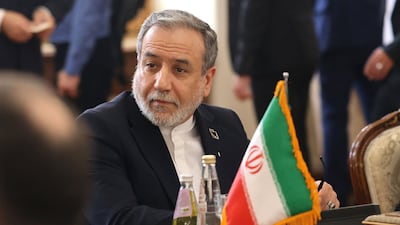
Iran will not allow the Strait of Hormuz to fully reopen until the US accepts its terms, Foreign Minister Abbas Araghchi has said, warning that Tehran is ready to resume fighting if the stand-off escalates, even as he insists diplomacy remains possible.
Indirect negotiations between Iran and the US were continuing through mediators Pakistan and Qatar, Mr Araghchi told Iraqi state television in an interview aired on Wednesday.
“Until an agreement or understanding is reached regarding this strait, it will not be open to everyone,” he said.

In an opinion article published later in The Financial Times, Mr Araghchi accused Washington of threatening more violence while showing little willingness to work on diplomacy.
“Any further escalation around the Strait of Hormuz or elsewhere in the region will put civilian lives and the well-being of all regional states and the global economy at great risk,” Mr Araghchi wrote. “Given that the White House has shown no willingness to reach an understanding on the way forward, while also threatening more violence, there is little reason to expect progress now."
His remarks came after Iran's Islamic Revolutionary Guard Corps claimed an oil supertanker carrying more than two million barrels exploded after hitting a naval mine near the Strait of Hormuz late on Tuesday. It was the latest in a series of such IRGC claims that remain unverified.
On Tuesday, Pakistani army chief Field Marshal Asim Munir travelled to Tehran with an official delegation to meditate between the two sides. Qatar, for its part, said communication between Washington and Tehran had “not stopped” and that the aim was to reach a solution as soon as possible.
The US and Israel appeared to be considering military options, however.
Last week, CNN reported that the US had developed strike plans that could include using the GBU-43/B Massive Ordnance Air Blast bomb, also known as the Mother of All Bombs, or Moab, against Iranian energy infrastructure and nuclear sites if US President Donald Trump orders renewed combat operations.
The weapon is the largest non-nuclear bomb in the US arsenal. Its inclusion would extend the threat of renewed military action to Iran's Pickaxe Mountain, a deeply buried site near the Natanz nuclear complex.
Warning of renewed attacks
Separately, The FT reported on Wednesday that Israeli Prime Minister Benjamin Netanyahu was pushing for large-scale strikes against Iran, having ordered the military to prepare for a major new offensive earlier this month.
The Israeli military had prepared a multi-day bombing campaign for the weekend of October 10 that would have struck civilian infrastructure, including power plants as well as nuclear facilities and sites associated with Iran’s leadership, The FT said, quoting three people familiar with the matter.
The operation was ultimately shelved amid opposition from Mr Trump, who did not want to restart the conflict before the US midterm elections on November 3, the sources said.
The proposed campaign was intended to be more intense than the joint US-Israeli offensive launched against Iran in February, The FT reported. Mr Netanyahu and Mr Trump have nevertheless continued to threaten renewed military action, saying the US and Israel must “finish” the job against Iran.

Meanwhile, Fox News, quoting two US officials, reported that the US was sending the USS Theodore Roosevelt carrier strike group and the 13th Marine Expeditionary Unit to the Middle East, adding about 10,000 sailors and Marines by the end of November.
It would be the third US aircraft carrier in the region.
The reports came after US Defence Secretary Pete Hegseth met Mr Netanyahu during an unannounced visit to Israel on Monday, as the two sides were discussing the possibility of resuming major combat operations against Iran before the US vote.
The visit came a day after Mr Trump publicly endorsed Mr Netanyahu's candidature in Israel's elections.
Iranian officials told Reuters that Tehran was preparing for possible renewed attacks and saw little prospect of a diplomatic breakthrough before the US elections. Mr Trump previously said Washington would not strike Iran again before the vote.
Tehran rejects US pressure
In the interview, Mr Araghchi repeated that Iran was preparing for possible renewed US and Israeli military action, despite its stated preference for diplomacy.
“Every possibility exists in the future, including the possibility that the Americans and the Zionist regime will launch another war against Iran,” he said.
He added that the dispute went beyond Iran’s nuclear programme.
“The nuclear issue is nothing more than a pretext," Mr Araghchi said.
Meanwhile, Iranian officials threatened to attack undersea cables, data and artificial intelligence centres if fighting resumed.
Qatar has warned that threats to cables, sea mines and oil spills in the Strait of Hormuz would harm countries across the region.
Shipping through the strait remains severely disrupted, putting pressure on energy markets and regional economies. Oil prices have edged higher on Middle East supply concerns. Brent crude touched $111.99 a barrel on Tuesday, the highest since May 20.