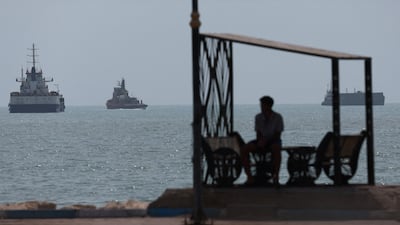
Iran has rejected holding talks with the US until Washington meets the conditions it has set, after President Donald Trump said Tehran wanted a deal quickly.
Mohsen Rezaei, secretary of Iran's Supreme National Security Council, warned on Tuesday against being distracted by Mr Trump's conflicting messages, which have alternated between rejecting negotiations and signalling openness to talks.
“Don't get distracted by the US President's mixed signals,” Mr Rezaei said in a post on X. “No talks” would take place until Iran's conditions were met. He did not specify the terms, he added.
Tehran has demanded an end to US military operations and threats, an end to an American blockade on Iranian shipping and the lifting of sanctions. It has also demanded the release of frozen assets and compensation for war damage, while linking the reopening of the Strait of Hormuz to Washington meeting its demands.
Mr Trump said on Monday that Iran was seeking an agreement “quickly and badly”, while leaving open the possibility that Washington could engage with Tehran.
“The failing nation of Iran wants to make a deal, quickly and badly,” the President wrote on Truth Social, saying he would decide whether the US would engage.

The conflicting statements highlight the wide gap between Washington and Tehran as fighting continues and diplomatic efforts to restore navigation through the Strait of Hormuz struggle to gain traction.
Mr Trump also said oil was flowing through the Strait of Hormuz and other countries “should and will” reimburse the US for the costs of the conflict.
Commercial traffic, however, remains severely disrupted. Kpler data showed only four commodity vessels transited the strait on Monday, down from 10 the previous day. The figures exclude vessels that may have switched off their transponders to avoid detection, meaning actual traffic could be higher.
Before the war began on February 28, the Strait of Hormuz typically handled around 125 large commercial vessels a day, carrying a fifth of global crude oil and liquefied natural gas supplies.
Diplomatic setback
State media in Iran has reported that an oil tanker exploded and caught fire after coming into contact with mines in the strait, citing the Islamic Revolutionary Guard Corps. The report did not provide a date for the incident, nor more details.
Gulf states have postponed planned discussions with Tehran over arrangements for navigation through the waterway.
Oman said conditions were not yet suitable for a meeting that had been scheduled to take place on Monday in Salalah, which was intended to support “constructive dialogue” and regional security and stability.
Iran said the postponement followed a request from some regional countries, with Tehran and Muscat agreeing to reschedule the talks. No new date has been announced.
The delay followed disagreements over an Iran-Oman framework for managing navigation through the Strait of Hormuz, including a proposed temporary corridor and efforts to clear mines.
Saudi Arabia had reportedly raised concerns about proposed changes to the arrangement, while Bahrain had said it would not take part. Gulf states have struggled to reach consensus on the framework.
Central Command, which oversees US military operations across the Middle East, said on Monday that American forces had redirected 101 commercial vessels to ensure compliance with its blockade on Iranian shipping.
The diplomatic setback came as Iran's attacks on Gulf neighbours and commercial shipping continued to threaten the region's energy infrastructure and deepen pressure on global oil markets.
Iranian Foreign Minister Abbas Araghchi will visit China on Wednesday, when he will hold talks with Chinese Foreign Minister Wang Yi, the Chinese Foreign Ministry said.
Washington, meanwhile, is seeking to maintain its military capacity. Mr Trump said the US has large stocks of interceptors and missiles following a surge in defence production.
His comments came after reports that American stocks of Patriot and Thaad interceptors had been significantly depleted during the conflict.
Mr Trump invoked the Defence Production Act in June to accelerate military equipment and munitions production, saying contractors were now delivering weapons to US forces in the Middle East and beyond.

