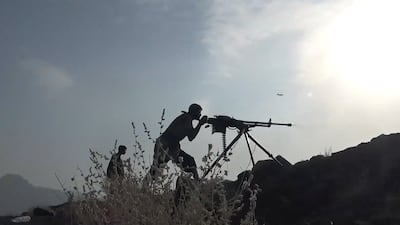
The US expects a change in the Red Sea security situation “soon” and is engaged in military co-ordination with regional allies over the Bab Al Mandeb strait, a senior adviser to President Donald Trump said in Dubai on Tuesday.
Speaking at the Arab Media Summit, Massad Boulos, Mr Trump’s senior adviser on Arab and Middle Eastern affairs, said freedom of navigation in the Red Sea was a “red line” for the US President and hinted that developments were already moving in a positive direction.
“We’re starting to see things turning in a positive direction in the past few hours. We haven’t announced it yet,” Mr Boulos said. “Freedom of navigation in the Red Sea is a red line and a very important topic for President Trump. There is co-ordination with our regional allies, and soon we will see a change,” he said.

His comments came as the security situation in and around the Red Sea was deteriorating, with the Iran-backed Houthi rebels launching a new wave of attacks on Saudi Arabia after advancing along Yemen's western coastline in an offensive that has now displaced more than 100,000 people.
The UN's refugee agency said a further 2,400 people had fled across the Bab El Mandeb strait to Djibouti in the Horn of Africa. These refugees are arriving "exhausted, distressed and carrying what little they could take with them", said Sandrine Desamours, a UNHCR representative in Djibouti.
Saudi Arabia’s Civil Defence on Tuesday urged people in six cities to remain indoors and stay away from windows, rooftops and exposed areas amid Houthi attacks. The cities included Yanbu, the kingdom’s main Red Sea oil port, where millions of barrels of crude are loaded each day. Authorities later said the danger had passed in Abha, AlUla, Jazan, Jeddah and Taif.
Saudi authorities said late on Monday that Houthi attacks on civilian areas had injured 13 people and damaged seven residential homes and two vehicles.
Maj Gen Turki Al Malki, spokesman for the Saudi-led coalition in Yemen, said the Houthis had launched ballistic missiles and drones at civilian areas in Abha, Khamis Mushait and Taif. The Houthis said they fired dozens of ballistic missiles and drones at Saudi Arabia’s King Khalid airbase, near Khamis Mushait.

Houthi military spokesman Yahya Saree said the targets included aircraft hangars, radar systems, runways and ammunition depots. He described the operation as retaliation for Saudi strikes on Yemen.
In a statement late on Monday, he said Saudi warplanes had carried out 54 air strikes over the previous 24 hours using F-15 fighter jets and Typhoons operating from bases in Khamis Mushait and Taif. He added that strikes hit areas in Taiz, Lahj, Al Jawf, Marib and Hajjah, and warned that they would “not pass without a response and punishment”.
The Houthi advance along Yemen’s western coast towards Bab Al Mandeb has heightened concerns over the security of one of the world’s key shipping routes.
Houthi war crimes allegation
In a report issued on Tuesday, Human Rights Watch said at least three cases of recent Houthi attacks on commercial vessels in the Red Sea and Gulf of Aden were likely to have constituted war crimes. Civilian crews must be protected under international humanitarian law, the group added.
“Whatever the geopolitics, attacks on civilian crews carried out deliberately or recklessly are war crimes,” said HRW researcher Niku Jafarnia.
The allegations add to concerns over the wider impact of the Houthi offensive, which has brought the group closer to the Bab Al Mandeb, a key global shipping route linking the Red Sea with the Gulf of Aden.
Officials with Yemen's internationally recognised government said the Houthis were digging into positions along the coast and had maintained control over much of the Red Sea shoreline.
The renewed fighting has raised concerns about the security of shipping and Saudi oil exports, particularly as regional tensions have already disrupted major energy routes.
The humanitarian toll in Yemen is also mounting. The International Organisation for Migration said on Tuesday that 93,864 people had been newly displaced across Yemen owing to fighting and flooding.
Taiz and Lahj were among the worst-hit areas. In the Jabal Habashy district of Taiz, 18,840 people were newly displaced, while 16,464 were displaced in Al Mudharibah district of Lahj, IOM figures showed.
The latest displacement comes after years of conflict had already forced millions of Yemenis from their homes and left large numbers dependent on humanitarian assistance. The combination of renewed fighting and flooding has put further pressure on communities already struggling with damaged infrastructure, limited shelter and disrupted access to basic services.
"This escalation could not come at a worse time for Yemenis," said Jan Egeland, secretary general of the Norwegian Refugee Council. "In a country where half the population are struggling to put food on the table, and where many children have only known displacement, renewed full-scale conflict would be a blow to millions of families already struggling to make ends meet."
Saudi Arabia has led a coalition fighting against the Houthis since 2015, although the conflict had largely eased under a ceasefire in recent years.
The Houthis seized the strategic port of Mokha last Thursday. They later took over Perim and Zuqar islands, near the Bab Al Mandeb strait.
Iran helped to direct the Houthi advance along the Red Sea coast, including the capture of Perim, sources told The National. Abdul Reza Shahlai, a high-ranking commander in the Islamic Revolutionary Guard Corps' foreign operations arm, the Quds Force, was at the heart of the operation.
Perim, which spans 13 square kilometres, lies between Yemen’s mainland and Djibouti, dividing the strait into two channels. Its position gives whoever controls it an exceptional advantage in monitoring vessels entering or leaving the Red Sea and those on the route towards the Suez Canal, moving between Asia, the Gulf and Europe.