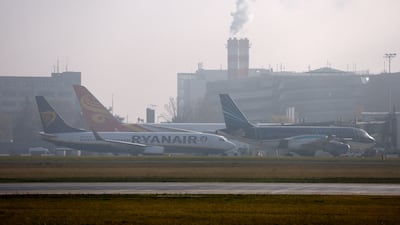

One of the first glimpses of email threats causing security chaos in Europe has revealed a wide-reaching ambition to inflict paralysing damage via anonymous bomb scares.
In its email to broadcasters in Ireland, references were made to the disruption facing dozens of flights this week, warning “this is only the beginning” and that the events were only a “small part of what awaits Europe in the near future”.

Irish authorities said an investigation was under way on Friday to determine who is behind a hoax email campaign that has disrupted air travel in Europe. It has been claimed by someone calling themselves “Mikhail Andropov”.
European flights and airports reported disruption and extra security checks on Friday as the authorities moved to address the security challenges from the encrypted messaging.
Earlier in the week supermarkets around Europe were helpless as fridges were hijacked and food spoiled as their temperatures rose to 50C.
Morning broadcasts
Media organisations, including the Irish public broadcaster RTE, evacuated newsrooms and abandoned programming after receiving the letter, which was titled “Message to the West”.
The Irish government said it is working to “establish who is responsible” for the “very serious” threats against media organisations.
“Hoax threats such as these cause fear, distress and disruption to people going about their daily lives and activities; they achieve no positive purpose whatsoever," it said in a statement.

The statement said it is not yet known if individual people or a co-ordinated effort was responsible for the threats.
“However, these threats come on the heels of the ongoing disruption to aviation around Europe caused by similar threats, and it seems likely that this is a co-ordinated campaign of disruption.”
The bomb threats to airlines come after a wave of sabotage attacks and attempts on targets across Europe.
These range from German electricity substations and airports to defence-related facilities in the Baltic region and supermarket refrigerators in France.
Officials have linked the campaign to Europe's support for Ukraine in its war against invading Russian forces, accusing Moscow of a campaign of “hybrid” disruptions that are cheap to execute, easy to deny and not expected to trigger an armed response. Moscow has strongly denied involvement.
Kaja Kallas warned on Friday that coordinated infrastructure attacks, cyber operations, and hybrid campaigns had active involvement from Moscow. "Russian sabotage operations throughout Europe must stop," she said.
The Spanish Foreign Minister José Manuel Albares said “the most reasonable assumption is that we are facing an attempt at hybrid aggression and a form of psychological warfare”.
Catching culprits
Finding out who is behind the spate of hoax emails, and determining if they are being co-ordinated or could be the work of copycats involves tracing the authors.
The message sent to broadcasters from “Mikhail Andropov” said that “we experimented with multithreading, and we succeeded in causing widespread panic, as well as forcing European authorities to spend a fortune on all these procedures”.
Multithreading is a concept in computing that allows multiple threads to run concurrently while producing simultaneous mailed-out messages that target recipients as individuals. The intention is to provoke organisational panic.
The authors promised systemic chaos in the message seen by the Irish media bosses.
“Very soon, we will be blowing up your airplanes, cruise ships, subway stations and trains. In the meantime, I recommend taking a vacation by plane while you still have the chance,” it said.
Adding to the confusion are reports that bomb threats claiming to be from “fighters of the Male State”, a far-right anti-feminist movement banned in Russia, have been sent to several airlines and airport operators in Rome and Milan.
The bizarre text, written in word-perfect Italian, said that “fighters” of the “Male State” had planted explosives on two incoming flights in an attack on Italy's “feminist regime” that would be “remembered forever”.
But Vladislav Pozdnyakov, a Russian blogger who set up Male State in 2016, said it no longer existed and the collective was not involved in any way in the current incidents.