
The ad men of Madison Avenue may think they conjured up the importance of brand recognition, but an archaeological study suggests its value stretches back as far as the Bronze Age.
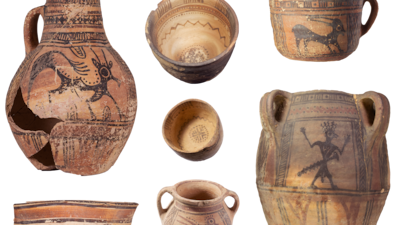
Items of painted pottery known as Midianite uncovered in an oasis in Saudi Arabia are so “distinctive, appealing and sought-after” that they should be considered a brand, researchers suggested.
Analysing vessels found in the oasis of Qurayyah offers unprecedented insights into trading 3,200 years ago, they said. Hundreds of items were found at the site, but hundreds of similar items had been exported abroad and have been found in the southern Levant.
“Oasis-dwellers were resourceful and inventive enough to create their own ceramic repertoire: to cherish at home and eventually export abroad”, says study lead Marta Luciani from the Department of Prehistoric and Historical Archaeology of the University of Vienna.
Prof Luciani told The National the pottery was painted red and black and included “an extremely rich repertoire of motifs”.

She said the items should be considered a brand because they have a strong visual identity, material consistency, technological continuity, centralised production, export circulation, local imitations, intentional commercial scope and cultural reputation.
She said: “We have geometrical motifs, flowers and a huge array of animals – lion, ibex, ostrich, bull, deer, fox, dog, gerbil, shrew, spiny-tailed lizard – and humans, both women and men, involved in performances linked to the funerary rituals. Men are represented with naked, very muscular torsos and either a dagger or chariot reins fastened to the waist, women dancing in long robes.”
Study co-author Doralice Klainscek said the painted animals and humans “became the brand that was exported over hundreds of kilometres north to the Southern Levant, to sites like Tell El Kheleifeh and even the Timna sanctuary of the Egyptian goddess Hathor, and south to North Arabia. But Qurayyah's potting tradition did not stop and continued to be based in the oasis for another thousand years, well into the final Iron Age”.
What is not yet known is how many other brands existed at the time.
The researchers were also able to dispel what they called old misconceptions about the “Midianite Pottery”, and for the first time prove that the pottery's origin was in fact the oasis of Qurayyah.
“Our discovery sheds light on how even in the arid environment of desert oases, where essential resources such as clay, water and fuel were scarce, local communities already in the Bronze Age were far from marginal but participated in wider networks of technological know-how shared with neighbouring regions, such as the Southern Levant and Syria,” said Prof Luciani in the study, published in the journal PLOS One.
“Our study's implications stretch beyond archaeology and the long-term relationship between humans and natural resources in climatically extreme regions into fields such as the economic mechanisms mediating producer-consumer relationships.”
The team included members of MIT, the Harvard Museum of the Ancient Near East, OeAI/OeAW, TU Wien and University of Sydney, with the support of the Heritage Commission of the Saudi Ministry of Culture.