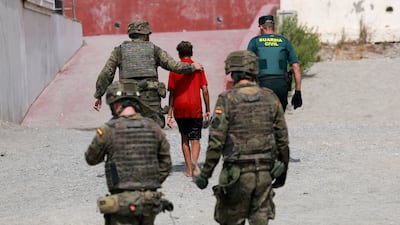

Deporting more than 1,000 unaccompanied minors left in the Spanish enclave of Ceuta after last week's mass arrivals is “basically impossible”, Ceuta government head Juan Vivas said on Thursday.
“If we look at the legislation and the treaties that have been signed, the returning of these minors back to their country of origin is basically impossible because you have to have the agreement of the minors,” Mr Vivas told the European Parliament's committee on home affairs.
Though the vast majority of 72,000 migrants who arrived in Ceuta in under a week have since returned to Morocco, about 3,000 to 5,000 people remain – largely non-Moroccans and including 1,100 unaccompanied minors. About 100 people died trying to cross into Ceuta, Mr Vivas said.
Children, who had arrived before and during the influx, cannot be summarily deported, unlike adults. They are expected to be transferred from Ceuta in North Africa to mainland Spain. Many are living in makeshift accommodation in warehouses or sleeping on the streets as Ceuta's reception centres struggle to cope.

Figures on the number of migrants still present in the enclave are a rough estimate, Mr Vivas said. “The fact that we don't have numbers on how many are still in Ceuta shows how few resources we have to deal with the situation,” he said.
He said the number of arrivals last Thursday was nearly equal to Ceuta's population – the equivalent of “50 million people entering Spain in one day”.
Not enough support
Spanish law states that adult migrants can apply for asylum. If rejected, they will face expulsion. The bar is normally very high for Moroccans to be granted humanitarian protection. Migrant minors who are unaccompanied by adults, however, are supposed to be granted protection and be taken care of by Spanish authorities.
The mass arrivals last Thursday caused alarm across the bloc and revived memories of its 2015-2016 migration crisis. Spain and Morocco have blamed social media manipulation. In Europe, right-wing politicians have raised questions over why Moroccan authorities did not stop tens of thousands of Moroccans from crossing into Ceuta by land and sea.
Those accusations were echoed by Mr Vivas, who said Ceuta has no communication with Morocco, which does not recognise Ceuta's sovereignty. Morocco maintains that Ceuta, which has been under Spanish control since the 16th century, is an occupied Moroccan territory. “Given what’s happened, Morocco is not reliable,” he said. “We're the only EU-Africa land border, and this is being put in the hands of Morocco. We need Europe and Spain to take the lead.”
Mr Vivas called for the immediate expulsion of Moroccans who are still present in the enclave, a structural response to the unique migratory pressure faced by Ceuta, the reinforcement of security along the border, and the mitigation of the arrivals' impact on the local economy.
He also criticised Spanish authorities for not heeding previous calls for help to prevent migratory flows: “We didn't think there would be this avalanche of people that was not predictable, but in the weeks and days running up, we pointed out that there was a worrying increase in the number of arrivals.”

Speaking to the same European Parliament committee, EU migration commissioner Magnus Brunner acknowledged Ceuta's vulnerability. “As long as control remains at the goodwill of one neighbouring state, we remain vulnerable, and we know that unless something changes, migrant smugglers will try it again,” he said.
Mr Brunner advocated continued dialogue with Morocco, which is negotiating a comprehensive partnership agreement with the EU. “We will speak to the Moroccans … as partners and also friends, putting all relevant topics of course on the table,” he said.
Spain's Minister for Migration, Elma Saiz Delgado, and Interior Minister Fernando Grande-Marlaska, declined to take part in the online meeting, organisers said.
Under a reform to Spanish immigration law implemented in 2025, after a surge of migration overwhelmed reception centres in the Canary Islands, unaccompanied minors must be redistributed from overstretched territories within 15 days of their case file being completed.