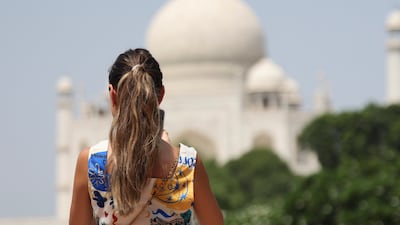

One of the first things I thought of when I saw the Taj Mahal was the UAE, the place I call home.
Standing in front of one of India’s most recognisable historic structures, my mind went almost immediately to the Sheikh Zayed Grand Mosque in Abu Dhabi – another vast white-marble landmark, another expression of Islamic architecture and another building that has become inseparable from the country in which it stands.
The similarities ended there, or at least, they quickly became more complicated. The Taj Mahal was built in Agra nearly four centuries ago by Mughal emperor Shah Jahan as a mausoleum for his wife, Mumtaz Mahal. The Sheikh Zayed Grand Mosque is a modern UAE landmark, completed in 2007 and conceived as an expression of the country’s contemporary identity. One emerged from the Mughal empire; the other from a young federation looking to the future.

I had come to India as one of three journalists from the UAE on a programme organised by the country's Ministry of External Affairs for foreign journalists ahead of the Brics summit in New Delhi. I had visited India before, but this was my first time in Agra.
During Brics week, my focus was supposed to be the India of today: its diplomacy, its growing influence and its role in a changing Global South.
Back in New Delhi, the country was preparing to host leaders and senior officials from 11 member states, including the UAE. The summit was about the present and the future: regional conflicts, geopolitics, trade, economic co-operation, technology and the evolving influence of the Global South.
The Taj Mahal felt like the opposite of all of that. It was a reminder of a much older India.
The visit offered an unexpected way of looking at the country, through a site that embodies centuries of movement between cultures, traditions and regions.
“Make sure you take plenty of photos. You’re now standing in an amazing place. It’s one of the world’s seven wonders,” said an Indian tour guide who was accompanying us.
There were about 90 journalists and influencers on the tour, from various corners of the world.
The guide then told us: “You are standing in the second-most beautiful thing on Earth,” prompting a colleague to ask: “What’s the first?” He paused before joking: “Sorry, ma’am, it’s my wife.”

Beyond the love story
The Taj Mahal is often described simply as a monument to love. And it is certainly that. But standing inside its complex, I was thinking less about the familiar story of Shah Jahan and Mumtaz Mahal and more about the layers of cultural exchange embedded in the building itself.
The name Taj Mahal is generally understood to mean “Crown Palace”, derived from Persian words. It is also widely believed to be a shortened form of Mumtaz Mahal.
Unesco describes it as one of the greatest achievements of Indo-Islamic architecture. Its design brings together Persian, Central Asian, Indian and Islamic influences. The craftsmen who worked on it came from across the Mughal empire and from places including Iran and Central Asia. What emerged was not an isolated expression of one culture, but something shaped by the movement of people, ideas and artistic techniques across borders.
That, perhaps, is where the Taj Mahal and Sheikh Zayed Grand Mosque offer two distinct stories about Muslim identity.
One is rooted in an empire that no longer exists, while the other belongs to a modern Arab state and deliberately draws from architectural traditions across the Islamic world, turning them into a distinctly Emirati site.
Both are monuments to Islamic heritage. But they speak to different moments in history, and to different ways of expressing that heritage.
I had seen the Taj Mahal countless times in photographs. Like many people, I thought I knew what it looked like. But photographs flatten places. They cannot quite convey the scale of the complex, the changing light on the marble or the way the building sits within its gardens.

The place was crowded, with visitors from different countries alongside Indians, young and old. I imagine it is even busier when the weather is cooler. Some people posed for photographs. Others simply photographed what they were seeing.
Everything seemed luminous under the strong sun. At some point, though, the heat became difficult to ignore. After walking around the complex, we were tired and looking for shade wherever we could find it. It had taken us about four hours to get there from Delhi by bus, with one stop along the way, and another four hours (or even more) to get back.
By the time we left Agra, Brics was back on my mind. I was heading towards New Delhi to cover the summit.
Brics is also, in its own way, a story about connections across borders, bringing together countries with very different histories, political systems, economies, cultures and even national interests. This year's summit, under India's chairship, was framed around resilience, innovation, co-operation and sustainability, with people-to-people exchanges forming part of the broader agenda.

During the summit, leaders agreed on a joint declaration, overcoming divisions that had prevented the group from issuing a joint statement at a meeting of foreign ministers in May.
It is easy, as a journalist, to become consumed by the big picture. We arrive for the leaders' meetings, the bilateral encounters and the carefully worded declarations. We chase comments and read statements. We follow the geopolitical calculations behind every handshake.
I travel often for work, covering conferences, events, UN sessions and other major gatherings. But there is much more of a country to see outside the conference rooms where we usually cover it.
And perhaps that was what the Taj Mahal gave me: a chance, even briefly, to step away from the India of summits and diplomacy and see a country whose story stretches far beyond the geopolitics of today.