
Iran has significantly slowed the pace at which it is accumulating near-weapons-grade enriched uranium, The Wall Steel Journal reported, quoting sources.
It has also diluted some of its stockpile, the report said, moves that may ease tensions with the US and allow the resumption of nuclear talks.
The report follows the release of four Iranian-American prisoners by authorities in Tehran from Evin prison into house arrest on August 10.
A fifth American, a woman whose detention was recently made public, is under house arrest.
White House National Security Council spokesman John Kirby said he could not confirm the WSJ report but “any steps that Iran might take to slow down enrichment certainly would be welcome.”
“We're not in active negotiations about the nuclear programme,” he said.
The White House said on August 11 there would be restrictions on what Iran could do with any funds unfrozen under an emerging agreement that has led to the release of the Americans.
An estimated $6 billion in Iranian assets are now held in South Korea.
-
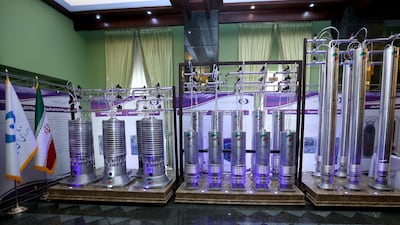
New generation Iranian centrifuges on display for Iran's National Nuclear Energy Day in Tehran, in April 2021. Iranian Presidency Office / Wana -

President Ebrahim Raisi, second right, is accompanied by Atomic Energy Organisation of Iran chief Mohammad Eslami, at Nuclear Technology Day in Tehran in April 2022. Iranian presidency / AFP -
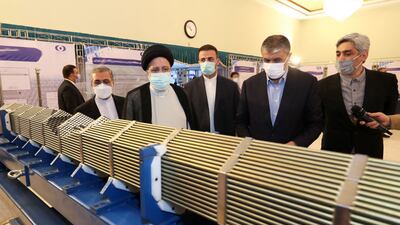
Mr Raisi and Mr Eslami at the April 2022 event. Iranian presidency / AFP -
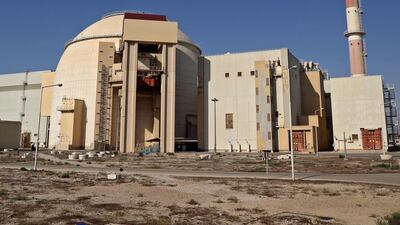
The Bushehr Nuclear Power Plant during a visit by Mr Raisi in October 2021. Iranian Presidency / AFP -
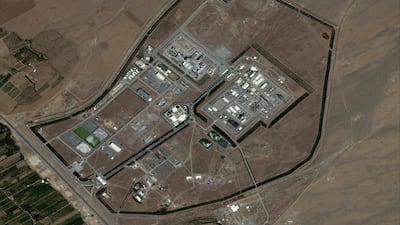
Iran's Arak Heavy Water Reactor complex, south of the capital Tehran in January 2020. Maxar Technologies / AFP -
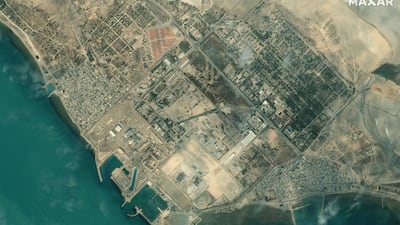
A satellite image of Iran's Bushehr Nuclear Power Plant in January 2020. Maxar Technologies / AFP -
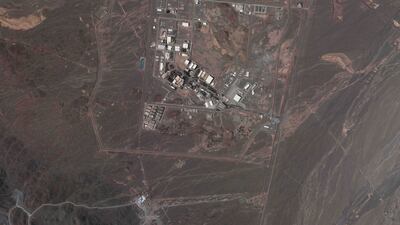
A satellite image of Iran's underground Natanz nuclear site in May 2022. Planet Labs PBC / AP -
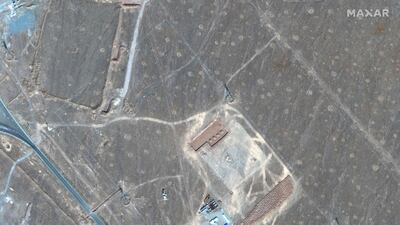
A satellite image in January 2020 of Iran's Fordow Fuel Enrichment Plant, north-east of the city of Qom. Maxar Technologies / AFP -
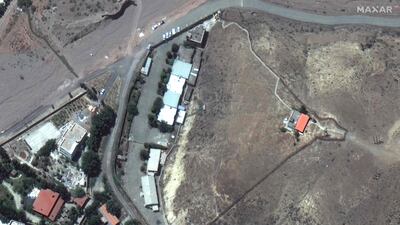
The Sanjarian nuclear centre, east of Tehran, in May 2021. Maxar Technologies / AFP


Mr Kirby told reporters that the US would have “full visibility” into where any released Iranian funds are directed and used.
The five Americans will be allowed to leave Iran after the funds are unfrozen, Reuters reported, quoting a source.
The transfer has drawn criticism that US President Joe Biden is effectively paying a ransom for the US citizens and also that allowing Iran to use the money for humanitarian goods could free up funds for its nuclear programme or to back militias in nations such as Iraq, Lebanon and Yemen, Reuters reported.
After the release of the four Americans, Mr Kirby had told Qatar-based broadcaster Al Jazeera the US is not engaged in negotiations with Iran on the nuclear deal.
“We are not in talks with Iran on the Joint Comprehensive Plan of Action [JCPOA],” he said when asked about other US-Iran files being addressed through mediators.
-
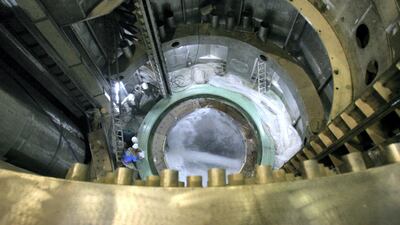
Russian contractors work at the Bushehr nuclear reactor site in 2007. The plant opened four years later. Bloomberg -
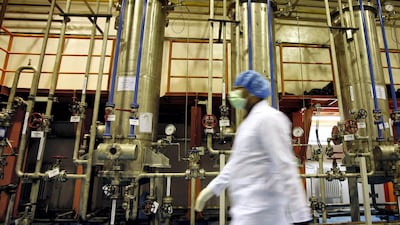
An Iranian technician at the International Atomic Energy Agency inspects the country's Isfahan plant in 2007. Tehran is no longer co-operating with the agency at nuclear sites across the country. EPA -

Workers wait to begin constructing a second reactor at the Bushehr nuclear power plant in 2019. AFP -
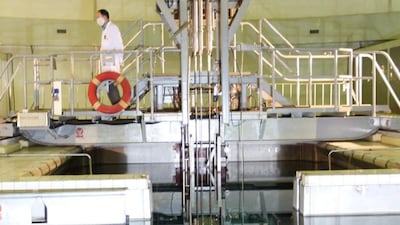
A metal-encased rod with 20 per cent enriched nuclear fuel is inserted into a reactor in Tehran in 2012. AFP -
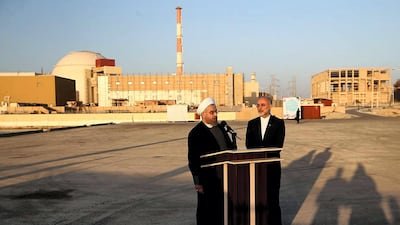
Fomer Iranian President Hassan Rouhani and the country's Atomic Energy Organisation chief Ali Akbar Salehi speak at the Bushehr nuclear site in 2015. AFP -
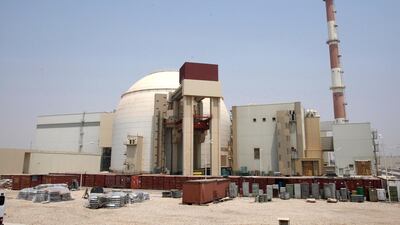
Iran's Bushehr nuclear plant has been restarted. EPA -
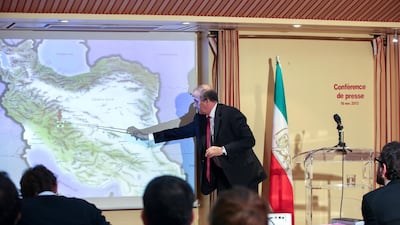
Mehdi Abrichamtchi, chairman of the Peace and Security Committee at the National Council of Resistance of Iran, shows journalists the location of a secret nuclear site in Iran in 2013. AFP -
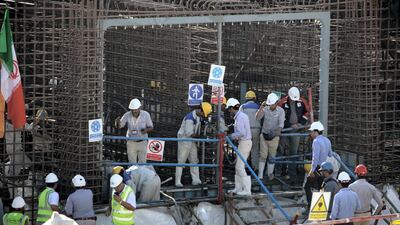
Workers prepare to begin the construction of a second reactor at the Bushehr site. AFP


In June this year, Hasan Alhasan, Middle East specialist at the International Institute for Strategic Studies, told The National that Iran appeared close to developing uranium enrichment to within the “threshold” of making a nuclear bomb to “blackmail” the region.
Iran is likely to have enriched its uranium to 80 per cent – 10 per cent away from making it viable for a nuclear device, he claimed.

