Iran on Monday said it would not renew its inspection agreement with the UN nuclear watchdog but would continue to record data for one more month.
The decision was made public after an accusation earlier in the day by the International Atomic Energy Agency that Tehran had failed to account for uranium traces.
"We have done our best to co-operate with the [IAEA] and provide all clarifications," said Ali Akbar Salehi, head of the Iranian Atomic Energy Organisation.
Mr Salehi said the decision to extend maintaining data for another month was aimed at making progress and concluding "technical talks" between the two agencies.
Iran's failure to explain traces of processed uranium found at several undeclared sites was revealed in the IAEA's quarterly report, released on Monday.
Three months ago Britain, France and Germany scrapped a US-backed plan for the International Atomic Energy Agency’s 35-nation board of governors to criticise Iran for not fully explaining the origin of the particles.
The three countries relented when IAEA chief Rafael Grossi announced new talks with Tehran.
Mr Grossi hoped to report progress in the talks before the board meets next week and as negotiations to revive the 2015 Iran nuclear deal continue in Vienna, Austria.
“After many months, Iran has not provided the necessary explanation for the presence of the nuclear material particles at any of the three locations where the agency has conducted complementary accesses,” he said in a report to member states.
In another report, the agency said Iran’s stockpile of enriched uranium was about 16 times the limit allowed in the 2015 deal with world powers, which tried to limit Iran’s ability to develop nuclear weapons.
It gave an estimate of a stockpile of 3,241 kilograms but said it could not verify the total.
Iran began increasing production after president Donald Trump withdrew the US from the deal in 2018.
Under the pact, the IAEA placed about 2,000 tamper-proof seals on nuclear material and equipment. Those seals communicated electronically with inspectors.
Automated measuring devices also provided real-time data from Iran’s nuclear programme.
But the IAEA's report said it had not been able to access monitoring data since late February, when Iran started restricting international inspections of its plants.
-
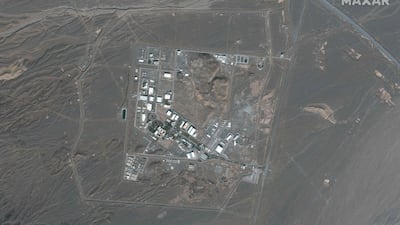
An overview of Iran's Natanz nuclear facility, south of the capital Tehran. Maxar Technologies / AFP -
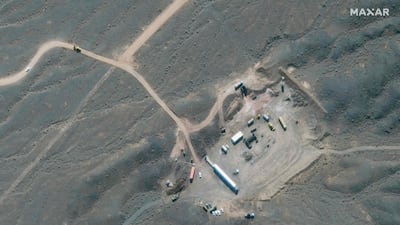
An overview of Iran's Natanz nuclear facility, south of the capital Tehran. Maxar Technologies / AFP -
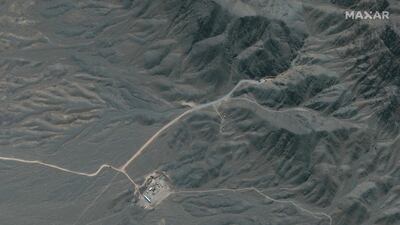
An overview of Iran's Natanz nuclear facility, south of the capital Tehran. Maxar Technologies / AFP -
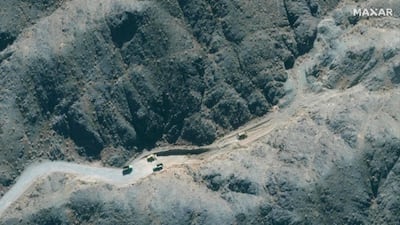
An overview of Iran's Natanz nuclear facility, south of the capital Tehran. Maxar Technologies / AFP


The IAEA said it has “not had access to the data from its online enrichment monitors and electronic seals, or had access to the measurement recordings registered by its installed measurement devices” since February 23.
While Iran and the UN watchdog earlier acknowledged that the restrictions limited access to surveillance cameras at Iranian centres, the latest report indicated they were tougher.
The IAEA said it could only provide an estimate of Iran’s nuclear stockpile as the country enriches uranium at a much higher level.
The IAEA’s latest report leaves Britain, France and Germany with a decision on whether to revive their push for a resolution criticising Tehran, which could undermine the talks to revive the deal.