

Palestinian President Mahmoud Abbas called on Middle Eastern states to back Palestinian statehood at the UN and “rescue” Jerusalem at the Arab League on Wednesday.
Mr Abbas’ call comes amid growing concern in Ramallah over the possible return of former right-wing prime minister Benjamin Netanyahu, who is still facing corruption charges, following Tuesday’s election in Israel.
The surge in support for his Likud party during Tuesday’s poll could propel him back to the prime minister’s office in one of the country’s most right-wing coalitions in its history.
"Israel, by its insistence on undermining the two-state solution, violating international law and the agreements signed with it, and its unilateral measures, left us with no choice but to reconsider the entire existing relationship with it," Mr Abbas told Arab leaders.
"They want to Judaize Jerusalem and Al Aqsa”.
Neither Mr Abbas nor other Arab leaders made explicit mention of Israel's election during the many speeches about Palestinian rights at the summit in Algiers.
The final communique of the conference simply continued Arab support for the Palestinian cause and, as in previous meetings, it said Jerusalem must be protected, it condemned Israel's use of violence against Palestinians and urged Israel to lift its blockade of Gaza.
However, in Ramallah and Gaza, Palestinian officials went further.
Palestinian Prime Minister Mohammad Shtayyeh said the projected election results highlighted "growing extremism and racism in Israeli society".
Bassam Salhe, a member of the Executive Committee of the Palestine Liberation Organization, told Reuters that the result would likely see the occupation of Palestinian lands worse.
"No doubt the result of such a coalition will increase the hostile attitude towards the Palestinian people and make occupation measures more extreme," he told Reuters.
The Palestinian Islamist group Hamas, which has fought several wars with Israel over the past decade, predicted the results meant more potential violence.
-
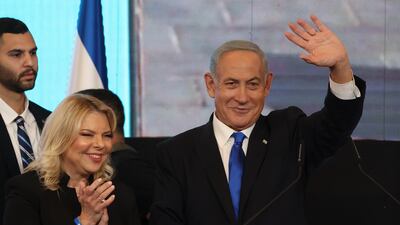
Former Israeli prime minister and leader of the Likud party Benjamin Netanyahu and his wife Sara greet supporters in Jerusalem as Israelis went to the polls on Tuesday. EPA -
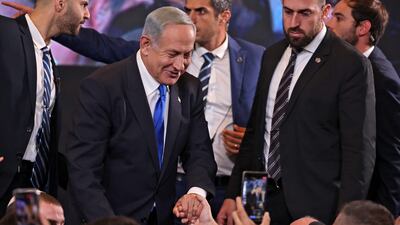
Mr Netanyahu greets supporters after the end of voting for the national elections. AFP -
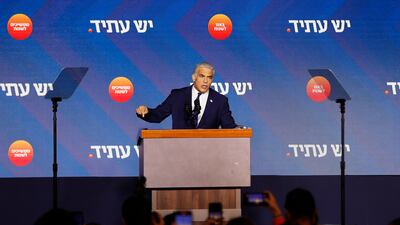
Prime Minister Yair Lapid addresses supporters at his campaign headquarters in Tel Aviv. EPA -
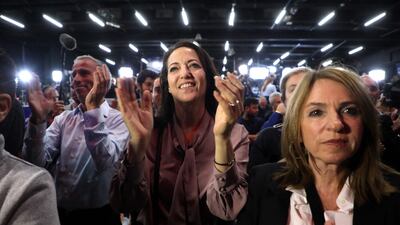
The prime minister's wife Lihi Lapid, centre, cheers her husband. AFP -

The leader of the Otzma Yehudit (Jewish Power) far-right party Itamar Ben Gvir at his party's campaign headquarters in Jerusalem. AFP -
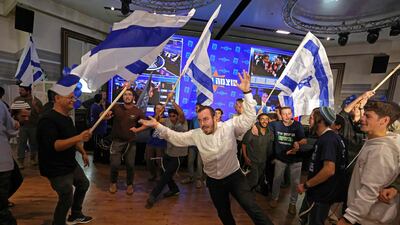
Otzma Yehudit party members in upbeat mood. AFP -
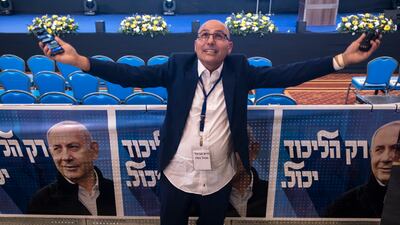
A Likud party supporter responds to favourable exit polls. Getty -
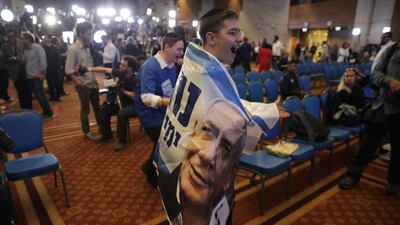
Supporters of Mr Netanyahu react as early exit polls suggest a comeback for the former leader. EPA -

An Ultra-Orthodox Jewish Israeli selects his ballot paper on the day of Israel's general election at a polling station in Jerusalem. Reuters -
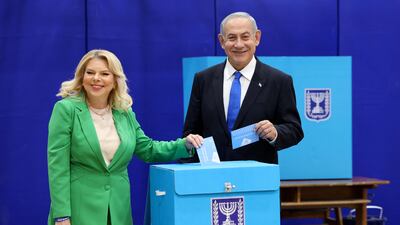
Mr Netanyahu and his wife Sara cast their ballot at a polling station in Jerusalem in the country's fifth election in less than four years. AFP -

A man kisses his dog after casting his ballot in Tel Aviv during the Israeli elections. AP -
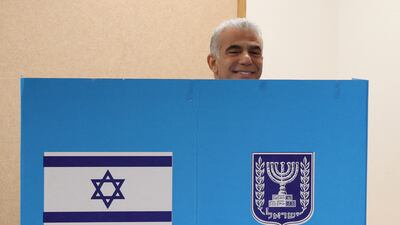
Israeli Prime Minister Yair Lapid smiles as he casts his vote at a polling station in Israel's coastal city of Tel Aviv. Mr Lapid urged the electorate to cast their ballot after voting in an election that might lead to veteran leader Benjamin Netanyahu making a comeback alongside far-right allies. Reuters -
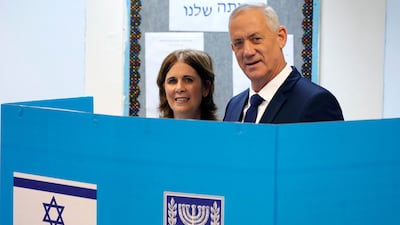
Israeli Defence Minister Benny Gantz, right, head of the new centre-right National Unity Party, and his wife Revital Gantz vote at a polling station in the city of Rosh Haayin in central Israel. AFP -

Ultra-Orthodox Jews watch their Rabbi Israel Hager vote during Israeli elections in Bnei Brak. AP -

An Ultra-Orthodox Jewish man votes in Israel's parliamentary election at a polling station in Bnei Brak. AP -
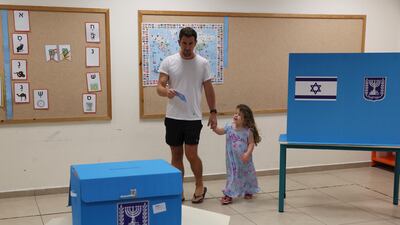
An Israeli man walks with a little girl towards the ballot box to cast his vote. AP -
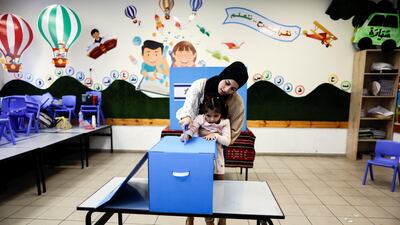
A little girl helps her mother cast her ballot on the day of Israel's general election at a polling station in Taibe, northern Israel. Reuters -

Israelis queue to cast their ballots on the day of Israel's general election at a polling station in Tel Aviv. Reuters -
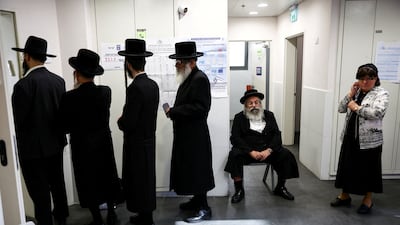
Ultra-Orthodox Jewish Israelis wait to cast their ballots at a polling station in Jerusalem. Reuters -
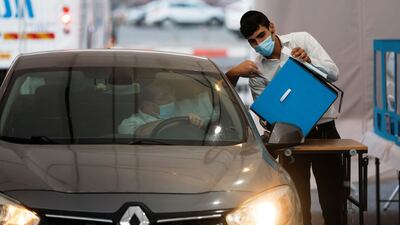
An Israeli man casts his ballot at a drive-through polling station for people quarantined as a result of Covid-19 in Jerusalem. Reuters


"It is clear that the Israelis are leaning towards more extremism, which also means aggression against our people would increase," Hamas spokesperson Hazem Qassem told Reuters.
"Netanyahu-led governments that launched several wars against our Palestinian people, and the presence of the most extreme figures in a coalition means that we are going to face more of the Zionist terrorism," he said.
Mr Netanyahu has long opposed the establishment of a Palestinian state alongside Israel and his potential coalition partners could include Bezalel Smotrich and Itamar Ben-Gvir, a nationalist polemicist who has softened his stance of advocating for the expulsion of all Palestinians to now calling for the expulsion of just those deemed to be traitors.
Reports suggest that Mr Ben-Gvir’s surge in the polls has also worried Israel’s allies in Washington, with unnamed sources reportedly telling the Israeli media that, “this is not someone we want to see as part of the government.”
Arab-Israeli lawmaker Aida Touma-Suleiman said Mr Netanyahu might be on track to form a government "with fascists by his side".
Leader of the Arab-Israeli party Ra'am Mansour Abbas, the first politician from an independent Arab party to enter an Israeli Cabinet, said he would never serve in a coalition that included Mr Netanyahu.
In an interview with Israel's /Channel 12/ last month, the politician blamed Mr Netanyahu for being responsible for "everything that has happened in Arab society".
But many Palestinians, including refugees in Jordan and Lebanon, said they saw no difference between Mr Netanyahu and other Israeli politicians.
"Certainly the situation is going to move from bad to worse. He will continue from where his predecessor left,” said Khaled Shriteh, 29, a Ramallah taxi driver.
"For us, the right and left parties are the same, both are our enemies," said Jamal Mansour, a Palestinian refugee in Bourj Al Barajneh camp in Beirut.
"The Palestinian people will get nothing from this government except war, destruction, killing, bloodshed, house demolition, razing of land and the building of more settlements at the expense of the Palestinian people," said Youssef Khattab, a TV director in Gaza.
Additional reporting by agencies

