Live updates: follow the latest news on Joe Biden's Middle East visit
Former president Jimmy Carter's pledge that the US would intervene militarily if needed to ensure the security of the Gulf is now outdated as US policymakers redefine Washington's already shrinking role in the region, political analysts say.
The common view is that the void left by the US can be filled by joint security and military co-operation between regional powers, which have become increasingly self-reliant amid the reality of an American focus on China and Russia.
“The Carter Doctrine is no longer relevant for US engagement in the Middle East today — in large part because of the increased military capacity within the region itself,” Brian Katulis, a senior fellow and vice president of policy at the Washington-based Middle East Institute, told The National.
The pledge of protection was made by the 39th president of the US in January 1980, one month after the Soviet invasion of Afghanistan.
Mr Carter set it as the basic tenet of American foreign policy in the Middle East, as it was widely believed that the former Soviet Union represented a threat to US interests in the Arab world.
It was associated with a Cold War mentality and also driven by the 1979 revolution in Iran.
Given the landscape of the Middle East at the time, the US stepped up its role and created much of the present-day infrastructure for engagement in the region.
“That was then. We're now in a transition phase redefining America's role — it's one that began years ago and it will continue to evolve in the next few years, increasingly driven by actors within the region,” said Mr Katulis, who has advised US policymakers and provided expert testimony to congressional committees.
The latest sign of the US's shrinking role in the Middle East and beyond was its withdrawal from Afghanistan in August last year, allowing the Taliban regime to return to power 20 years after being toppled by a US-led invasion ordered by former president George W Bush to hunt for Al Qaeda and its leaders.
In 2011, former president Barack Obama announced the complete withdrawal of the 160,000-strong US force in Iraq after eight years of occupation.
The incumbent US President, Joe Biden, who is visiting Israel, Palestine and Saudi Arabia this week, pledged in his campaign for the 2020 election to end the US’s “forever wars”.
Although the US today has only about 2,500 troops in Iraq, mainly for training and security co-ordination with Iraqi military and security services, there are still 45,000 to 60,000 US military personnel stationed at bases, airfields and outposts across the region, according to estimates cited by US media outlets.
Bahrain hosts the headquarters of the US Navy's Fifth Fleet, while the US Air Force operates out of the Al Udeid base in Qatar.
-
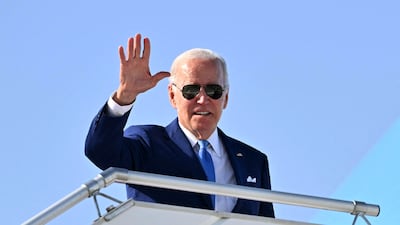
US President Joe Biden waves from a plane at King Abdulaziz International Airport in Jeddah. AFP -

US President Joe Biden boards a plane at King Abdulaziz International Airport in Jeddah. AFP -
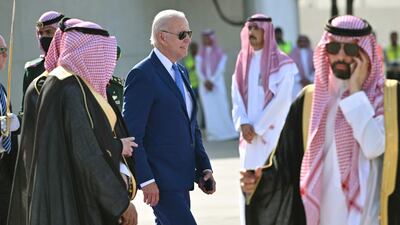
Mr Biden walks to the plane. AFP -
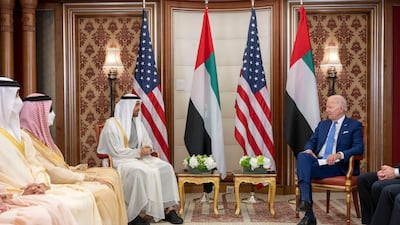
President Sheikh Mohamed in discussion with Mr Biden during the Gulf Co-operation Council GCC+3 Jeddah Security and Development Summit. Photo: Abdulla Al Neyadi for the Presidential Court -
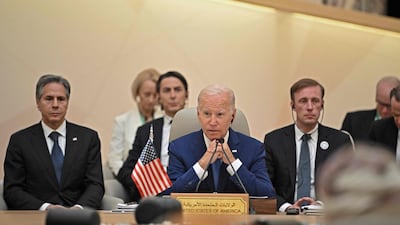
US President Joe Biden attends the Gulf Co-operation Council GCC+3 Jeddah Security and Development Summit at a hotel in the Saudi Arabian Red Sea coastal city. AFP -
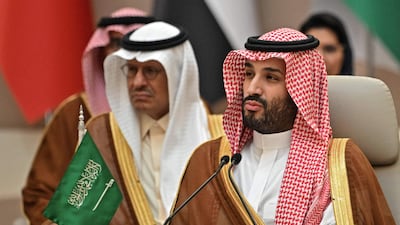
Saudi Arabia's Crown Prince Mohammed bin Salman attends the Gulf Co-operation Council GCC+3 meeting in Jeddah. AFP -
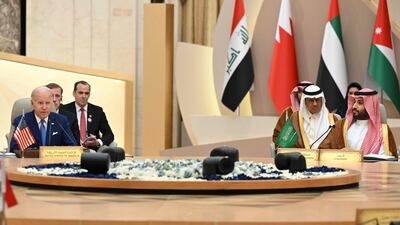
US President Joe Biden and Saudi Arabia's Crown Prince Mohammed bin Salman at the GCC+3 Jeddah Security and Development Summit. AFP -
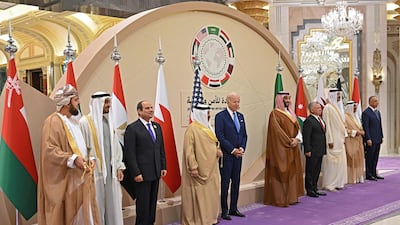
President Sheikh Mohamed attended a traditional summit 'family photo call' in the company of, from left: Asaad bin Tariq Al Said, Omani Deputy Prime Minister for International Relations and Co-operation Affairs and the Special Representative of the Sultan; Sheikh Mohamed; Egypt's President Abdel Fattah El Sisi; Bahrain's King Hamad bin Isa bin Salman Al Khalifa; US President Joe Biden; Saudi Crown Prince Mohammed bin Salman; Jordan's King Abdullah II; Qatar's Emir Sheikh Tamim bin Hamad Al Thani; Kuwait's Crown Prince Mishal Al Ahmad Al Jaber Al Sabah, and Iraq's Prime Minister Mustafa Al Kadhimi. AFP -
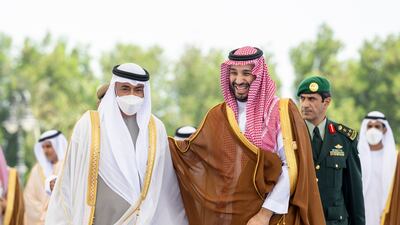
President Sheikh Mohamed is received by Saudi Arabia's Crown Prince Mohammed bin Salman upon his arrival at King Abdulaziz International Airport. Photo: Abdulla Al Neyadi for the Presidential Court -
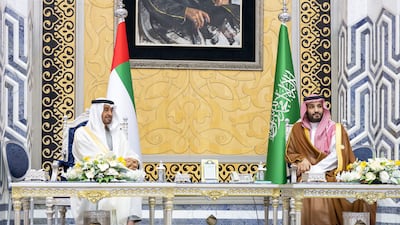
President Sheikh Mohamed is received by Saudi Arabia's Prince Mohamed bin Salman upon his arrival at King Abdulaziz International Airport. Photo: Abdulla Al Neyadi for the Presidential Court -
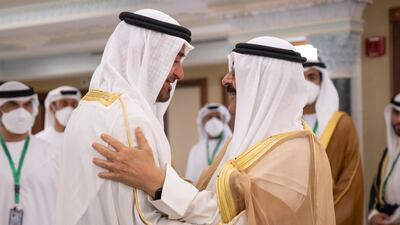
President Sheikh Mohamed greets Sheikh Mishal Al Sabah, Crown Prince of Kuwait, during the GCC+3 Jeddah Security and Development Summit. Photo: Rashed Al Mansoori / Presidential Court -
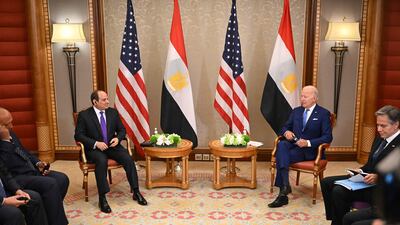
US President Joe Biden and Secretary of State Antony Blinken meet Egyptian President Abdel Fattah El Sisi, Foreign Minister Sameh Shoukry and other officials during a bilateral meeting at a hotel in Saudi Arabia's Red Sea coastal city of Jeddah before the GCC+3 meeting. AFP -
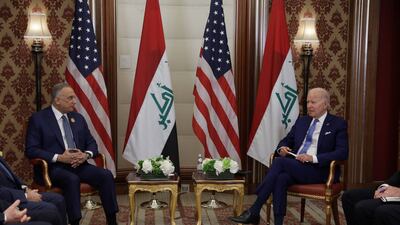
US President Joe Biden meets Iraqi Prime Minister Mustafa Al Kadhimi, in Jeddah before the beginning of the GCC+3 meeting. Reuters -
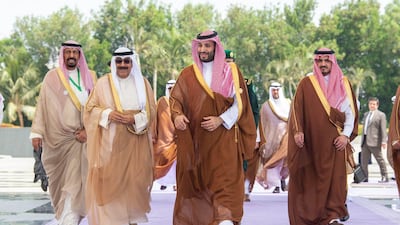
Saudi Arabia's Crown Prince Mohammed bin Salman receives Sheikh Mishal Al Sabah, Crown Prince of Kuwait, before the GCC + 3 Jeddah Security and Development Summit on Saturday. SPA -
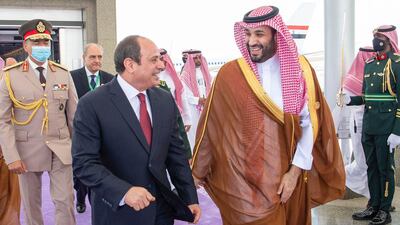
Saudi Arabia's Crown Prince Mohammed bin Salman and Egypt's President Abdel Fattah El Sisi arrive for the Jeddah summit. SPA -
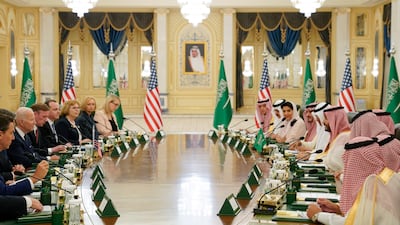
US President Joe Biden participates in a working session with Saudi Crown Prince Mohammed bin Salman at Al Salam Palace in Jeddah. AP -
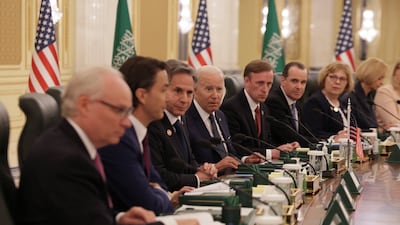
US President Joe Biden and US Secretary of State Antony Blinken in a bilateral meeting with Saudi officials led by Crown Prince Mohammed bin Salman at Al Salam Palace. Reuters -
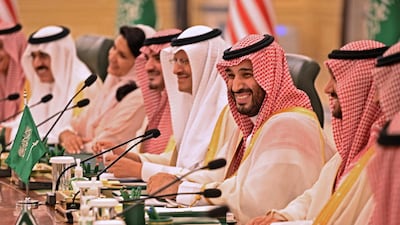
Saudi Arabia's Crown Prince Mohammed bin Salman takes part in a working session with US President Joe Biden and his team. AFP -
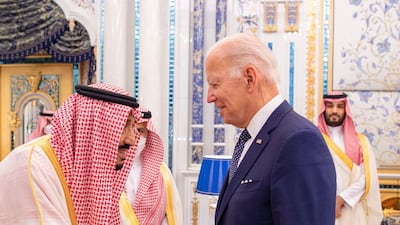
Saudi Arabia's King Salman greets US President Joe Biden at Al Salam Palace in Jeddah. Photo: @spagov -
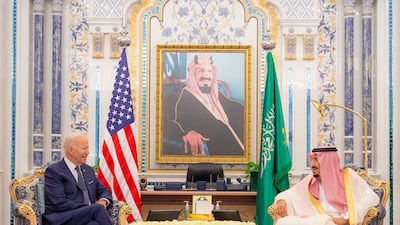
King Salman and US President Joe Biden in discussions at Al Salam Palace in Jeddah. Photo: @spagov -
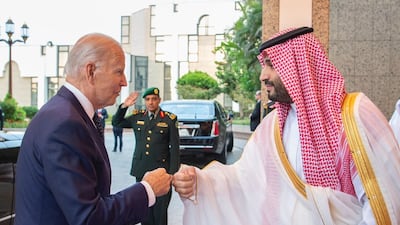
US President Joe Biden meets Saudi Crown Prince Mohammed bin Salman in Jeddah. Photo: @spagov -
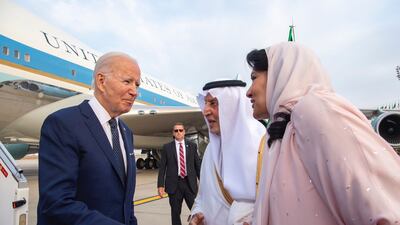
US President Joe Biden arrives at King Abdulaziz International Airport in Jeddah. Photo: @spagov -
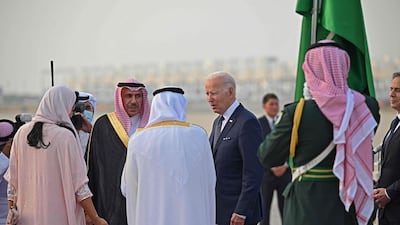
US President Joe Biden is welcomed by Saudi Arabian officials. AFP -
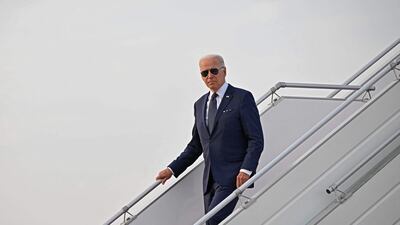
Mr Biden disembarks from Air Force One at King Abdulaziz International Airport, following a flight from Tel Aviv. AFP -
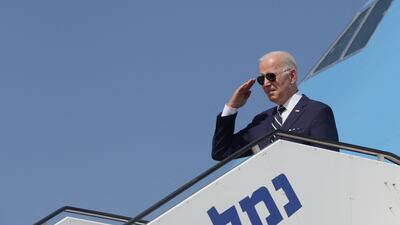
US Presidents Joe Biden salutes as he boards Air Force One at Ben Gurion International Airport in Lod, near Tel Aviv en route to a meeting with the GCC+3 in Jeddah, Saudi Arabia. Reuters -
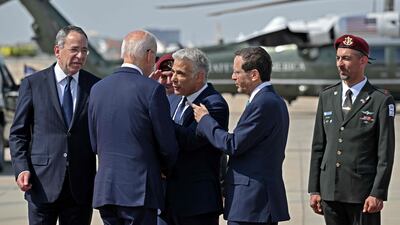
Israel's President Isaac Herzog, second right, and caretaker Prime Minister Yair Lapid, centre, bid farewell to US President Joe Biden at Ben Gurion Airport. AFP -
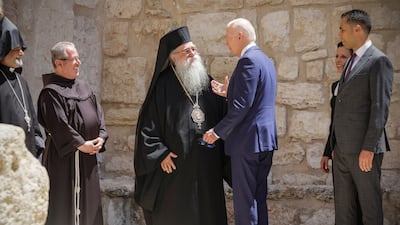
US President Joe Biden meets clergy at the Church of Nativity in Bethlehem, in the occupied West Bank. Reuters -
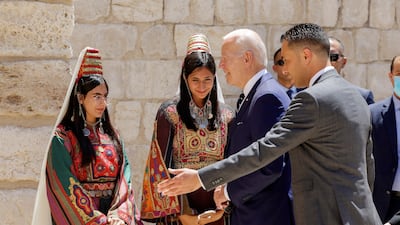
US President Joe Biden is introduced to local people at the Church of Nativity in Bethlehem. Reuters -

US President Joe Biden arrives at the Church of Nativity in Bethlehem, on the second full day of his Middle East visit. AFP -
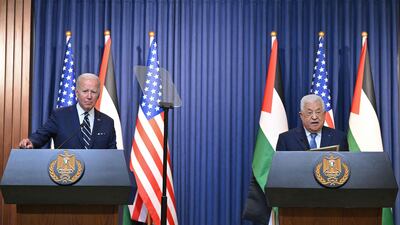
US President Joe Biden and Palestinian President Mahmoud Abbas address the media after their meeting at the Muqataa Presidential Compound in Bethlehem, the occupied West Bank. AFP -
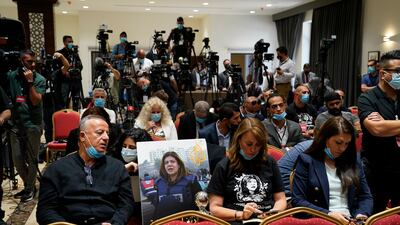
A photo of journalist Shireen Abu Akleh is placed on a chair as reporters wait for US President Joe Biden and Palestinian President Mahmoud Abbas to speak. She was killed in a raid by Israeli forces in May. The caption reads: 'Shireen Abu Akleh, voice of Palestine'. AP -
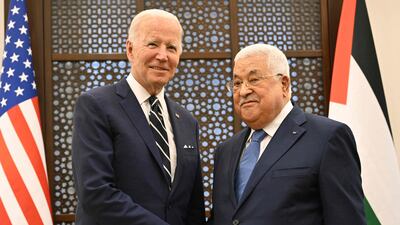
US President Joe Biden with Palestinian President Mahmoud Abbas at a welcome ceremony at the Palestinian Muqataa Presidential Compound in Bethlehem, in the occupied West Bank. AFP -
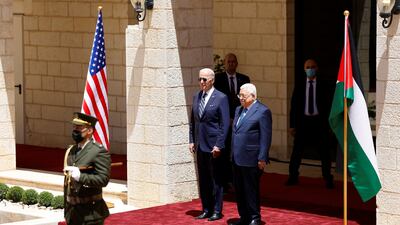
Palestinian President Mahmoud Abbas welcomes US President Joe Biden to the Israeli-occupied West Bank. Reuters -
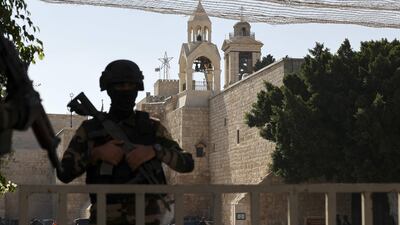
A Palestinian security officer stands guard near the Church of the Nativity in Bethlehem in the occupied West Bank before US President Joe Biden’s official visit. AFP -
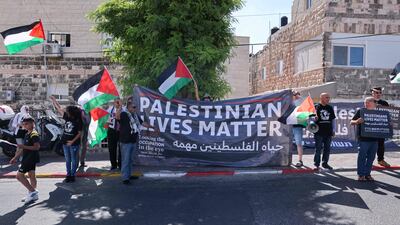
Palestinian and Israeli human rights campaigners lift banners during a rally near Augusta Victoria Hospital in East Jerusalem as US President Joe Binden visits. AFP -
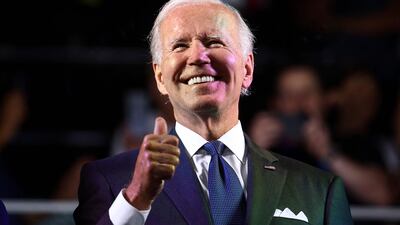
US President Joe Biden greets fans as he attends the opening ceremony of the Maccabiah Games at Teddy Stadium in Jerusalem. AFP -
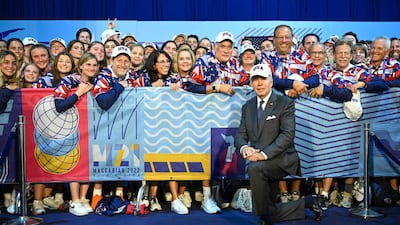
US President Joe Biden poses for a picture with US athletes competing in the Maccabiah Games. AFP -

People use the lights of their phones during the opening ceremony of the Maccabiah Games in Jerusalem, attended by US President Joe Biden. Reuters -
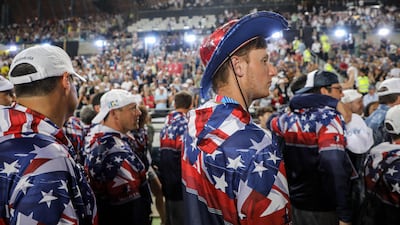
US athletes attend the opening ceremony of the Maccabiah Games in Jerusalem. AFP -
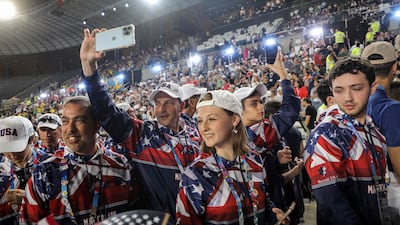
The Maccabiah Games coincided with the US President Joe Biden's visit to the Middle East. AFP -
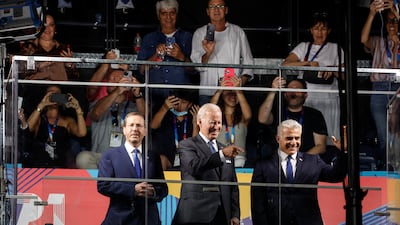
US President Joe Biden, centre, Israel's caretaker Prime Minister Yair Lapid, right, and President Isaac Herzog attend the opening ceremony for the Maccabiah Games in Jerusalem. Reuters -
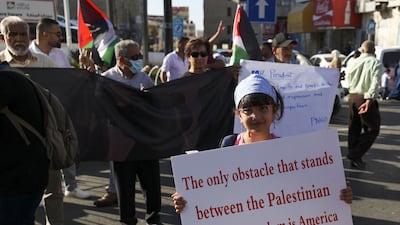
A Palestinian protester carries a placard during a demonstration in the occupied West Bank city of Ramallah as US President Joe Biden visited Israel. AFP -
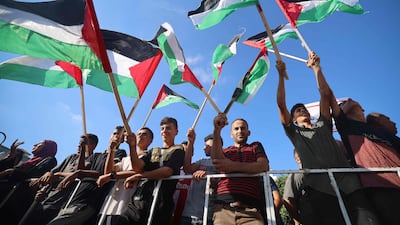
In Gaza City, Palestinian demonstrators wave their national flag as they gather to protest against the visit by US President Joe Biden to Israel. AFP -
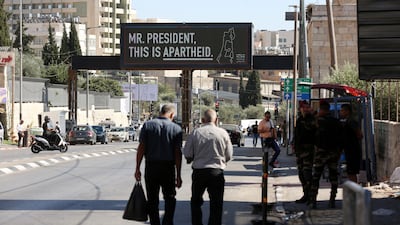
A billboard, part of a campaign organised by the Centre for Human Rights B'Tselem, installed before US President Joe Biden's arrival for an official visit in the West Bank city of Bethlehem. PA -
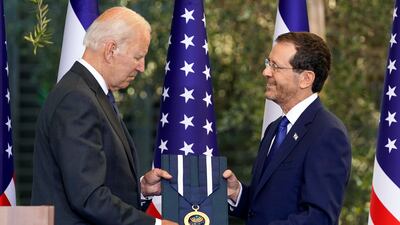
US President Joe Biden receives the Israeli Presidential Medal of Honour from Israeli President Isaac Herzog in Jerusalem. AP Photo -
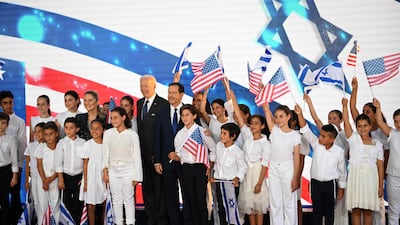
US President Joe Biden, centre left, and President Isaac Herzog with children after Mr Biden's arrival at the presidential residence in Jerusalem. AFP -
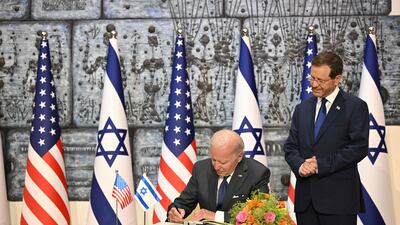
US President Joe Biden signs the guest book in the presence of President Isaac Herzog on arriving at the presidential residence in Jerusalem. AFP -
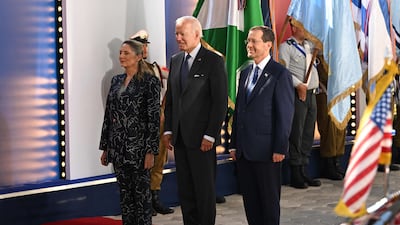
US President Joe Biden with President Isaac Herzog and Mrs Michal Herzog in Jerusalem. AFP -
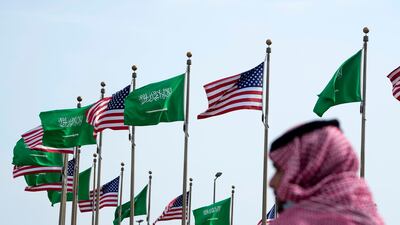
US and Saudi Arabian flags in a square in Jeddah, Saudi Arabia, before US President Joe Biden's visit. AP -
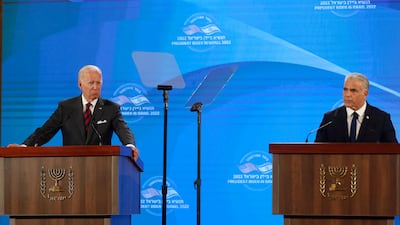
US President Joe Biden and caretaker Israeli Prime Minister Yair Lapid at a press conference at the Waldorf Astoria Hotel in Jerusalem. EPA -

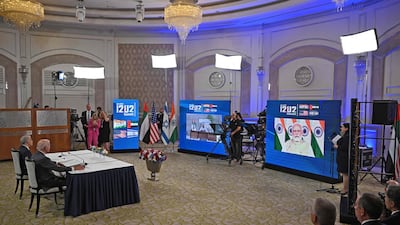
President Sheikh Mohamed delivers the opening speech during the I2U2 summit, a meeting between the leaders of the UAE, India, Israel and the US. Seen with Sheikh Abdullah bin Zayed, UAE Minister of Foreign Affairs and International Co-operation. Photo: Presidential Court -
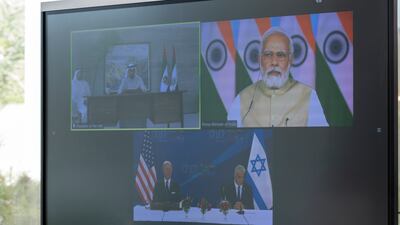
President Sheikh Mohamed speaks with Indian Prime Minister Narendra Modi, US President Joe Biden and Israeli Prime Minister Yair Lapid during the I2U2 summit. Photo: Presidential Court -
US President Joe Biden and caretaker Iraeli Prime Minister Yair Lapid address a joint press conference. AFP -
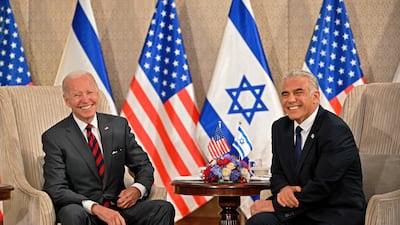
US President Joe Biden and Israeli caretaker Prime Minister Yair Lapid during their meeting at a hotel in Jerusalem. AFP -

US President Joe Biden speaks to Holocaust survivors Dr Gita Cycowicz and Rena Quint in the Hall of Remembrance, at Yad Vashem in Jerusalem. AP -
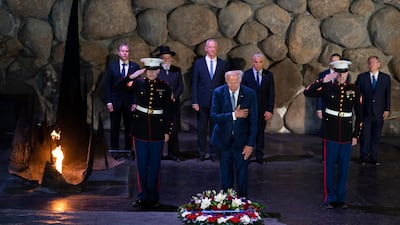
US President Joe Biden participates in a wreath-laying ceremony in the Hall of Remembrance at Yad Vashem Holocaust Remembrance Centre in Jerusalem. AP -
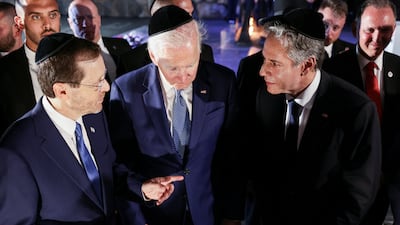
Israel's President Isaac Herzog speaks with US Secretary of State Antony Blinken and US President Joe Biden during their visit to Hall of Remembrance at Yad Vashem Holocaust Remembrance Centre in Jerusalem. Reuters -
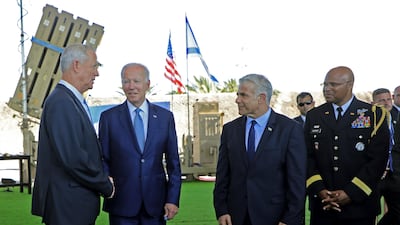
Israeli Defence Minister Benny Gantz, left, US President Joe Biden, second left, caretaker Prime Minister Yair Lapid, right, and Brig Gen Shawn Harris, defence attache to the US embassy, in front of Israel's Iron Dome defence system during a tour at Ben Gurion Airport. AP -
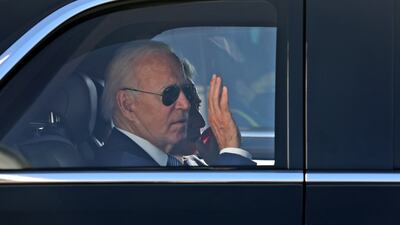
US President Joe Biden waves as he leaves Israel's Ben Gurion Airport on his way to Jerusalem. EPA -
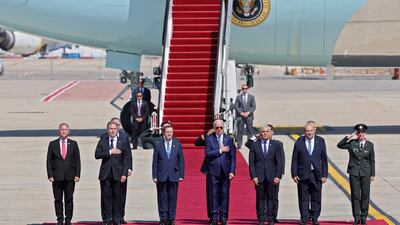
US President Joe Biden, centre, stands for the national anthems alongside Secretary of State Antony Blinken, second left, Israel's President Herzog, third left, caretaker Prime Minister Yair Lapid, third right, and departing prime minister Naftali Bennett, second right, at Ben Gurion Airport. AFP -
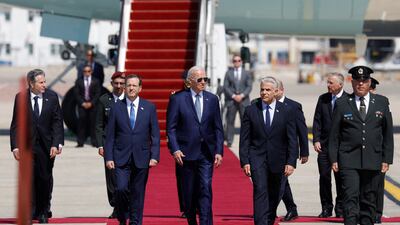
Caretaker Israeli Prime Minister Yair Lapid and President Isaac Herzog welcome US President Joe Biden to Israel as his trip begins. Reuters


Refocusing goals in the region
Key and traditional allies in the region were disappointed when the Obama administration secretly negotiated and in 2015 signed a nuclear deal with Iran that did not address its ballistic missile and drone programmes.
The deal was reached in talks that did not include the concerns of Arab states and was seen as counter to the basic tenets of the Carter Doctrine. The perception of US disengagement and inaction has gained ground in the region since, particularly after a string of missile and drone attacks by the Iran-aligned Houthis in Yemen on Saudi Arabia and Abu Dhabi.
“US policymakers need to correct that impression, as Washington's network of relationships and interests in the Middle East still matters — especially in the aftermath of Russia's invasion of Ukraine,” Jason M Brodsky, policy director of United Against Nuclear Iran, an American advocacy group, told The National.
A pledge to deny Iran atomic weapons in the US-Israeli joint declaration signed during Mr Biden's visit on Thursday is seen as a sign of American resolve to refocus on the threat from Tehran after the collapse of the 2015 deal. Former president Donald Trump quit the pact aimed at curbing Tehran's nuclear weapons capability in 2018, deeming it insufficient, a move welcomed by Israel.

Mr Biden said after arriving in Jerusalem on Wednesday that he remained committed to resurrecting the nuclear deal, saying “the only thing worse than the Iran that exists now is an Iran with nuclear weapons”.
In an interview with Israel’s Channel 12 TV, Mr Biden said the US would not allow Iran to gain a nuclear weapon and would use military force as a “last resort”.
“Some of the logic of the Carter Doctrine as it relates to US interests still holds, but US presidential administrations have undermined it with their actions. It is time to update it not only rhetorically but also in terms of actions. President Biden's visit to the Middle East is an opportunity to do just that,” said Mr Brodsky.
Last month, Israeli Defence Minister Benny Gantz said his country was building a US-sponsored regional air defence alliance, an effort he suggested could be boosted by Mr Biden's visit.
Mr Gantz did not mention which countries were involved and regional heavyweights have not commented on his statements.
Israel has recently established ties with the UAE, Bahrain and Sudan, and re-established relations with Morocco, after the landmark 2020 Abraham Accords that helped reshape Middle East geopolitics and alignments.
But previous talk about regional alliances has not led to any concrete steps or the creation of a formal structure such as the North Atlantic Treaty Organisation, says Yezid Sayigh, a senior fellow at the Carnegie Middle East Centre in Beirut, where he leads the programme on Civil-Military Relations in Arab States.
“There has been no success in forming formal multinational military alliances: witness talk of a Nato-Gulf body — discussed in Istanbul over a decade ago; a Saudi attempt to forge an Islamic defence alliance around 2015; and more Egyptian efforts to create a collective defence forum. I don't expect that to change,” he said.