Not long ago, Sudan’s pro-democracy politicians and army generals had nothing but mutual praise for their partnership in the post-Omar Al Bashir transition to democratic rule.
Even as tensions grew and distrust deepened with time, the two sides continued to tout their alliance as an inspiring example for the rest of Africa.
Then came last week’s failed military coup.
-

Sudanese protesters run for cover from tear gas canisters fired by police outside the military headquarters in the capital Khartoum on April 6, 2019. AFP -
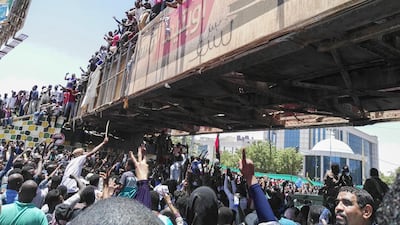
Sudanese protesters rally in front of the military headquarters in the capital Khartoum on April 8, 2019. AFP -
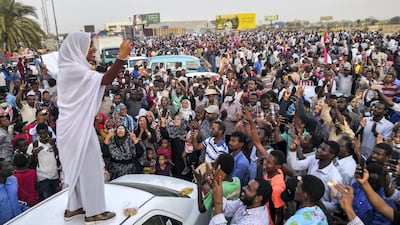
Alaa Salah, a Sudanese woman propelled to internet fame earlier this week after clips went viral of her leading powerful protest chants against President Omar Al Bashir, addresses protesters during a demonstration in front of the military headquarters in the capital Khartoum on April 10, 2019. AFP -
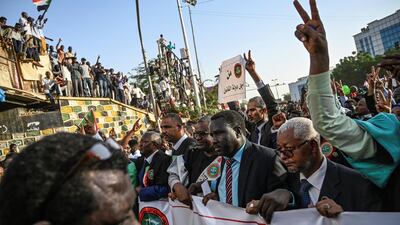
Sudanese judges, dressed in their robes, gather for a "million-strong" march outside the army headquarters in the capital Khartoum on April 25, 2019. AFP -

A Sudanese anti-regime protester kisses a soldier on the head during protests on April 11, 2019 in the area around the army headquarters in Sudan's capital Khartoum. AFP -
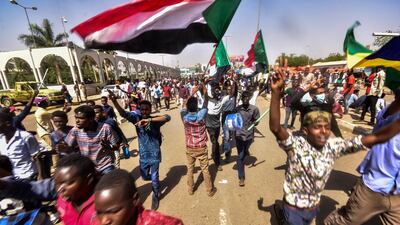
Sudanese demonstrators march with national flags as they gather during a rally demanding a civilian body to lead the transition to democracy. AFP -
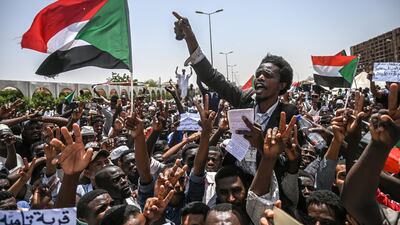
Protesters massed outside the army complex in central Khartoum on April 6, initially to demand the overthrow of longtime leader Omar Al Bashir. AFP -
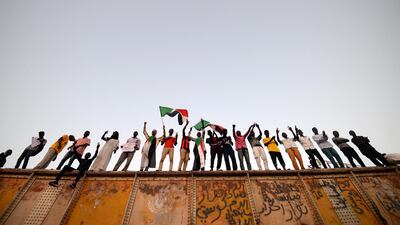
Sudanese protesters gather outside the army headquarters in Khartoum on May 6, 2019. AFP -
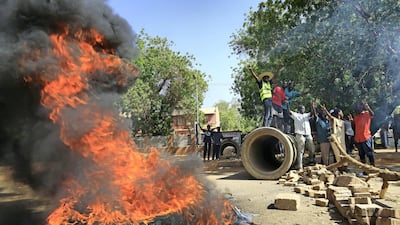
Sudanese protesters burn tyres as they block Nile Street for the second consecutive day during continuing protests in Sudan's capital Khartoum on May 13, 2019. AFP -
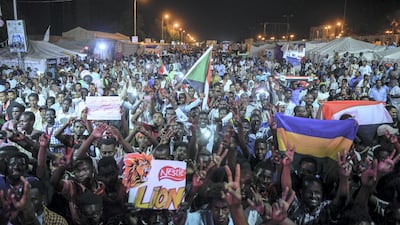
Sudanese protesters wave flags and flash victory signs as they gather for a sit-in outside the military headquarters in Khartoum on May 19, 2019. AFP -
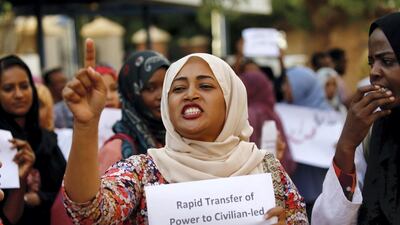
A Sudanese health worker carries a placard as scores of medics hold a rally in front of a hospital in the capital Khartoum on May 23, 2019. AFP -
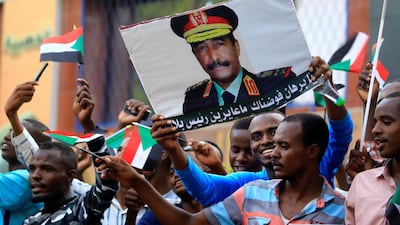
Sudanese supporters of the ruling Transitional Military Council (TMC) hold up a sign showing a portrait of its head General Abdel Fattah Al Burhan with a caption below reading in Arabic "we have delegated you Burhan, we want no president but you", during a rally in the centre of the capital Khartoum on May 31, 2019. AFP -
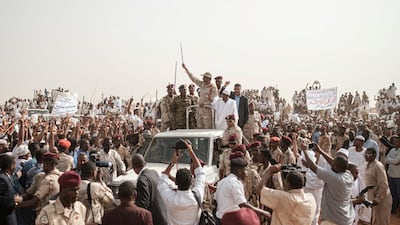
Mohamed Hamdan Dagalo, known as Himediti, deputy head of Sudan's ruling Transitional Military Council and commander of the Rapid Support Forces paramilitaries, waves a baton to supporters on a vehicle as he arrives for a rally in the village of Abraq, about 60 kilometres northwest of Khartoum, on June 22, 2019. AFP -
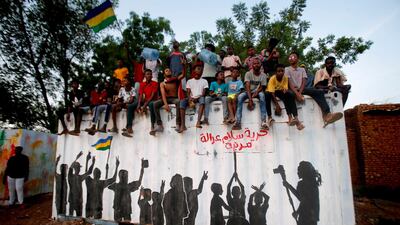
Sudanese protestors celebrate in the streets of Khartoum after ruling generals and protest leaders announced they have reached an agreement on the disputed issue of a new governing body on July 5, 2019. AFP -
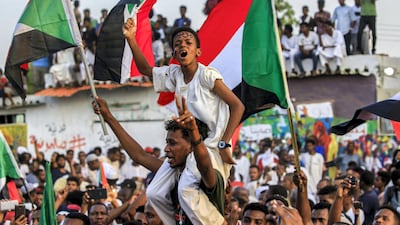
Thousands went to the streets to welcome the agreement on Saturday. AFP -
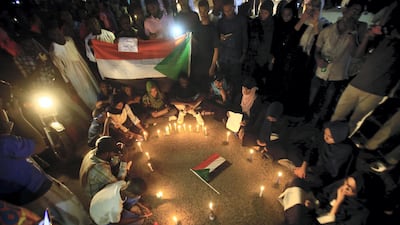
Sudanese protesters take part in a vigil in the capital Khartoum to mourn dozens of demonstrators killed last month in a raid on a Khartoum sit-in. AFP -
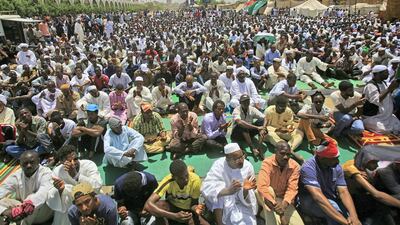
Sudanese protesters gather during Friday noon prayers outside the army headquarters in Khartoum on May 3, 2019, as they continue to protest demanding that the ruling military council hand power to a civilian administration. AFP -
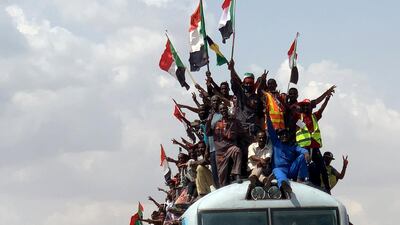
Sudanese civilians from other provinces ride on the train to join in the celebrations of the signing of Sudan's power-sharing deal. Reuters -
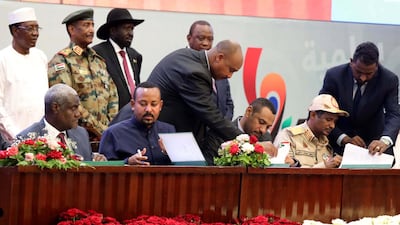
Sudan's Forces of Freedom and Change coalition leader Ahmad Rabiah (3-R) and Sudan's General and Vice President of Sudanese Transitional Military Council, Mohamed Hamdan Dagalo (2-R) sign power-sharing agreement,. EPA -
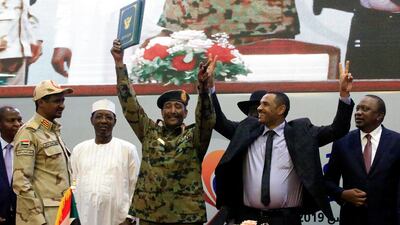
Sudan's Head of Transitional Military Council, Lieutenant General Abdel Fattah Al-Burhan, and Sudan's opposition alliance coalition's leader Ahmad Rabiah, celebrate the signing of the power-sharing deal, that paves the way for a transitional government, and eventual elections. Reuters -
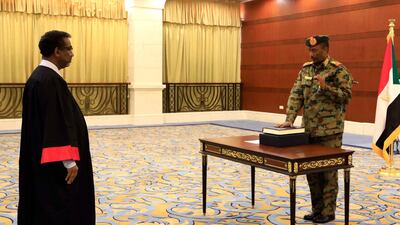
epa07783624 Leader of Sudan's transitional council, Lieutenant General Abdel Fattah Abdelrahman Burhan (R) is sworn in as the Head of the newly formed transitional Council at the presidential palace in Khartoum, Sudan, 21 August 2019. The Sudanese opposition and military council signed on 17 August a power sharing agreement. The agreement sets up a sovereign council made of five generals and six civilians, to rule the country until general elections. Protests had erupted in Sudan at the end of 2018, culminating in a long sit-in outside the army headquarters which ended with more than one hundred people being killed and others injured. Sudanese President Omar Hassan al-Bashir stepped down on 11 April 2019. EPA/STRINGER -
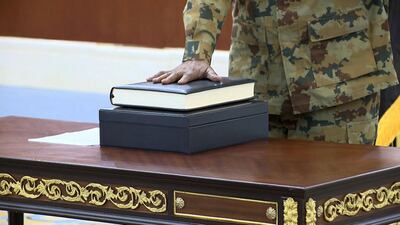
A pictured released by Sudan's Presidential Palace shows General Abdel Fattah al-Burhan, the head of Sudan's ruling military council, during a swearing in ceremony in Khartoum on August 21, 2019. Burhan was sworn today as chairman of Sudan's new sovereign council that will steer the country through a three-year transition to civilian rule. "General Abdel Fattah al-Burhan Abdel Rahman was sworn in as president of the sovereign council," the official SUNA news agency reported. / AFP / SUDAN PRESIDENTIAL PALACE / - / RESTRICTED TO EDITORIAL USE - MANDATORY CREDIT "AFP PHOTO / SUDAN PRESIDENTAIL PALACE" - NO MARKETING NO ADVERTISING CAMPAIGNS - DISTRIBUTED AS A SERVICE TO CLIENTS -
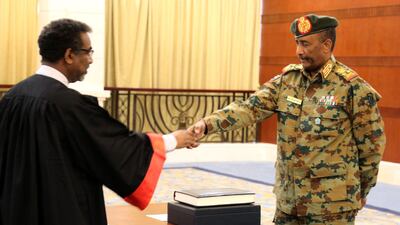
A picture released by Sudan's Presidential Palace shows General Abdel Fattah al-Burhan, the head of Sudan's ruling military council, during a swearing in ceremony in Khartoum on August 21, 2019. Burhan was sworn today as chairman of Sudan's new sovereign council that will steer the country through a three-year transition to civilian rule. "General Abdel Fattah al-Burhan Abdel Rahman was sworn in as president of the sovereign council," the official SUNA news agency reported. / AFP / SUDAN PRESIDENTIAL PALACE / - / RESTRICTED TO EDITORIAL USE - MANDATORY CREDIT "AFP PHOTO / SUDAN PRESIDENTAIL PALACE" - NO MARKETING NO ADVERTISING CAMPAIGNS - DISTRIBUTED AS A SERVICE TO CLIENTS -
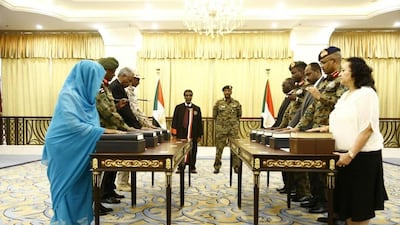
A picture released by Sudan's Presidential Palace shows General Abdel Fattah al-Burhan (C-R), the head of Sudan's ruling military council, standing during a swearing in of the new sovereign council, in Khartoum on August 21, 2019. Sudan took further steps in its transition towards civilian rule today with the swearing in of a new sovereign council, to be followed by the appointment of a prime minister. The body replaces the Transitional Military Council (TMC) that took charge after months of deadly street protests brought down longtime ruler Omar al-Bashir in April. Burhan, who already headed the TMC, was sworn in as the chairman of the new sovereign council in the morning. / AFP / SUDAN PRESIDENTIAL PALACE / - / RESTRICTED TO EDITORIAL USE - MANDATORY CREDIT "AFP PHOTO / SUDAN PRESIDENTAIL PALACE" - NO MARKETING NO ADVERTISING CAMPAIGNS - DISTRIBUTED AS A SERVICE TO CLIENTS -
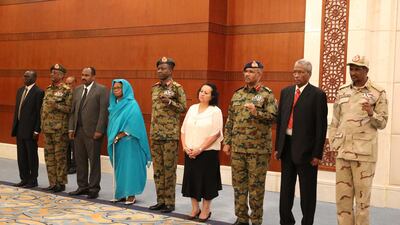
epa07784051 Members of Sudan's newly formed transitional Council (R-L) General Mohamed Hamdan Dagalo, Hassan Sheikh Idris, Genereal Ibrahim Jaber, Raja Nicola Issa Abdul-Masseh, General Shams al-Din Kabashi, Aisha Moussa, Mohamed Alfaki, General Yasser al-Atta and Sadeek Tawer look on during their sweaing-in ceremony at the presidential palace in Khartoum, Sudan, 21 August 2019. The Sudanese opposition and military council signed on 17 August a power sharing agreement. The agreement sets up a sovereign council made of five generals and six civilians, to rule the country until general elections. Protests had erupted in Sudan at the end of 2018, culminating in a long sit-in outside the army headquarters which ended with more than one hundred people being killed and others injured. Sudanese President Omar Hassan al-Bashir stepped down on 11 April 2019. EPA/MORWAN ALI -

Demonstrators march with banners and the old (L) and current (R) flags of Sudan outside a courthouse complex in the capital's twin city of Omdurman on August 21, 2019 during the trial of 40 members of Sudan's now-dissolved National Intelligence and Security Service facing charges over the death in custody of Ahmed al-Kheir, a teacher from the eastern town of Khashma el-Girba, in the early days of the wave of nationwide protests that eventually brought longtime ruler Omar al-Bashir. / AFP / Ahmed Mustafa -
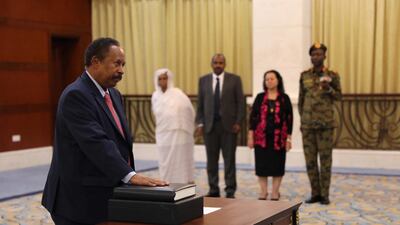
epa07784904 Sudan's new Prime Minister Abdalla Hamdok (L) swears in during a ceremony at the presidential palace in Khartoum, Sudan, 21 August 2019. The Sudanese opposition and military council signed on 17 August a power sharing agreement. The agreement sets up a sovereign council made of five generals and six civilians, to rule the country until general elections. Protests had erupted in Sudan in December 2018, culminating in a long sit-in outside the army headquarters which ended with more than one hundred people being killed and others injured. Sudanese President Omar Hassan al-Bashir stepped down on 11 April 2019. EPA/MARWAN ALI -
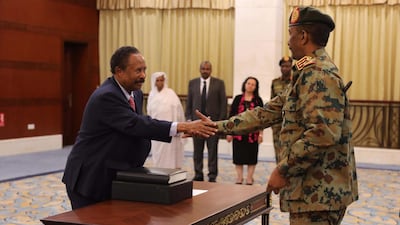
epa07784903 Sudan's new Prime Minister Abdalla Hamdok (L) shakes hands with Abdel Fattah Abdelrahman Burhan (R) after being sworn in during a ceremony at the presidential palace in Khartoum, Sudan, 21 August 2019. The Sudanese opposition and military council signed on 17 August a power sharing agreement. The agreement sets up a sovereign council made of five generals and six civilians, to rule the country until general elections. Protests had erupted in Sudan in December 2018, culminating in a long sit-in outside the army headquarters which ended with more than one hundred people being killed and others injured. Sudanese President Omar Hassan al-Bashir stepped down on 11 April 2019. EPA/MARWAN ALI -
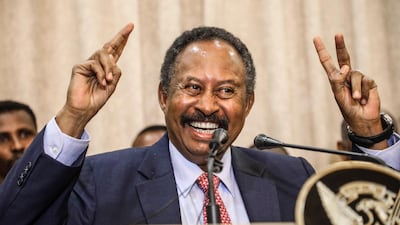
Sudan's new Prime Minister Abdalla Hamdok speaks duringa press conference in Khartoum, Sudan, Wednesday, Aug. 21, 2019. (AP Photo)


Bitter recriminations followed the attempted takeover on September 21. The facade of unity and common purpose marketed by both sides has perhaps been irreparably damaged, throwing the future of Sudan’s transition into deep uncertainty, Rasha Awad and other analysts said.
Political leaders and army generals have always been at loggerheads, taking their differences public for the first time since signing a power-sharing deal two years ago.
They have blamed each other for the country’s many woes while claiming the higher moral and patriotic ground. This acrimony has intensified speculations on a possible coup by army officers taking advantage of the popular discontent fuelled by an acute economic crisis.
Ms Awad, who is also the editor-in-chief at online newspaper Al Taghyier, believes the military is likely to again try to seize power.
“Last week’s attempted coup was not the real coup,” she said. “The real coup is the one being plotted by the military component of the transitional administration led by Gen Abdel-Fattah Al Burhan and his regional backers.”
The politicians have also threatened to bring the “masses” out on the streets to “protect the revolution” if the military does not show its commitment to the transition to democracy and respect for the politicians and activists who masterminded months of street protests against Al Bashir’s rule.
However, the power of politicians to mobilise has significantly diminished, with most Sudanese now preoccupied with their daily struggle to make ends meet.
Divisions between the pro-democracy politicians and activists have also devalued their standing among the masses.

Of the 65 years of independent Sudan, the generals have been at the helm for more than 50. The democratically elected governments have often failed at resolving challenges, such as ending civil wars or overhauling the economy.
But amid a dramatic change in Sudan's socio-political landscape, a military coup may no longer secure power for the plotters, analysts and activists contend.
Sudanese activists have used the power of social media to organise and mobilise. And the freedoms that came with the ousting of Al Bashir, they say, are difficult for any government to roll back.
“The citizens may be discontented, but a coup will not content them either,” Prime Minister Abdalla Hamdok said in response to charges of negligence and power abuse levelled against him and his government ministers by Sudan’s head of state, Gen Al Burhan, and his deputy, Gen Mohamed Hamdan Dagalo.
While the generals may not relish the prospect of handing over power to civilians, they can't attempt a power-grab given the backlash it would trigger, said prominent Sudan expert Hany Raslan at Egypt’s Al Ahram Centre for Political and Strategic Studies.
“The generals don’t want to leave power but they also cannot just keep the power,” Mr Raslan said. “They are more likely to try and change existing arrangements with the civilian politicians.”
His view is echoed by Sudanese activists such as Sulaima Ishaq, a lecturer at Al Ahfad university who took part in the “December Revolution” and is now a prominent civil society figure.
“Everyone realises that a coup will send the country back to being a pariah state and more years of crippling isolation,” she said.

Gen Dagalo said on Saturday night: “Let us be clear: we have pledged before God from day one to shepherd the Sudanese people to democracy. Military regimes have been useless.”
But his comments and similar words by Gen Al Burhan have not been taken at face value by some, who continue to question the intentions of the military.
“There is no substitute now for the revolution to correct its course," Ms Awad said. "The civilians in the administration need to regroup and reconnect with the people. The Sudanese are totally opposed to coups and that’s something that should be built on.”
Her view that the military remains set on seizing power is not without evidence.
Gen Al Burhan, the head of the Sovereign Council, has been acting in an increasingly presidential manner of late, going it alone on major foreign policy decisions and speaking of the military as the land’s ultimate source of power.
He went on record last week reminding the politicians of the vast power the military wields and emphasising that the generals alone were in charge until elections were held.
Under the power-sharing deal signed in August 2019, Gen Al Burhan would be the country’s de facto president for 21 months before a civilian takes over from him for the remaining 18 months of the transitional period leading to elections.
However, a peace deal reached with rebel groups in October 2020 prompted an amendment of the power-sharing deal, adding 14 months to the transitional period.
The military and the pro-democracy movement, known as the Forces of Freedom and Change, differ over the exact date of the handover, but have asked the justice ministry to arbitrate.
“The problems are made worse with every passing day," Mr Raslan said. "The divisions in the ranks of the Forces of Freedom and Change and the splintering of the traditional political parties are not making things any easier. The transition simply cannot continue like this.”