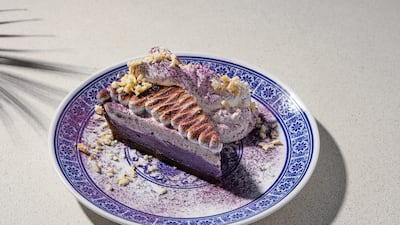

What goes into the making of a viral food trend? Is it the colour? Texture? Its versatility as an ingredient? Or is it a memorable flavour?
And what makes ube, a starchy yam root vegetable native to the Philippines, fit these criteria?
Its vibrant purple shade is an obvious reason, but ube's popularity is also owing to its velvety texture and sweet flavour. Much like how matcha has made its way into practically every coffee shop and cafe in the UAE over the last few years, ube is now the ingredient being incorporated into every sweet treat recipe and hot drink order.


As a matcha lover, I set out to put its rival to the test, speaking to chefs behind the bakes. Here are some ways UAE eateries are incorporating ube into their menus – and my verdict.
Nina's Bakes
Christina Tamayo, the Filipina owner of Nina's Bakes, says the purple yam is connected to some of her best childhood memories.
“We put it in all our desserts, such as halo-halo, ice cream, leche flan and cakes. Everyone in our village planted them in their backyards.”
As its use becomes more prevalent in the UAE, Tamayo has folded it into her recipes, creating an ube and white chocolate chip cookie (Dh25).

Tamayo began by taking ube roots to make ube halaya, which has a jelly-like consistency. After boiling and mashing the yam, it takes about an hour of stirring to turn it into a smooth jam for filling.
The heart of the bright purple cookie is creamy – a blend of sweet and savoury that jumps between the distinct flavour of the yam and the sweet vanilla. The white chocolate chips are a pleasant addition.
“It’s pretty safe to say that the ube’s popularity is due in large part to its photogenic nature,” Tamayo says.
I love the rich and gooey texture of Nina's Bake's indulgent cookies, and the uber-jam centre is moreish.
Available for order through Zomato and Talabat in Abu Dhabi
Nette
Not satisfied with one viral food trend, Nette in Dubai has created an ube matcha drink (Dh36) in a colour combination straight out of Beetlejuice.
It's an unexpected duo, but I find it strangely comforting. The ube adds a sweetness, but that earthy taste remains, with neither feeling overpowering.
The French-Japanese restaurant also lists cloud ube (Dh36) on its drinks menu – adapted from the popular cloud matcha – which consists of coconut water topped with an ube and oat milk mixture to form a smooth cream. This is milder, more refreshing intro to the ube flavour.
Nette also offers two dessert options. First, its crinkle cookies with coconut cream cheese filling (Dh30). I appreciate the perfect cookie-to-cream ratio, although the creamy flavour overpowers the ube essence. It's enjoyable nonetheless and a great sharing option.

The vibrant burnt Basque ube cheesecake (Dh50) feels smooth and melts in the mouth. The ube's flavour pairs really well with the coconut vanilla Chantilly cream, miso butterscotch sauce and toasted coconut flakes, making it one of my favourite ube-inspired dishes so far.
Nette's culinary director Craig Small says he saw ube becoming a popular trend long ago.
“To me, ube is purple gold – it has an incredible natural colour and flavour, but it also naturally contains anthocyanins – powerful plant pigments known for their antioxidant properties, along with fibre and other beneficial plant compounds,” Small says. “It has heritage, versatility and real nutritional value, and I think we’re going to see ube become a much bigger ingredient across the UAE.”
Al Barari, Dubai
Jun's
“It’s easy to use ube in simple desserts and drinks, but it can also be a little finicky,” says award-winning Chinese-Canadian chef Kelvin Cheung. “If you’re working with artificial ube flavouring or essence, it can be very powerful, so you have to use it carefully to ensure it doesn’t overpower the palate.”
Cheung, whose food is rooted in “third-culture cuisine”, prioritises collaborating with his Filipino team members “to create dishes that celebrate their culture, food and heritage” at his restaurant, Jun's, which has been ranked eighth among the Middle East & North Africa’s 50 Best Restaurants.
Jun's ube menu includes an ube calamansi spritz, a gluten-free coconut ube pie, the signature Ube Kelvin cake made with brown-butter taro root spread, and ube flan cookies. After sampling several of those items, I notice that Cheung uses ube to magnify and complement each dish with a subtle rather than overpowering flavour.

The coconut ube pie (Dh55) offers comfort with familiar textures and memorable flavour combinations. The pie crust is not too thin nor too thick and the layers come together in harmony. The creamy coconut mousse hits first, followed by the toasted meringue, while the ube mousse is smooth and airy.
The ube calamansi spritz (Dh35) is a cool, refreshing summer drink. Both ube and calamansi oranges are native to the Philippines and they create a sweet and sour blend.
Lastly, the soft ube flan cookies (Dh30) are a sweet treat, combining chocolate and ube in every warm bite.
Cheung believes ube could become popular just like matcha on a global scale, especially as a caffeine-free drinks option.
“The region is always excited to embrace new flavours and dessert trends, and cafe culture is such a big part of life here. With its vibrant colour and unique taste, ube is the perfect ingredient to take over right now,” he says.
Cheung also highlights that beyond driving creativity and visually appealing dishes, viral ingredients can foster a new appreciation for culinary traditions.
“I only see positives when an ingredient rooted in a particular culture is given a global spotlight, because it encourages people to discover more about the cuisine it comes from,” he says.