Saudi Arabia’s foreign minister has urged the international community to be firm on full and transparent nuclear inspections in Iran, amid ongoing global talks to revive a nuclear deal with Tehran.
Prince Faisal bin Farhan discussed Iran’s nuclear program with IAEA chief Rafael Grossi in Vienna on Monday, after world leaders continued negotiations on a nuclear accord in the Austrian capital.
The meeting was also attended by Abdullah bin Khaled, Saudi Arabia’s ambassador to Austria.
A number of bilateral issues between Saudi Arabia and Austria were also discussed during Prince Faisal's two day visit, including regional peace and energy.
During the meeting, they discussed "the importance of imposing the necessary mechanisms for a rapid and comprehensive inspection of all Iranian nuclear sites,” as well as the need for “stopping Iranian policies and violations of international laws and norms that destabilise the security and stability of the region and the world," the foreign ministry said.
The importance of “adhering to the procedures of international atomic energy standards in order to stimulate growth and progress to achieve sustainable development globally” was also discussed.
Ebrahim Raisi, Iran’s president-elect, welcomed the negotiations aimed at reviving a 2015 nuclear deal, in which Iran and six other countries had reached an agreement to massively curtail nuclear work.
In exchange, Washington put an end to strictly enforced sanctions, allowing for an increase in international trade with Iran.
After former US president Donald Trump pulled out of the deal and re-imposed sanctions on Iran, the country restarted work on its nuclear program.
But with Mr Biden’s administration this year, international talks in Vienna have resumed to restore the agreement to limit Iran's nuclear development.
Several rounds of talks were held between leaders from Russia, China, Germany, France, Britain and Iran. There was no direct US participation.
Abbas Araqchi, Iran's chief nuclear negotiator, said representatives in Vienna were "closer than ever to an agreement”.
-
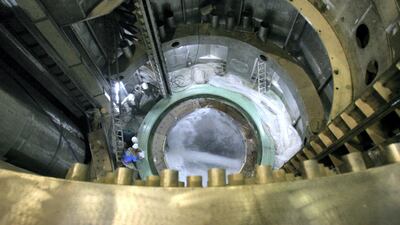
Russian contractors work at the Bushehr nuclear reactor site in 2007. The plant opened four years later. Bloomberg -
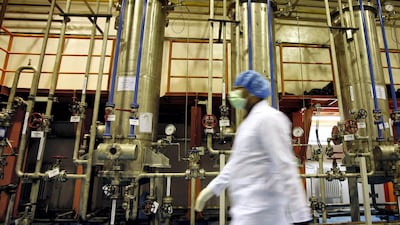
An Iranian technician at the International Atomic Energy Agency inspects the country's Isfahan plant in 2007. Tehran is no longer co-operating with the agency at nuclear sites across the country. EPA -

Workers wait to begin constructing a second reactor at the Bushehr nuclear power plant in 2019. AFP -
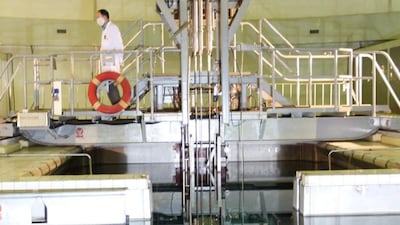
A metal-encased rod with 20 per cent enriched nuclear fuel is inserted into a reactor in Tehran in 2012. AFP -
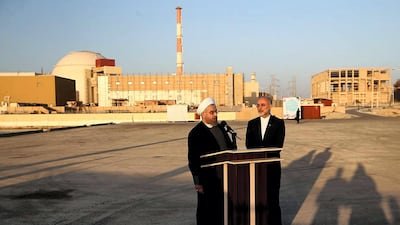
Fomer Iranian President Hassan Rouhani and the country's Atomic Energy Organisation chief Ali Akbar Salehi speak at the Bushehr nuclear site in 2015. AFP -
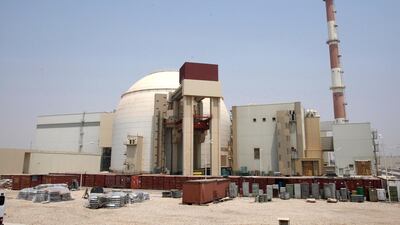
Iran's Bushehr nuclear plant has been restarted. EPA -
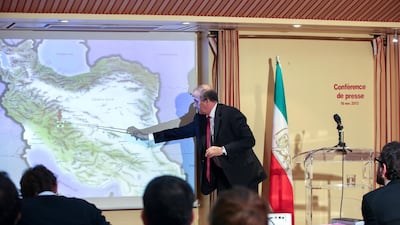
Mehdi Abrichamtchi, chairman of the Peace and Security Committee at the National Council of Resistance of Iran, shows journalists the location of a secret nuclear site in Iran in 2013. AFP -
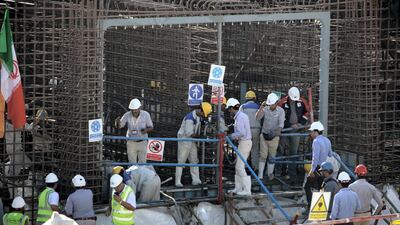
Workers prepare to begin the construction of a second reactor at the Bushehr site. AFP


“We are closer to a deal, but we are not still there,” said Enrique Mora, the European Union's official chair.
"We will not allow negotiations to be for negotiations' sake," Mr Raisi said. "Negotiations should not be dragged out but each sitting should bear results. A result-oriented [negotiation] is important to us and it should have an outcome for the Iranian nation.”
International co-operation
On Tuesday, Prince Faisal also held a joint press conference with his Austrian counterpart Alexander Schallenberg in Vienna.
The Austrian foreign minister said both countries discussed the Iranian nuclear program and its impact on the region, adding that “we value the Saudi initiatives for peace in Yemen.”
Mr Schallenberg said Houthi attacks on the kingdom are “unacceptable” and that the militia organisation must engage in talks to end the violence and attacks on civilians.
Referring to Iran nuclear talks in Vienna, Prince Faisal said, “the International Atomic Energy Agency plays a very important role in the matter. Iran must adhere to all decisions made by the IAEA.”
Prince Faisal said both countries discussed Iranian interference in the region due to “deliberate escalated attacks by Houthis” on the kingdom.
The crisis between Israel and Palestinians was also discussed, where Prince Faisal reiterated that the kingdom “does not have any relationship with Israel.”
He said Saudi Arabia has historical ties with Austria and will continue to work on developing them further. Mr Schallenberg said Austria supports ongoing developments taking place across Saudi Arabia including the kingdom’s Green Initiative, which will involve large scale tree planting and a surge in investment in renewable energy.
Countering crime and corruption
Prince Faisal also met with the executive director of the United Nations Office on Drugs and Crime (UNODC) and the director general of the United Nations Office at Vienna, Ghada Fathi Waly.
They discussed ways to boost co-operation between the kingdom and the UN and reviewed the Riyadh initiative that aims to establish the Global Operations Network for Anti-Corruption Law Enforcement Authorities (GlobE).
Mazin bin Ibrahim Al Kahmous, president of the Saudi Oversight and Anti-Corruption Authority (Nazaha) on Monday met with Hatim Ali, UNODC regional director.
Steps to boost the strategic partnership between Nazaha and the UNODC were on the agenda.
Mr Ali praised Saudi Arabia's efforts to combat corruption and maintain transparency. Saudi Arabia is leading the world through the Riyadh Initiative, also known as GlobE, he said.
Prince Faisal also held bilateral talks with Sebastian Kurz, the Federal Chancellor of the Republic of Austria.
“We talked about the further development of bilateral relations and discussed the most important international issues of mutual interest,” Prince Farhan said in a German-language tweet.