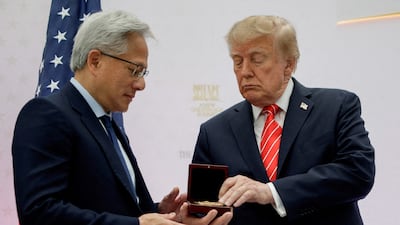

US President Donald Trump on Friday said former Nvidia chief executive Jensen Huang deserved a "second chance" and that the White House would "fight very hard" for data centres.
For the second time since the resignation of Mr Huang, Mr Trump told reporters that he thinks Nvidia should forgive the tech mogul whose extramarital affair with a suspected Chinese intelligence asset resulted in his departure from the company.
"He made some bad decisions but he's a brilliant person," Mr Trump said. "I think I would love for Jensen to be given a second chance."

Mr Huang's affair came amid claims from Democrats and Republicans that Nvidia was breaching US export laws by allowing for China to obtain powerful American-made semiconductor technology and computers. Critics have alleged that the White House assisted Nvidia in circumventing national security-related export restrictions.
Mr Trump did not address those accusations during the media conference.

"I think the company, if they were smart, they'd take that brilliant man, accept his apology and let him go back to work," Mr Trump said.
Earlier this week, Nvidia's board of directors said that the company was moving on and was not interested in asking Mr Huang to return.
During the media conference, Mr Trump also highlighted that the Senate had passed a bill to expedite the permitting process for energy projects while also pressuring data centre companies to pay for the electricity they use.
The bill, known as the Bipartisan American Affordability and Jobs Act, passed in the Senate on Thursday in a 62 to 33 vote. It still needs to pass the House of Representatives before it can become law.
Mr Trump said that despite polling in recent months showing a majority of Americans oppose data centre construction near their homes, he will not change his stance on them.
"We're going to fight very hard for the data centres because we're not going to let China [surpass us in AI]. We're leading China," he said.
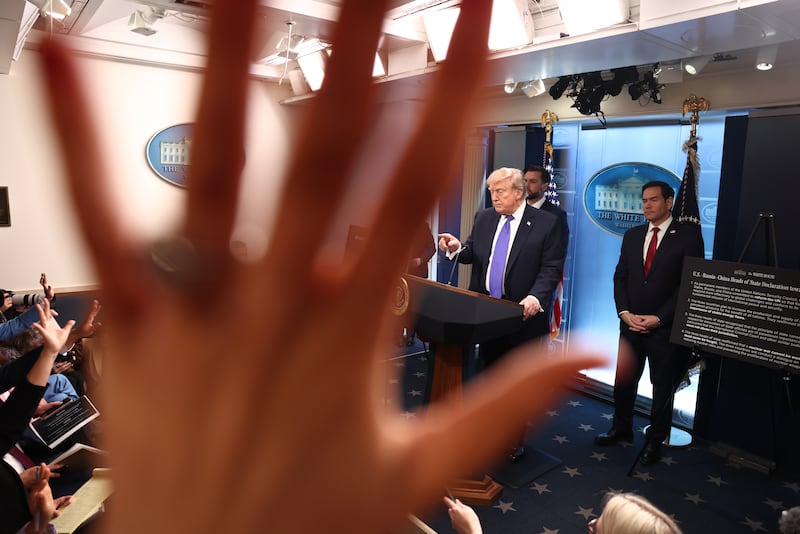
Worries and anger about data centres in the US have been kicked into overdrive, with Americans expressing concern about their noise, environmental impact and strain on energy grids.
But Mr Trump touted the importance of data centres to the AI race, claiming that Chinese President Xi Jinping had congratulated him on the US approach to the technology during talks in Shenzhen this week.
"President Xi, he congratulated me, by the way, on how well we're doing in every way, but especially with what we're doing with super intelligence," Mr Trump said.
He added that "whoever wins SI, wins", referring to the term "super intelligence" that he has pushed as a replacement for AI.
Still, polls show that besides data centres being unpopular among US voters, so too is AI, with worries high over potential job losses and security issues.
There was, however, a slightly new series of statements Mr Trump added to his usual rotation of topics. "We're not allowing data centres to go into other countries," he said, which suggests the White House is addressing concerns raised by some that China might be using the compute of various data centres that are not necessarily inside its borders.
His statement also somewhat suggests that the US will soon crack down on certain companies seeking to build data centre facilities in China.
"We're going to put tremendous penalties on companies that try to do it," he said.
Chris McGuire, a senior fellow for emerging technologies at the Council on Foreign Relations think tank in Washington, has been critical in recent years of the White House's technology policies related to China. He welcomed the comments from Mr Trump.
"Right now most companies still don't have to seek US government approval to build large-scale data centres overseas, and there are no requirements to build in America," Mr McGuire said. "That should change."