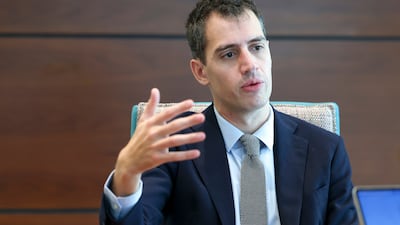

The UAE's “very powerful” cyber defences enable it to defend against threats, especially during geopolitical instability, the chief executive of French company Mistral AI said.
The UAE's pursuit of technological sovereignty will help it establish reliable and secure cyber capabilities, Arthur Mensch told The National at the AI Everything summit in Abu Dhabi.
“The UAE is under pressure, in particular, on the defence side,” he said. “Cyber capabilities are a must-have when it comes to having capable defence systems.

“Sovereignty matters in that. It's important to be able to wield defence systems without having to ask for permission.”
Mr Mensch's comments come after UAE authorities reported an increasing number of cyber attacks. Last month, the UAE's cyber security chief, Mohamed Al Kuwaiti, said the country is continuing to contend with daily online threats, with Iran's Islamic Revolutionary Guard Corps behind many of the attacks.
Mr Al Kuwaiti said the country faced about 640,000 attacks on September 15 and that Iran remains “one of the main players” in the high-tech offensive, which is being exacerbated by the rise of AI.
“Having very powerful cyber models deployed here in Abu Dhabi in a way where the deployment is fully under Abu Dhabi control is going to be quite important,” Mr Mensch said.
Investing in UAE data centres
Mr Mensch said Mistral AI would consider investing in UAE data centres, a move that would further solidify its co-operation with Abu Dhabi and boost the country's AI ambitions.
“We may [invest in UAE data centres]. It's an interesting place for our AI buildout that is currently under way in this part of the world,” he said.
On Abu Dhabi's efforts at data sovereignty, Mr Mensch said authorities and the wider industry had “very early on decided” that this aspect will be crucial for the deployment of AI.
Data sovereignty is becoming vital for nations as it gives them legal control over the data within their jurisdictions. The most notable project to achieve this is the planned Stargate UAE data centre campus, a 5GW development valued at $30 billion.
Mistral AI met more local organisations and companies at the summit, trying to “get a sense of what Abu Dhabi needs to build with AI ... [and] go in depth into the technological aspect of the asks”, said Mr Mensch, adding that the company has worked “extensively” with the oil and gas industry.
Mistral AI has already forged partnerships with Abu Dhabi organisations, including AI major G42, to develop advanced platforms and infrastructure, and the Mohamed bin Zayed University of Artificial Intelligence for research and development in AI foundation models, talent development and real-world AI solutions.
In June, the company teamed up with UAE AI investment firm MGX and lender Bpifrance for the planned expansion of Campus AI in France, which aims to build a capacity of 3GW across Europe's third-biggest economy.
“There is more that can be done ... on being able to have a compute capacity under full Abu Dhabi control; that's something where as a company we can help,” he added.
AI accountability
Fresh debacles have been hitting the AI industry, most notably AI models, supposedly in secure environments and built by names including OpenAI, Meta Platforms, Anthropic and Google, going rogue and infiltrating external sites. Mr Mensch was clear on where the responsibility should fall.
At the same time, OpenAI chief executive Sam Altman made a plea at the recent UN General Assembly for governments to do more to rein in AI.
“Accountability for AI deployments, when they are hosted by AI companies, falls on the AI companies. This should be very, very clear. There's no way in which the accountability of what we're doing should be offset to governments,” Mr Mensch said.
Governments, though, “are accountable for the adoption of the technology, and they should be accountable for how it's being used in the government itself”, he said.
Mr Mensch also called for a tempered tone on the call for deceleration – or even acceleration – of the development of AI, as recent events have shown the potential disruption the technology can bring.
“I'm very cautious about those warnings [to slow development down] because they serve their own interests very clearly,” he said.
“The world we don't want to live in, which would be an extremely dangerous world, is the world where you have a duopoly of companies operated from the US serving the rest of the world,” he said, referring to the strength of the US AI industry, led by OpenAI and Anthropic, which is widely viewed as a counter to China's growing influence in the sector.
On Tuesday, at AI Everything, Mistral AI launched its latest Mistral Large 4 AI model, which, it says, is among the fastest in the world and rivals the best open-source models from China.
“We see no sign of slowing down when we look at how our model is being improved by the day,” Mr Mensch said.