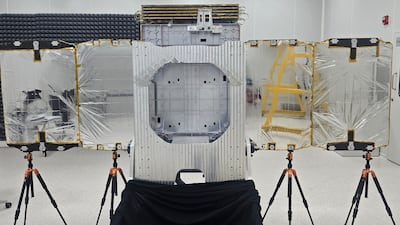

The mobile “dead zone” could become a thing of the past by the end of the decade as satellites begin connecting directly to ordinary smartphones, Space42 has said.
The UAE space technology company is developing direct-to-device technology designed to keep regular, unmodified phones connected when users travel beyond the reach of conventional mobile networks.
Viktor Stoyanov, chief operating officer of Smart Solutions at Space42, said the technology could provide connectivity in areas where 4G and 5G networks fall short, including at sea, in deserts and in mountains.
“In the near future, you'll be able to connect to the satellites and receive connectivity even if you're deep in the ocean, deep in the desert, high in the mountains,” he told reporters at the company's headquarters in Abu Dhabi.
The aim is for the transition between terrestrial and satellite networks to become almost unnoticeable.
Space42 and Viasat last week committed $1 billion to Equatys, a joint venture developing a global direct-to-device satellite network, with services expected from 2029.
It builds on a partnership announced last year to extend satellite coverage to communication black spots.
The technology is part of a wider push by Space42 to use satellites to fill gaps in both connectivity and observation, with its Foresight constellation also capable of producing radar imagery at resolutions of up to 25cm.
Seeing smaller
Space42's Foresight constellation currently comprises five synthetic aperture radar, or SAR, satellites.
“What this means is you can capture an object that is the size of 25cm or larger and correctly visualise it on an image,” Mr Stoyanov said.
Unlike conventional optical satellites, SAR does not rely on sunlight. It uses radar signals to collect imagery through conditions including cloud, smoke and dust.
Mr Stoyanov said the technology was similar to taking an “X-ray image of the Earth”.
Abdullah Sharif, senior manager of the Foresight Constellation at Space42, described the ability to see what conventional optical satellites cannot as a form of “superpower”.
He showed SAR imagery of an explosion site where smoke obscured an optical satellite. The radar image, he said, allowed damage on the ground to be located and assessed.
Space42 is also combining repeated observations with artificial intelligence to detect changes over time.
Mr Sharif said feeding AI with successive images of the same location could turn Foresight into a “change detection machine”.
Christos Kolimenakis, chief executive of ICEYE UAE, Space42's partner on the Foresight programme, said comparing successive images could reveal patterns.
Sovereign capability
Three of the five Foresight satellites currently in orbit underwent assembly, integration and testing in the UAE.
Space42 also operates its own mission ground segment, while its downstream analytics and AI models are developed in the country.
“Sovereignty is the key here for Space42,” Mr Sharif said. “The UAE today is controlling its eye.”
For consumers, however, direct-to-device connectivity could provide the most visible change.
Nermeen Negm, vice president of communications at Space42, compared the intended experience to a smartphone switching seamlessly from home Wi-Fi to a mobile network.
By the end of the decade, she said, people could look back at mobile dead zones much as they now think about life before Wi-Fi or Google Maps.