Low-cost financing can help power a green energy transition while saving the world $50 trillion in its goal to reach net zero by 2050, according to a report.
Governments, financial institutions and investors must jointly find ways to reduce the risk of investing in green projects by developing blended and low-cost finance solutions to attract private sector funding, global consultancy Deloitte said.
This will help countries balance economic growth and climate neutrality, especially in emerging economies.
Major investments of $5 trillion to $7 trillion per year are needed through to 2050 in the energy sector to drive the transition but less than $2 trillion is currently spent each year, according to the report.
This highlights underinvestment in green projects and the high return rates required because private investors perceive sustainability projects as riskier than alternative investments.

Taking swift action means that the projected savings of $50 trillion through to 2050 can reduce the annual investment needed by more than 25 per cent, Deloitte said in its Financing the Green Energy Transition report.
“Just as we are continually developing solutions and technology to rapidly decarbonise, we must take definitive steps to remove financial barriers in order to accelerate a just energy transition, especially in developing economies,” said Jennifer Steinmann, Deloitte's global sustainability and climate practice leader.
“Decisive and co-ordinated policy support and hand in hand action across the global finance ecosystem are critical to guiding investments toward green projects and supporting the growth of sustainable economies.”
The report comes a day before the Cop28 UN climate summit in Dubai on Thursday, when world leaders will focus on accelerating the world’s transition to more sustainable forms of energy.
In a sluggish global economy, a major question is how to pay for it, and climate finance will be a key topic during the global gathering.
“If investments do not scale up rapidly, the world will fail to meet its climate objectives,” Deloitte said in its report.
Less than half of green investments are currently made in developing economies, mostly due to greater risks and stricter public budget constraints for energy transition projects. These projects are seen as less bankable, which means their risk-return profile does not meet investors' criteria to inject capital.
-

John Kerry, US Special Presidential Envoy for Climate, arrives in Dubai for the Cop28 Climate Summit. AP -
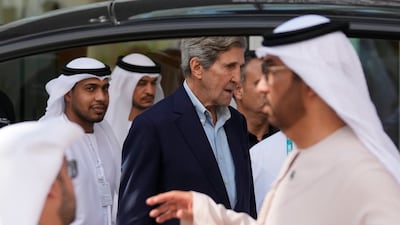
Mr Kerry entering the Cop28 venue, Expo City Dubai. AP -
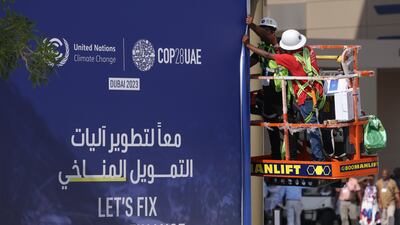
Workers prepare a banner that reads 'Let's Fix Climate Finance' ahead of the official opening of Cop28 in Dubai. Getty Images -

National flags of the participating countries being arranged outside the Cop28 venue. AFP -
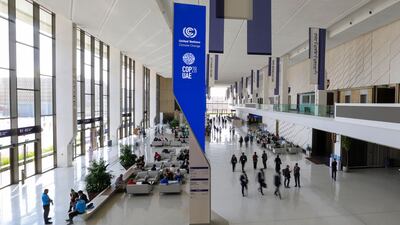
Participants gather in a hall at Dubai Expo City. The UAE is hosting the summit from November 30 to December 12. AFP -

Final coats of paint as workmen get ready for the UN Climate Summit. AP -
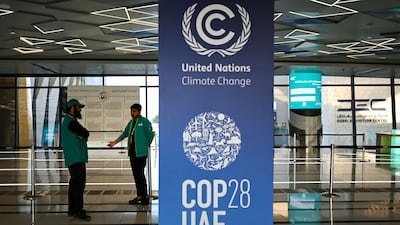
Signs on the Dubai Metro. Cop28 participants are encouraged to use public transport to travel to the venues. AFP -
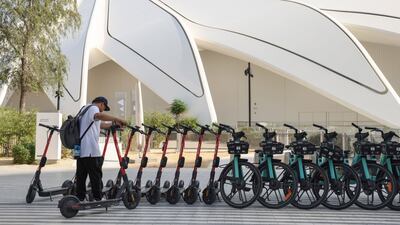
Electric scooters and bicycles for hire in the climate conference's Green Zone. Bloomberg -
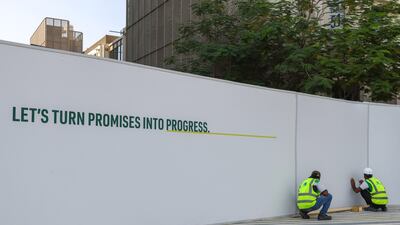
Construction workers fix a hoarding in the Green Zone. Bloomberg -
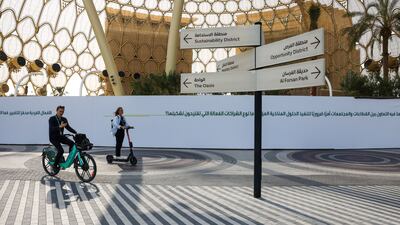
Summit attendees use an electric hire bicycle and scooter in the Green Zone. Bloomberg -
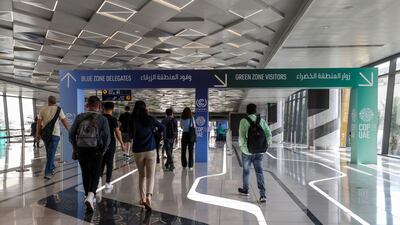
Participants enter the Blue and Green zones ahead of the Cop28 climate conference at Expo City. Bloomberg -

A Cop28-themed dessert on offer ahead of the summit conference at Expo City. Bloomberg -

Solar-powered e-trees in the Green Zone. Bloomberg -
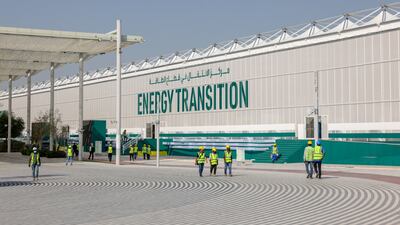
The Energy Transition hub in the Green Zone will provide a platform to showcase sustainability plans and forge partnerships for working towards net zero goals. Bloomberg -
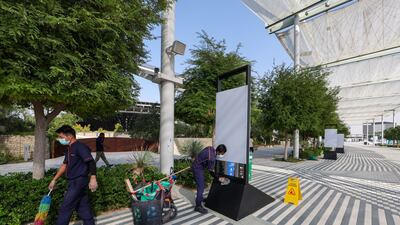
Workers clean street furniture in the Green Zone. Bloomberg -
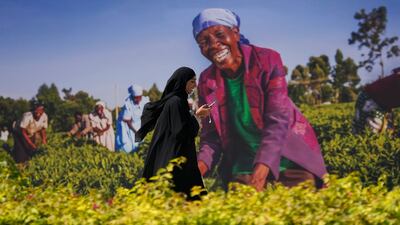
A woman is dwarfed by a giant poster for Cop28 in Dubai. AP -
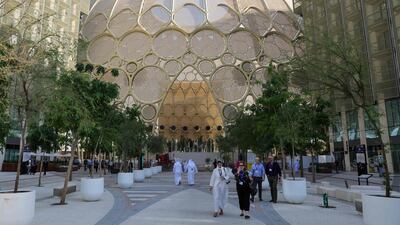
Attendees in Al Wasl Plaza in the summit's Blue Zone. AFP -
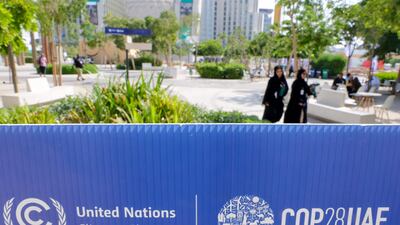
A Cop28 poster in Dubai. Organisers expect 70,000 people to attend the summit this year. AFP


However, to reach net zero, nearly three quarters of green investments would need to be made in developing economies by 2030, according to the report.
“To further lighten the financial burden on the Global South, governments, financial institutions and international organisations must implement concessional finance – a loan made on more favourable terms than the borrower could obtain in the market – through innovative financing structures that mobilise private capital for climate action,” said Hans-Juergen Walter, Deloitte's global financial services industry sustainability and climate leader.
“Major financial institutions, such as development banks and multilateral funds, play a pivotal role in this context.”
Call to action
Governments, financial institutions and industries must work together to develop mechanisms and tools that will unlock private finance at attractive costs to accelerate the energy transition, the report said.
“Two key efforts chiefly aimed at emerging economies will be to de-risk projects to lower the cost of capital and to remove barriers constricting the flow of private capital toward green projects,” Deloitte said.
Without concessional finance in developing economies, a net-zero scenario would cost more than $7 trillion per year through to 2050, or $200 trillion in total by midcentury, the report showed.
About 70 per cent of those investments would take place in low and middle-income economies.
Making green projects more bankable can “unleash private finance” and bring investment spending down by $2 trillion every year. This amounts to $50 trillion in total by midcentury, which is about half of the global annual gross domestic product today, the report said.
Concessional funding using better financing structures can reduce the cost of the energy transition by nearly 40 per cent for developing countries, lowering global investment needs to $5.5 trillion per year.
The green transition can increase the world economy by $43 trillion between 2021 and 2070, the report said.
Required investment levels remain below 6 per cent of global GDP annually, whereas a current policy pathway – aligned with plus 3°C of global warming – would entail almost 8 per cent of global GDP loss by 2070, the report said.
“To reach climate goals, some 70 per cent of green investments would need to happen in the Global South by 2030. This can only be possible with international co-operation and the active participation of development finance institutions and multilateral development banks,” the report said.