The world is on track to warm by as much as 2.9°C above pre-industrial levels this century unless drastic action is taken to change course, a UN report has warned.
The Emissions Gap Report 2023 underlined how, "like a broken record", the world had once again failed to slash warming emissions, with temperatures hitting new highs this year.
Emissions must fall by 28 per cent to 42 per cent to limit warming to 2°C and 1.5°C through a “relentless” transformation, it said.
Scientists have also warned if warming of this magnitude continues, billions of people could be affected by heat and humidity that severely damages their health.
The report comes days before Cop28 in Dubai, which will add further pressure on leaders to act when it starts on November 30.
UN Secretary General
"The report shows that the emissions gap is more like an emissions canyon," said UN Secretary General Antonio Guterres, who also called for leaders to act at Cop28.
"A canyon littered with broken promises, broken lives and broken records. All of this is a failure of leadership, a betrayal of the vulnerable and a massive missed opportunity.
"Renewables have never been cheaper and more accessible."
The report examines the nationally determined contributions (NDCs), or climate action plans, that countries submit to the UN to tackle the crisis. as set out under the 2015 Paris Agreement.
As of September 25, nine countries had submitted new or updated NDCs since Cop27 last year, bringing the total number of updated NDCs to 149.
But the report outlined how the world remains way off track in its pledges to meet the goals of the Paris deal, where countries agreed to "pursue efforts" to limit warming to 1.5°C.
It warned even in the "most optimistic scenario", the chance of limiting global warming to 1.5°C was only “14 per cent”.
"Humanity is breaking all the wrong records when it comes to climate change," said Inger Andersen, executive director of the UN Environment Programme, which issued the report on Monday.
“The world must change track, or we will be saying the same thing next year and the year after and the year after, like a broken record."
The report said the world needed to cut predicted 2030 emissions by 28 per cent to get on track to hit the 2°C goal and 42 per cent for the 1.5°C goal. It said if all conditional NDCs and long-term net-zero pledges were met, limiting the temperature rise to 2°C would be possible.
“However, net-zero pledges are not currently considered credible: none of the G20 countries are reducing emissions at a pace consistent with their net-zero targets,” the UNEP said. "Even in the most optimistic scenario, the likelihood of limiting warming to 1.5°C is only 14 per cent."
The study also comes in the same year temperature records were broken and extreme weather events became more common.
According to the UN, at least 86 days before October this year were recorded with temperatures more than 1.5°C above pre-industrial levels.
The hottest September was recorded, with global average temperatures of 1.8°C above pre-industrial levels. Global greenhouse gas emissions also continue to rise.
"There is no person or economy left on the planet untouched by climate change, so we need to stop setting unwanted records on greenhouse gas emissions, global temperature highs and extreme weather," said Ms Andersen.
"We must instead lift the needle out of the same old groove of insufficient ambition and not enough action, and start setting other records: on cutting emissions, on green and just transitions and on climate finance."
Threat to human life
The 1.5°C goal is still seen as crucial in preventing the worst impacts of climate change.
The world has already warmed by more than 1°C, with scientists believing that going beyond the 1.5°C threshold would pose a serious threat to civilisation.
Dr Sultan Al Jaber, Cop28 President-designate and Minister of Industry and Advanced Technology, has called the 1.5°C goal the "North star" that will guide Cop28, and the first assessment of how countries are doing under the Paris deal will be made.
Known as the "global stocktake", it is also expected to try to chart a way out of the crisis and will help inform the next rounds of NDCs expected in 2025 to drive further action.
"Cop28 is a critical moment for addressing this," Tom Evans, a climate expert at the E3G think tank, told The National.
He said negotiations in Dubai could help leaders agree on measures to ensure much faster emissions reductions.
"New global goals to triple renewables and double energy efficiency by 2030, matched with a commitment to phase out all fossil fuels, are critical steps for closing the emissions gap," he said.
The report said some progress had been made since the Paris deal was signed in 2015, when emissions in 2030 projected to increase by 16 per cent. Today, the projected increase is 3 per cent.
It also calls for all countries to focus on the energy transition; and warns new oil, coal and gas "would emit over 3.5 times to the carbon budget available to limit warming to 1.5°C and almost the entire budget available for 2°C”.
It says wealthier countries responsible for more emissions have a larger role to play.
Climate finance, too, needs to be scaled up, as delaying cutting emissions will increase future reliance on the removal of carbon dioxide from methods such as afforestation, reforestation and forest management, and to technology such as direct air carbon capture and storage.
The report, however, warned such technology might not be scaled up in time to achieve the results it hopes to yield.
"Leaders can’t kick the can any further. We’re out of road," said Mr Guterres. "Cop28 must set us up for dramatic climate action – now."
The Secretary General said he was travelling to Chile and Antarctica to "see for myself" the impact of the climate crisis.
"Scorching temperatures mean Antarctic ice is melting ever faster, with deadly consequences for people around the world," he said.
"I will take my experiences to Cop, where I will call for action that matches the scale of the crisis."
Expo City Dubai as Cop28 venue - in pictures
-
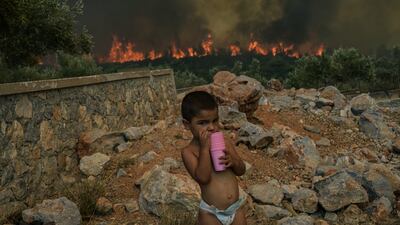
A child stands in his family's yard as a wildfire burns nearby, in the village of Agios Charalampos near Athens, in July 2023. Europe saw record temperatures amid a relentless heatwave and wildfires that scorched vast regions of the Northern Hemisphere, forcing the evacuation of 1,200 children close to a Greek seaside resort. Health authorities sounded alarms from North America to Europe and Asia, urging people to stay hydrated and shelter from the burning sun, in a stark reminder of the effects of global warming. AFP -
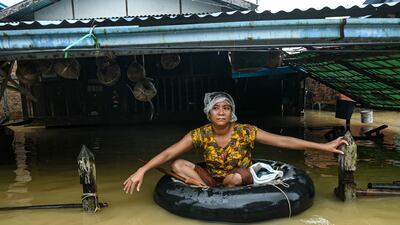
A resident uses a buoy to move through a flooded house after heavy rains in Bago township, in Myanmar's Bago region, in October. Floods sparked by record rain hit parts of southern Myanmar, inundating roads and fields and sending residents fleeing for higher ground. AFP -

Ali Hakim, an Iraqi Marsh Arab man, Iooks at the remains of a buffalo that died due to drought and the salinity of the water at the Basra marshes, Iraq. Reuters -
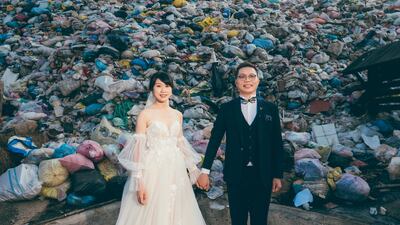
Iris Hsueh, left, and her fiance Ian Ciou pose for a pre-wedding photo in front of a rubbish heap in Puli Township, Taiwan. The couple chose the site for their photoshoot because the environment-conscious bride said she wanted to discourage guests and the public from generating waste. AFP -
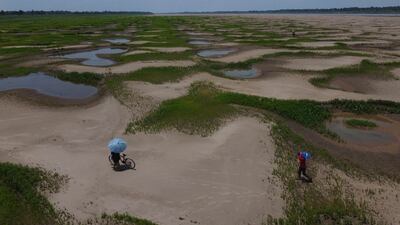
Residents of a riverside community in Amazonas state, Brazil, carry food and containers of drinking water distributed by the state's humanitarian aid action, amid a continuing drought and high temperatures that affect the region of the Solimoes River. AP -
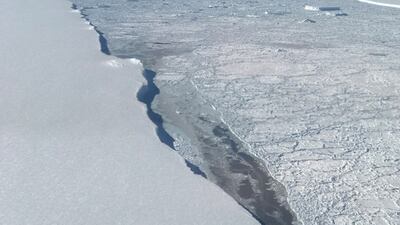
The edge of Larsen C Ice Shelf, left, and the western edge of iceberg A68 in the distance over the Antarctic in November 2017. The iceberg detached from the ice shelf in July 2017, becoming one of the largest in recorded history to split off from Antarctica. AFP -

A man walks past construction vehicles submerged in debris caused by flash floods after a lake burst in Rangpo, India, in October. Reuters -
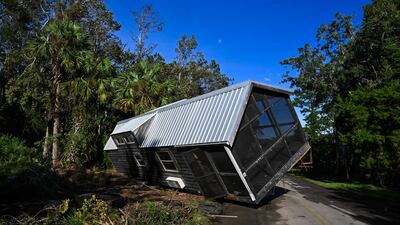
A mobile home swept by floodwaters in Steinhatchee, Florida, in August 2023, after Hurricane Idalia made landfall. Idalia slammed into north-west Florida as an 'extremely dangerous' Category 3 storm, buffeting coastal communities as officials warned of 'catastrophic' flooding in parts of the southern US state. AFP -
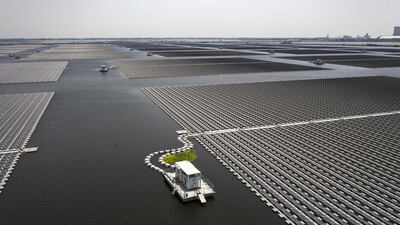
A floating solar farm, built on the site of a former coal mine since filled with water, in Huainan, China. The installation by Sungrow Power Supply Co covers the size of more than 400 football pitches and generates power for more than 100,000 homes. Getty Images -
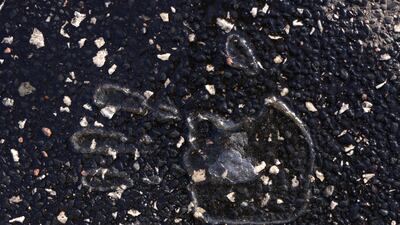
A handprint of glue left behind by an activist from the group Last Generation (Letzte Generation), after they were removed by police, is visible on the asphalt following a blockade at an intersection in Berlin, Germany, in September. Last Generation is continuing its disruptive protests in an effort to put pressure on politicians to stop the burning of fossil fuels. Getty Images