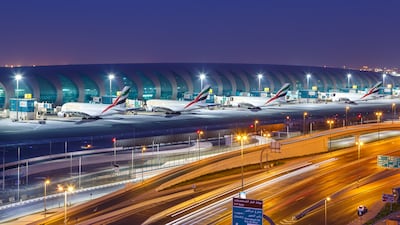

Dubai’s transport infrastructure has allowed the emirate to build on its status as a financial centre, the former leader of the City of London has said.
Prof Michael Mainelli, who served as the City of London’s lord mayor in 2023 and 2024, said Dubai’s financial districts have maintained expansion mode as sustained growth at its international airport demonstrates.
“As long as those air routes can be kept open, I don’t see that Dubai is going to have much of a problem,” he told The National. “It's not a commercial calculation, it's just a human necessity.”

Dubai remains in the top 10 cities on the Global Financial Centres Index, coming ninth in the biannual report’s latest findings in September. The index, which Prof Mainelli helps co-writes, had shown no “great loss of faith in Dubai”.

The Iran war has led to airspace restrictions, while some flights to the UAE remain suspended. The UK's national carrier British Airways resumed flights to Dubai last week, after an eight-month suspension.
In a speech at the Arab Chamber of Commerce on Tuesday, Prof Mainelli said the Gulf should not be defined by crisis moments.
“We should acknowledge that tragedy without allowing us to define the region's future. The hope must be for restraint, diplomacy and durable peace, in which people can rebuild their lives and businesses can once again plan their confidence,” he said, speaking at an event about the Dubai Airport Free Zone.
Uncertainty
London faces its own questions about building a third runway that would expand capacity at Heathrow Airport.
UK Prime Minister Andy Burnham has refused to say whether he backs plans to build the third runway, which were first proposed in 2006. His predecessor Keir Starmer approved construction on the project last year but it has since been mired in uncertainty.
Government ministers claim no one has yet applied to build the runway and that Londoners must to be consulted on any proposal once a submission is lodged.
The government is also coming to terms with a new spate of complex security risks affecting the country, in the absence of all-out war.

Major cyber attacks, state-backed sub-threshold attacks from Russia, and alleged Iranian use of organised crime groups and petty criminals to conduct arson and other attacks led the UK government to publish its Resilience Action Plan last month.
The war, climate crises and the increasing range of technology available to track their implications have changed how finance professionals in the City of London and elsewhere make their calculations, Prof Mainelli told The National.
“We’re very dependent on space observation, we’ve got much more integration on biology and crops, and how those interact with the market,” he said. “The models that we used to have, which were purely financial, are now having to integrate with real-world models of what’s going on out there.”
Risks everywhere
British company founders are still hoping to expand to Dubai, while also becoming increasingly aware of the risks of conflict at home.
“I also think even in the UK, it’s something we’ve got to give thought to because we never know what’s coming tomorrow,” said Lisa Hicks, chief executive of Snoap, which produces hard soaps to reduce global plastic waste.
Ms Hicks is planning to open an office at Dubai Airport Free Zone as part of ambitions to expand her company.
She hopes that establishing herself in a free zone will provide “some protection” against regional conflict. Her main concern is how to choose distributors in an unfamiliar and possibly fractured region.
“We will be looking at partnering with distributors, that’s where we will certainly do our due diligence,” she said. “I try to stay away from politics even within the UK, but it’s important to understand what they [our potential partners] believe in, [what] sides they’re on.
Ninfeng Fiona Lee, an oncologist and co-founder of VasoDynamics, a pharmaceuticals start-up, is also planning to open an office in Dubai to collaborate on clinical trials and sell her products.
The company is developing drugs that could support patients against side effects of cancer therapy, such as hair loss and dermatitis.
Its global trial included patients in the Middle East, she said. “We are looking into how to collaborate locally to develop the trial at a high-quality level,” she said.