
US authorities escalated an investigation into whether Tesla’s Autopilot is defective and revealed they have reviewed about 200 crashes involving vehicles using the driver-assistance technology.
The National Highway Traffic Safety Administration (NHTSA) announced on Thursday that its preliminary evaluation of how Tesla Autopilot handles crash scenes with first-responder vehicles warrants further review and upgraded the probe.
Since opening the inquiry about 10 months ago, the agency has reviewed a much broader set of collisions beyond Teslas running into fire engines and police cars.
The agency has sifted through the circumstances of 191 crashes involving Tesla vehicles operating some version of Autopilot.
In roughly 50 cases, NHTSA found drivers were insufficiently responsive to the driving task. In about two dozen other incidents, the agency said the primary factor appears to be drivers using the system in environments and conditions where the technology encounters limitations, such as off highways or in inclement weather.
-
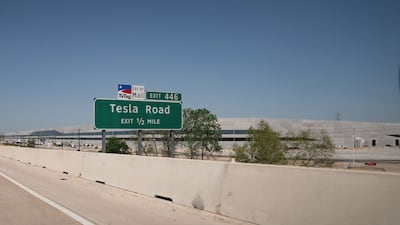
A Tesla Road exit sign on the Toll 130 motorway points to the new Gigafactory in Austin, Texas. AFP -

Workers set up for the grand opening party at the new Tesla Giga Texas plant in Austin, Texas. AFP -
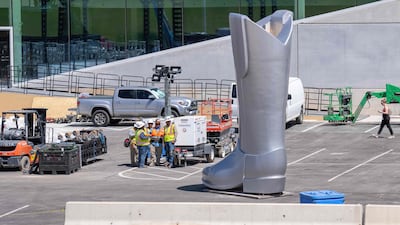
Tesla's unveiling of the new factory in Austin has highlighted corporate America's growing affinity for Texas, compared with California and other states that are considered to be less tax-friendly. AFP -

The parking lot at Tesla's Austin factory is packed with employees' cars. Bloomberg -

The construction site of the Tesla Gigafactory in Austin, Texas, in October 2021. Reuters -

A closer look at the construction site of the Tesla Gigafactory in Austin, Texas. Reuters -
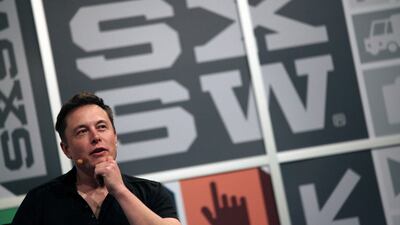
Elon Musk speaks at the South by Southwest Interactive festival in Austin, Texas. Reuters


The risk for Tesla extends beyond the potential for the NHTSA to ultimately conclude a defect does exist.
The regulator has the power to order recalls, and its investigation could force chief executive Elon Musk to come up with better safeguards against driver inattentiveness or ways to restrict Autopilot from being used in situations it cannot handle safely.
“NHTSA appears to be increasingly closer to taking firm action against Tesla, which will hopefully be strong enough to permanently dissuade the company from continuing to mislead the public about the capabilities of its vehicles,” said Michael Brooks, acting executive director and chief counsel of the Centre for Auto Safety.
Tesla did not respond to a request for comment on the NHTSA upgrading its investigation. The company’s shares closed down 0.9 per cent, erasing earlier gains. The stock has fallen by 32 per cent this year.
In a document posted to its website, the NHTSA said its probe now applies to an estimated 830,000 vehicles, about 65,000 more than when it started evaluating the potential defect in August.
Three more crashes involving Teslas hitting first-responder vehicles have occurred since the investigation started, the latest occurring in January.
The NHTSA said in the document that it will “explore the degree to which Autopilot and associated Tesla systems may exacerbate human factors or behavioural safety risks by undermining the effectiveness of the driver’s supervision”.
The agency also dispelled the notion that driver misuse of Autopilot may preclude it from making a defect determination.
“This is particularly the case if the driver behaviour in question is foreseeable in light of the system’s design or operation,” the NHTSA said.
Tesla has marketed certain assistance features as Full Self-Driving for years and charged customers thousands of dollars to test the technology.
On Thursday, the NHTSA repeated that “no commercially available motor vehicles today are capable of driving themselves”.
Autopilot is facing increased scrutiny from the NHTSA on another front. Last week, the agency disclosed the number of complaints it has received about Teslas suddenly braking at high speeds had more than doubled since it opened a defect investigation into that issue in February.
The NHTSA has given Tesla until June 20 to respond to pages of questions and information requests related to that probe. The agency is also planning to release data in the coming weeks about crashes involving automated-driving features roughly a year after it issued a standing general order for car makers to begin sharing information.

