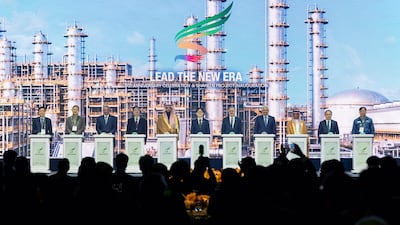

Saudi Arabia's Aramco and its Seoul-based subsidiary S-oil have inaugurated the $7 billion Shaheen project in South Korea, aimed at growing petrochemicals demand in Asia.
The project is the world's largest oil-producing company’s biggest investment in the country. Shaheen is expected to add about 3.2 million tonnes of annual petrochemical production capacity for S-Oil, making it a key player in the global supply of high-value polymers and advanced materials, Aramco said on Wednesday.
The deal was first announced in November 2022 during visit to South Korea by Saudi Crown Prince Mohammed bin Salman.

“Economic headwinds and rising geopolitical risks do not alter our long-term view on strategic investments,” said Amin Nasser, Aramco president and chief executive.
“Investments like Shaheen build the resilience that markets need in uncertain times.”

Aramco, Opec’s biggest oil producer and the main driver of Saudi Arabia's industrial sector, has faced waves of missile and drone attacks from Yemen’s Houthi militants.
This month, an administrative building in Riyadh belonging to Aramco was damaged by falling shrapnel during an attempted attack, the Saudi Ministry of Energy said. The building sustained minor damage, with no injuries or deaths reported.
In October, a Houthi missile attack damaged Saudi Aramco’s headquarters in Dhahran. The attack caused a fire in an administrative building in the complex.
Several crude refining sites, including those in Jazan in the west and Riyadh, have also been attacked in recent weeks.
However, the company will continue to invest in expanding its projects, both domestically and internationally, Aramco said this month, as it reported a 34 per cent annual increase in its third-quarter net income.
Technology boost
Located in Ulsan, the Shaheen project combines refining capabilities with the first major commercial deployment of Aramco’s thermal crude to chemicals technology. The use of the technology is expected to increase the share of crude oil converted into high-value chemicals.
The project features the “world’s largest single steam cracker, a propylene fractionator, crude-to-chemicals conversion facilities, and polymer production units”, Aramco said.
Expanded production from the facility is projected to increase the share of petrochemicals in S-Oil's overall business portfolio from 12 per cent to 25 per cent, Aramco said.
It will be integrated with S-Oil’s existing refining and petrochemical facilities in Ulsan. Through pipeline networks, the facility is expected to provide a domestic supply of basic petrochemical feedstocks to nearby downstream companies, reducing their reliance on imports and logistics.
Commercial operations are scheduled to begin in 2027 following the completion of commissioning.
The project will help “meet the rising demand for materials essential to Asia’s key industries, from electric vehicles to semiconductors”, Mr Nasser said.
The global petrochemicals market is expected to grow from $702.9 billion in 2026 to $977.80 billion by 2034, according to data from Fortune Business Insights. Asia Pacific dominates with a market share of more than 50 per cent in 2025, data shows.
Aramco, which made an initial investment in S-Oil in 1991, is currently its majority shareholder, holding more than 63 per cent of the Korean company’s shares.
“Petrochemicals are critical to overall industrial competitiveness,” Mohammed Al Qahtani, Aramco Downstream president, said.
The focus on advanced manufacturing is “expected to support product diversification and industrial growth and help meet rising demand for petrochemical feedstock in the years to come”, he added.