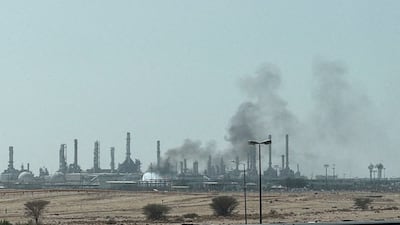

Saudi Arabia's Aramco, the world's largest oil-producing company, has reported a 34 per cent annual increase in its third-quarter net income despite disruption in the Strait of Hormuz and attacks on energy infrastructure in the kingdom.
Net profit for the three months to the end of September rose to 135.94 billion Saudi riyals ($36.25 billion), up from 101 billion riyals for the same period last year, Aramco said on Tuesday in a statement to the Tadawul stock exchange, where its shares are traded.
“Geopolitical uncertainty and attacks on key energy facilities continued to amplify the global energy supply crisis in the third quarter of 2026, with serious implications for global energy security,” Aramco president and chief executive Amin Nasser said.

“Despite challenges, the flexibility of our system and the strength of a supply network built over decades enabled us to continue delivering reliably to our customers through this extraordinary period.”
Aramco's board approved a third-quarter base dividend of $21.9 billion, a 3.5 per cent year-on-year increase, which will be paid in the fourth quarter of this year.

Revenue boost
The annual quarterly increase was driven by higher revenue despite volatile global energy markets, where prices shifted according to geopolitical headlines.
Total revenue for the reporting period rose to $140.5 billion, up from $111.6 billion recorded for the third quarter of 2025.
“The increase in revenue was predominantly driven by higher prices of refined and chemical products and crude oil, partially offset by lower volumes sold of crude oil and refined and chemical products,” Aramco said.
The company's increased quarterly income provides a boost for Saudi Arabia, the Arab world’s biggest economy, which still relies heavily on the sale of hydrocarbons for revenue.
Aramco, Opec’s biggest oil producer and the main driver of Saudi Arabia's industrial sector, has faced waves of missile and drone attacks from Yemen’s Houthi militants that have put pressure on government revenue.
In October, a Houthi missile attack damaged Saudi Aramco’s headquarters in Dhahran. The attack caused a fire in an administrative building in the complex.
Several crude refining facilities, including those in Jazan in the west and Riyadh, have also been attacked in recent weeks, raising fresh concerns about Saudi Arabia’s energy industry and Aramco’s ability to continue supplying crude oil to its global clientele.
The disruption to shipping through the Strait of Hormuz, where Iranian attacks on vessels rose in October to the highest level since the US Iran-war began on February 28, is adding to oil exporters’ woes.
Overseas storage
To avoid Hormuz, Saudi Arabia has ramped up crude shipments from its main export hub at Ras Tanura.
The kingdom has relied on its East-West pipeline to pump crude to its Red Sea port. However, the pipeline was temporarily shut down after missiles launched from Iraqi territory damaged a pumping station.
Saudi Arabia, which is also facing a Houthi-enforced maritime blockade, is exploring more routes to keep servicing its customers in Asia.
“We continue to explore additional overseas storage capacity and alternative export routes to further strengthen our global supply network,” Mr Nasser said.
While the East-West pipeline provides export flexibility, the company remains focused on operations and will continue to invest in projects, Aramco said.
Production started at the company's Zuluf crude oil increment project in October. Major upstream projects, including Jafurah phase two, the Fadhili Gas Plant expansion, and the Dammam development project, remain on track, the company said.
Aramco's capital expenditure of $10.5 billion in the third quarter is, however, lower than the $12.6 billion reported for the same period in 2025.
“Backed by our strong balance sheet, we remain focused on the disciplined execution of priority projects … to unlock new opportunities,” Mr Nasser said.
“This is how we will continue to meet the world’s evolving energy needs and deliver value for our shareholders and customers.”