Chancellor Angela Merkel’s coalition agreed on a sweeping €130 billion($146bn/Dh535.8bn) stimulus package designed to spur short-term consumer spending and get businesses investing again.
The wide-ranging plan exceeded the top end of expectations by 30 per cent. Alongside an immediate jolt by a temporary reduction in the value-added tax, Germany allocated money to build out its 5G data networks, improve railways and double incentives for electric vehicles.
In one of the most contentious issues in the talks, the auto industry fell short of its goal of getting direct government support for purchases of conventional cars, as Ms Merkel sent a signal that she intends to take a longer term view in fostering a recovery of Europe’s largest economy.
“We couldn’t just set out a stimulus package that was done in the traditional sense,” Ms Merkel told reporters late Wednesday in Berlin. “It had to be a package of measures that contained a view to the future. And this is precisely what we have emphasised.”
Following an initial shot of stimulus in March, Ms Merkel’s administration vowed to spend whatever it takes to get the country growing again. Including programs to guarantee company liquidity, Germany has made more than €1.3 trillion available – the most in the European Union by far. Still, the efforts could not halt unemployment rising in May to the highest level since late 2015.
Christian Schulz, an economist at Citigroup in Frankfurt, said the tax cut in particular was “a big and welcome surprise to us”.
“The idea is that households bring forward some spending on discretionary items, which then sets off a virtuous cycle of rising demand feeding on itself,” he wrote in a note to clients.
After tense negotiations over two days, the chancellor overcame an impasse in the governing parties to broker a deal, which covers programs running through 2021.
The euro briefly extended its advance for the day, reaching an almost 12-week high of $1.1257, before paring its gain for the day to around 0.6 per cent.
After a brief period of unity at the height of the pandemic, party differences hampered efforts to revive Germany’s faltering economy. Ms Merkel’s Christian Democrat-led bloc was keen to limit the amount of new debt and get businesses investing again, while the Social Democrats were pushing for higher spending and measures focusing on workers and families.
The latest stimulus package could represent the last major spending initiative before elections late next year, meaning stakes for the ruling parties were high.
-
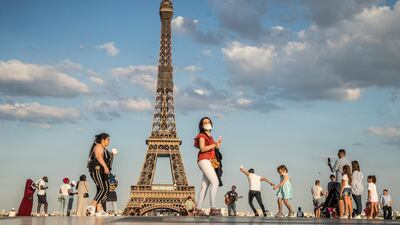
People dance to music at the Trocadero Human Rights Plaza near the Eiffel Tower in Paris, France. EPA -
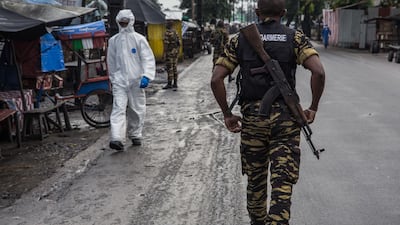
A member of the Covid-19 operational centre (CCO) is seen as soldiers form the Malagasy Gendarmerie patrol the streets of Toamasina, a port city in eastern Madagascar, where containment measures have been reinforced since June 1. AFP -
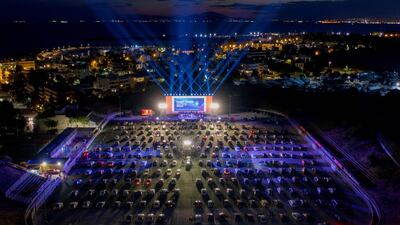
An aerial view shows the opening night of a drive-in festival in the southern Athens' suburb of Glyfada as Greece eases lockdown measures taken to curb the spread of Covid-19. AFP -
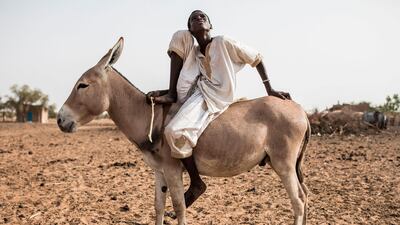
A young Fulani herder sits on his donkey in the village of Mbetiou Peulh. Pastoral families have been stuck around this village since the Covid-19 restrictions were put in place in March 2020. AFP -
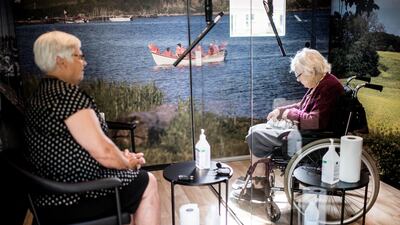
Two elderly women meet in a so-called "Heart Room" installed on the grounds of the Humlehaven nursing home in Arslev on the island of Funen, Denmark. AFP -
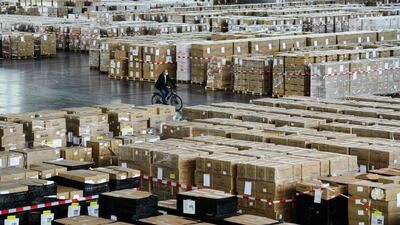
An employee drives with his bicycle at the state camp of North Rhine-Westphalia with protective equipment in Duesseldorf, western Germany amid the ongoing pandemic. AFP -
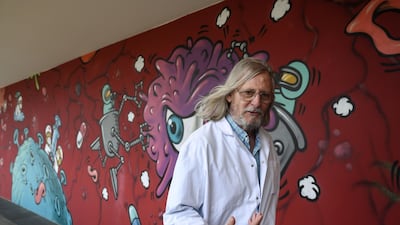
French medecine professor Didier Raoult walks along a wall painted by graffitti artist Jace at his IHU medical institute in Marseille where his works have been at the forefront of promoting hydroxychloroquine as a potential treatment for Covid-19 and has also been subject to criticisms over methodology. AFP -
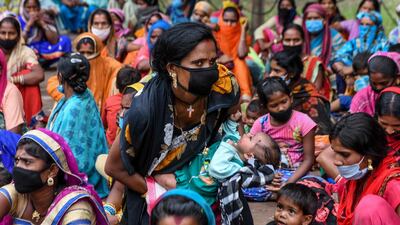
Migrant labourers and their families from Chhattisgarh sit during a protest held against the government and to demand their return to their native places outside the Deputy Commissioner's office after the government eased a nationwide lockdown, in Amritsar. AFP -
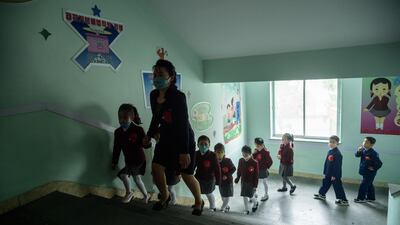
Primary school children wearing face masks as a protective measure arrive for a class at Hasin Primary School in Sosong District in Pyongyang following the re-opening of schools. AFP -

Berlin Tango ridden by David Probert goes on to win Unibet Classic Trial Stakes, as racing resumes behind closed doors at Sunbury-on-Thames, Britain. Reuters -
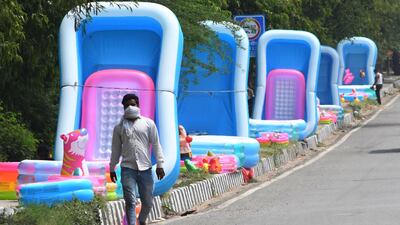
A man walks past inflatable items for sale on a roadside amid an easing of coronavirus lockdown measures, in New Delhi, India. EPA -
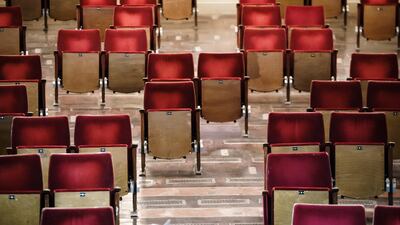
The seating area of the Berliner Ensemble theatre shows gaps of removed seats due to coronavirus measures in Berlin, Germany. EPA


The Social Democrats have been in crisis ever since reluctantly agreeing to enter the coalition two years ago, while Ms Merkel’s conservative bloc faces its first national campaign in nearly two decades without the chancellor, who has said she will leave politics when her current term ends.
The package is part of a deeper shift by Ms Merkel. In the final phase of her political career, the chancellor is looking to take a more activist approach to managing Germany’s economy.
The first step is to pull Germany out of deep recession. Weeks of stringent restrictions to contain the virus hurt demand for everything from Volkswagen cars to Adidas shoes and prompted the landmark €9bn bailout of Deutsche Lufthansa. The economy is expected to contract by more than 6 per cent this year, which would be a more severe contraction than during the financial crisis.
“We have tried to do the best we can in a very, very difficult situation,” Ms Merkel said.