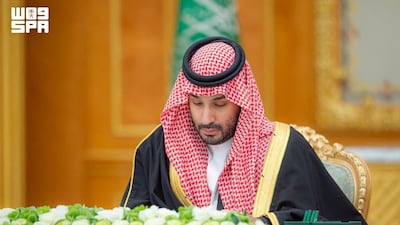

Saudi Arabia has approved a 2027 budget with spending of SR1.39 trillion ($371.2 billion) and a deficit of SR190.56 billion ($50.8 billion), as the kingdom recovers from a war-driven slump in oil output and slower growth in the rest of the economy.
Revenue is estimated at SR1.2 trillion, the cabinet said on Tuesday after a session chaired by Crown Prince Mohammed bin Salman. The figures are in line with the Finance Ministry's pre-budget statement in September, which put the deficit at about 3.6 per cent of gross domestic product.
That would be narrower than this year's shortfall. In September, the ministry estimated that the 2026 deficit would reach SR245 billion, or 4.9 per cent of GDP, well above the SR165 billion projected in last year's budget, as the war disrupted oil exports.
"We are maximising the impact of the Vision on people's lives, transforming its achievements into a sustainable strength for our economy and renewed opportunities for future generations," Prince Mohammed said in a statement carried by the Saudi Press Agency, referring to Vision 2030, the kingdom's plan to diversify its economy away from oil.
The budget comes as Saudi Arabia enters the third and final phase of the programme, which runs until 2030.
Non-oil activities are now estimated to grow 2.5 per cent this year, Prince Mohammed said, down from the 3.2 per cent the ministry forecast in September. The ministry expects the overall economy to shrink 3.6 per cent in 2026, after a 21.8 per cent drop in oil activities, before rebounding 12.8 per cent next year.
Prince Mohammed said regional events had shown the economy's ability to adapt, pointing to investment in the East-West Pipeline and ports on the Red Sea coast. Those routes have allowed the kingdom to keep oil and other exports flowing while avoiding the Strait of Hormuz.
The budget announcement comes as Saudi Arabia continues to face Houthi attacks. On Tuesday, a tower in Riyadh's financial centre was targeted in what the Saudi-led coalition described as a "cowardly terrorist attack". Last week, a Houthi strike damaged the Public Investment Fund tower in the same district.
Prince Mohammed said the kingdom would defend its security, sovereignty and national assets "with strength and resolve". National security and stability were the foundation for preserving development gains and building military and defence capabilities, he said, praising the armed forces and security personnel stationed on the borders.
Finance Minister Mohammed Al Jadaan told reporters the kingdom was "resilient enough to withstand a prolonged conflict" with the Houthis. The idea that "blackmail by missiles" could make Riyadh compromise on national security was "a total mistake", he said.
Saudi Finance Minister
Brent crude was trading near three-month lows on Tuesday, below $90 a barrel, as rising supply outweighed concerns about shipping in the Gulf.
The budget prioritises social support for those most in need, infrastructure and public services, and transport and logistics networks, as well as defence spending. Prince Mohammed said government entities must improve spending efficiency, measure results and align resources with national strategies.
He said public debt would be kept at sustainable levels and the government would maintain "substantial" reserves. The Public Investment Fund and the National Development Fund will continue to back strategic sectors and private sector investment, he added.
Alongside the budget, King Salman issued a royal order allowing the General Organisation for Social Insurance to compensate Saudi employees of eligible companies for up to three months through its unemployment insurance scheme, known as Saned.
A committee of the ministers of finance, economy and planning, and human resources, along with the head of the social insurance agency, will decide which sectors and companies qualify.
The Finance Ministry is expected to publish its full budget statement, including spending by sector and its borrowing plan, in the coming days.
Mohamad Ali Harisi contributed to this report