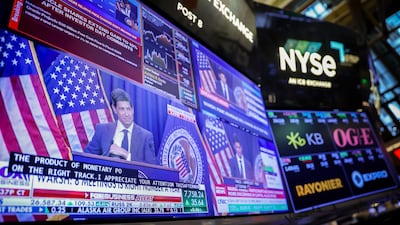

A hotter-than-expected inflation report has put new pressure on the Federal Reserve to raise interest rates at its December meeting, and a top policymaker said he expects the Iran war to have a lingering effect on energy costs.
US government data on Tuesday showed Consumer Price Index inflation accelerated at a 0.4 per cent monthly pace in October, slower than its 0.6 pace in September but still above estimates.
Core inflation, which excludes the volatile food and energy indices, rose at a 0.3 per cent monthly pace last month, also higher than forecasts. The Bureau of Labour Statistics did not submit a year-on-year measure due to the October 2025 government shutdown.

Traders have virtually locked in odds for the Fed to raise rates in its final policy meeting of the year. About 90 per cent expect the Fed to raise interest rates by 25 basis points, while about 10 per cent expect a larger increase of 50 basis points, according to data from the CME Group.
Driving these odds was Fed governor Christopher Waller, an influential member on the central bank's rate-setting committee, who said before the report's release thaat he would support raising rates by 50 basis points next month if October inflation held firm. It would be the Fed's largest rate increase since 2022.
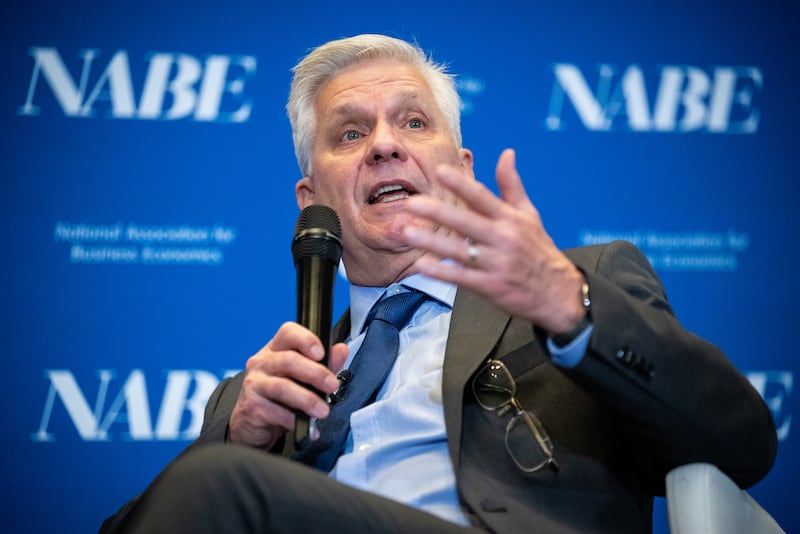
“Hiking only 25 basis points would put our credibility at risk; a risk I am not eager to take," Mr Waller told an event in the UK.
Karl Schamotta, chief market strategist at Korpay, wrote in a note: “The last consumer inflation update before the Fed’s early December meeting took on added significance this morning when Governor Christopher Waller indicated he would vote for a rate hike."
Dallas Fed president Lorie Logan, another voting member on the Federal Open Market Committee, also added to expectations of a December rate increase when she told an audience in Houston that she supports raising it at least two more times.
“It may be possible to move more rapidly this winter than the FOMC has moved so far this fall,” Ms Logan said.
The US central bank left interest rates unchanged in October after raising them by a quarter percentage point in September. Fed chairman Kevin Warsh at the time said the central bank remained committed to reining in inflation, which has remained above the Fed's 2 per cent target for more than five years.
Last month's increases were driven by rising energy and food costs, which remain high due to Iran war. The Bureau of Labour Statistics said four of the six major grocery shop food group indexes increased last month, while one decreased. The energy index moderated from a 5.2 per cent increase in September to 0.7 per cent in October.
“Grocery-store inflation accelerated notably after a string of quiescent readings, underscoring the lags between energy price shocks and non-energy consumer prices,” wrote Bernard Yaros, deputy chief US economist at Oxford Economics.
US central bankers typically look through energy price shocks because they fade quickly, although the nine-month conflict in the Middle East has – for now – reset that perspective.
“And there are reasons to also expect elevated energy prices to persist,” Mr Waller said. “First, even as there is increased tanker traffic through the Strait of Hormuz, that traffic is moving at great expense."
Mr Waller said maritime insurance to pass through the waterway, and the ship-to-ship transfer of oil to guard against Iranian attacks, are reportedly raising oil prices by between $20 and $30 a barrel.
Mr Waller, who was a finalist for the Fed chairman job last year, said diesel oil production is affected by limited refining capacity and other restraints.
“As a consequence, elevated prices for diesel in the United States are not expected to moderate as readily as crude oil prices would in a more peaceful Middle East,” he said.
The yield on the 10-year Treasury, a benchmark for borrowing costs, climbed back to 5 per cent after the CPI inflation report, while the yield on the 30-year Treasury rose more than 10 basis points to 5.36 per cent. The yield on the two-year Treasury, which is sensitive to short-term Fed rate moves, climbed 19 basis points to 4.736 per cent.
Major indexes on Wall Street were all trading in the red, continuing a period of volatility spurred by Democrats' sweeping midterms victory last week. The dollar gained against a basket of currencies. Prices for spot gold and silver fell.
Current projections from the Fed show they expect rates to remain steady at 4.1 per cent in 2027 before slowly easing in 2028.
The Fed's preferred inflation metric is forecast to end the year at 3.7 per cent before moderating to 2.3 per cent in 2027 and 2.1 per cent in 2028. Central bankers are set to update those forecasts next month.