Middle East countries spent 4.2 per cent of their gross domestic product (GDP) on defence in 2023, the highest rate globally, as Israel's military expenditure jumped by nearly a quarter amid its intensifying war in Gaza, according to new research.
Military expenditure as a percentage of GDP, known as the military burden, is a measure of the relative economic cost of defence for a country.
In 2023 the average military burden "grew substantially" for nations in the Middle East by 0.5 percentage points, according to the latest data by the Sweden-based think tank Stockholm International Peace Research Institute (Sipri). The independent institute conducts research into conflict, armaments, arms control and disarmament.
The biggest military burden increases in the region were led by Lebanon with an increase of 6 percentage points, Israel up 0.9 percentage points and Saudi Arabia rising 0.7 percentage points.
The Middle East's estimated military expenditure grew 9 per cent to $200 billion in 2023, as the Israel-Gaza war in October and escalating geopolitical tensions fuelled the region's biggest annual spending increase over the past decade.

The expenditure rise was mainly driven by the region's biggest military spenders Saudi Arabia, Israel and Turkey.
"The Gaza war may force Middle East countries to reassess their budgetary priorities. In the past years, we witnessed a relative slowing down of military expenditures which was due to the pandemic and the trends towards regional de-escalation," Jean-Loup Samaan, a senior research fellow at the University of Singapore’s Middle-East Institute, told The National.
"The war is changing this regional environment. Moreover, the wave of attacks between Israel and Iran underlines the enduring relevance of air defence systems for Gulf states and this will probably drive the strategic thinking in the Arabian peninsula for the coming years."
Israel's military spending spike
Israel’s military spending – the second biggest in the Middle East after Saudi Arabia – grew by 24 per cent to reach $27.5 billion last year, driven mainly by Israel’s bombing of Gaza in October 2023.
Israel’s monthly military expenditure rose "substantially" since the start of the war in Gaza, increasing from an average of $1.8 billion per month before October to $4.7 billion in December 2023, Sipri data shows.
"The large increase in military spending in the Middle East in 2023 reflected the rapidly shifting situation in the region – from the warming of diplomatic relations between Israel and several Arab countries in recent years to the outbreak of a major war in Gaza and fears of a region-wide conflict," Diego Lopes da Silva, senior researcher with Sipri's military expenditure and arms production programme, said.

The Middle East's military spending spree comes as Israel's war in Gaza approaches 200 days on April 24, with unprecedented and devastating impact on the enclave. More than two million people in the occupied Gaza Strip are facing famine and widespread disease, with most of its inhabitants now homeless.
The US House of Representatives on April 20 approved a $25 billion foreign aid package for Israel. The aid bill includes $4 billion for Israel’s missile defences in the wake of drone and missile attacks by Iran. It provides $9 billion in global humanitarian aid including for use in Gaza at Democrats’ insistence. The whole aid package will go to the US Senate. The US President Joe Biden has promised to sign it immediately.
Since Hamas's raid on southern Israel on October 7, which killed around 1,200 people, mostly civilians, Israel has bombarded and invaded Hamas-controlled Gaza, killing more than 34,000 people and wounding more than 76,900, according to the Gaza Health Ministry.
The West Bank has also seen a rise in violence since the war erupted, with about 500 Palestinians killed due to Israel raids, checkpoint shootings and settler violence.
Since Israel's attack on Iran's consulate in Syria on April 1, which prompted Iran to retaliate by firing a barrage of 300 drones and missiles at Israel, tensions between the two countries have intensified. This has heightened fears of tit-for-tat escalation and a wider war.
The rise in frequency and intensity of geopolitical threats has led to calls for de-escalation from world leaders seeking to diffuse tensions.
Iran was the fourth largest military spender in the Middle East in 2023 with $10.3 billion, up marginally 0.6 per cent. The share of military spending allocated to the Islamic Revolutionary Guard Corps grew from 27 per cent to 37 per cent between 2019 and 2023, Sipri said.
Who arms Israel?
The US remains Israel’s biggest arms supplier, accounting for 68 per cent of its weapons imports between 2013 and 2022, according to Sipri's arms transfer database. The US military also has stockpiles of weapons for its own use on the ground in Israel also gives Israel about $4 billion in military aid annually, including about $500 million for air and missile defences.
Germany is in second place, accounting for 23.9 per cent of Israel's conventional arms procurement from 2011 to 2020, according to Sipri.
The UK and Italy are traditionally also among one of Israel’s top arms suppliers. Other military exporters include France, Canada and Australia.
United Nations experts in February called for an immediate halt in any transfer of weapons or ammunition to Israel that would be used in Gaza, as this is likely to violate international humanitarian law.
“International law does not enforce itself,” the UN experts said in a February 23 statement. “All states must not be complicit in international crimes through arms transfers. They must do their part to urgently end the unrelenting humanitarian catastrophe in Gaza.”
The UN welcomed the suspension of arms transfers to Israel by Belgium, Italy, Spain, the Netherlands and the Japanese company Itochu Corporation.
The rise in Israeli spending amid its six-month assault on Gaza is a threat to the country’s economy, which is already facing structural challenges, analysts have said. The country is facing weak governance and policy implementation risks and a further rise in the national defence budget will disrupt government finances.
Saudi Arabia in top 5 military spenders
Saudi Arabia ranked among the top five biggest military spenders in the world in 2023 following the US, China, Russia and India, according to Sipri. Together these countries accounted for 61 per cent of world military spending.
The UK, Germany, Ukraine, France and Japan rounded off the top 10 military spenders globally. Collectively the top 10 spenders in 2023 accounted for almost three quarters (74 per cent) of the world total.
Saudi Arabia's spending increased by 4.3 per cent to an estimated $75.8 billion, or 7.1 per cent of its GDP, in 2023.
The kingdom's share of world military spending reached 3.1 per cent last year. Its military spend as a share of government expenditure was 24 per cent, the highest globally after conflict-ridden Ukraine.
"Saudi Arabia is the world’s largest exporter of crude oil, and the growth in its military spending in 2023 was partly financed on the back of increased demand for non-Russian oil and rising oil prices following Russia’s full-scale invasion of Ukraine," the report said.
While regional security challenges are driving the kingdom's defence s expenditure, the Saudi Armed Forces have also been embarking on a modernisation programme in the last five years that requires major investments," Mr Samaan said.
-
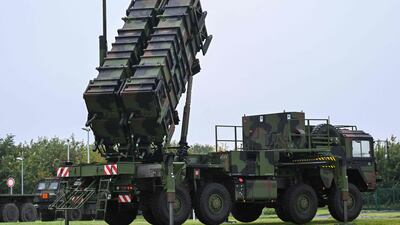
Air defence: Ukraine’s air defence largely depends on the Patriot system. AFP -
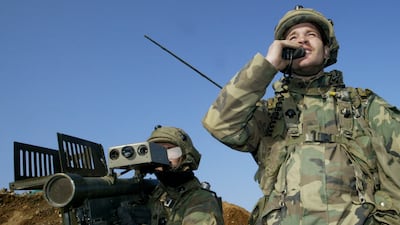
Air: Stinger short-range surface-to-air missile. Reuters -
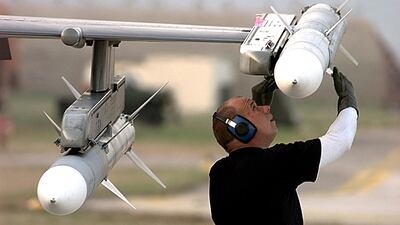
Air: Aim-120 air-to-air missiles. More than 14,000 of the missiles, that have a range exceeding 120km, have been produced with their accuracy so good that they have been nicknamed “Slammer”. Getty Images -
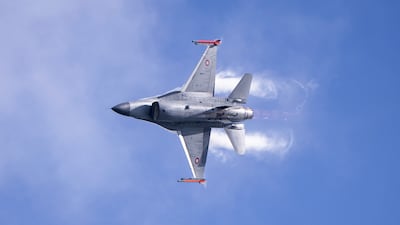
Air: F-16s will provide greater surveillance and the ability to attack high-value targets behind Russian lines in occupied Ukraine. EPA -
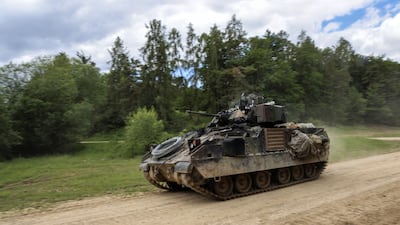
Armour: Bradley IFV. The Ukrainians have found the Bradley infantry fighting vehicle, with its 25mm cannon, very useful in protecting troops and providing decent firepower. Bloomberg -
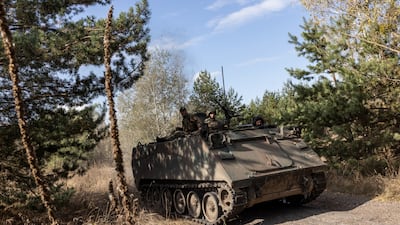
Armour: M113. The 1960s-designed versatile M113 armoured personnel carrier has proven effective in protecting troops against minefields. Getty Images -
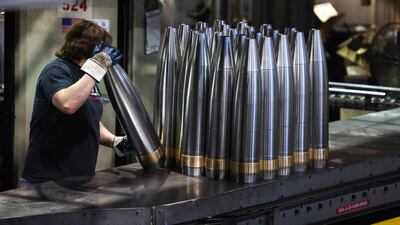
Artillery: 155mm artillery rounds. A massive delivery of 155mm rounds could prove crucial in preventing further Russian advances, particularly in its expected summer offensive. AFP -
Artillery: ATACMs long-range precision missiles. The ATACMS have a range of 300km with the ability to land within a few metres of a target. Getty Images -
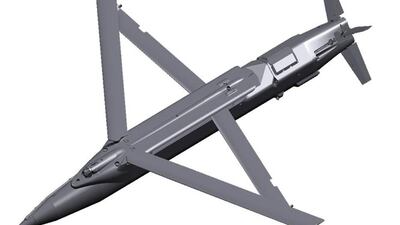
Artillery: Ground-Launched Small Diameter Bomb (GLSDB). It can be fired from the HIMARS system. Photo: Wikimedia Commons -

Artillery: M777 guns and replacement barrels. The Ukrainians need many M777 howitzer barrels to replace those worn down by extensive use. Getty Images


Global military spending surges to record high
As Russia's war in Ukraine continues and Israel's assault on Gaza rages on with no sign of relenting, the world's total military spending increased 6.8 per cent year-on-year in 2023 to a record $2.443 trillion, the steepest annual increase since 2009, Sipri data showed.
"The unprecedented rise in military spending is a direct response to the global deterioration in peace and security,’ Nan Tian, senior researcher with Sipri's military expenditure and arms production programme, said.
"States are prioritising military strength but they risk an action – reaction spiral in the increasingly volatile geopolitical and security landscape."
Global military expenditure rose for the ninth consecutive year in 2023 and increased in all regions, with the biggest rises in Europe, Asia and Oceania and the Middle East.
"The rise in global military spending in 2023 can be attributed primarily to the ongoing war in Ukraine and escalating geopolitical tensions in Asia and Oceania and the Middle East," Sipri said.
The world's military burden increased to 2.3 per cent in 2023, while average military spend as a share of government expenditure rose 0.4 percentage points to 6.9 per cent.
Ukraine became the eighth largest military spender in 2023, increasing its expenditure by 51 per cent to $64.8 billion. This was the biggest percentage increase among the top 10 spenders.
Ukraine's military spending reached 37 per cent of its GDP and the country bears the largest increase in military burden among the top 10 spenders.
The US House of Representatives on Saturday approved a foreign aid package that includes $61 billion in funding for the Ukrainian military as it enters a dangerous phase in its defence against Russia's invasion.

Russia’s military spending increased by 24 per cent to an estimated $109 billion in 2023. Its military expenditure made up 16 per cent of total government spending and its military burden was 5.9 per cent.
China, the world’s second largest military spender, allocated an estimated $296 billion to the military in 2023, an annual increase of 6 per cent. This was China's 29th annual consecutive increase and the country accounts for half the military spending in Asia and Oceania region.
"China is directing much of its growing military budget to boost the combat readiness of the People’s Liberation Army,’ Xiao Liang, researcher with Sipri's military expenditure and arms production programme, said.
"This has prompted countries like Japan and Taiwan to significantly build up their military capabilities, a trend that will accelerate further in the coming years."
The US, the largest military spender in the world, allocating $916 billion in 2023, an increase of 2.3 per cent from 2022. The biggest percentage increase among all US military spending categories in 2023 was for research, development, test and evaluation.