
Since the early-2000s, the International Energy Agency has regularly monitored the environmental impact of industrial activity. The energy body has noted a 70 per cent rise in industrial emissions until now.
But while emission levels declined temporarily in recent years due to the Covid-19 pandemic, they have since rebounded and even exceeded pre-pandemic levels with a 3 per cent growth recorded in 2021.
To align with the strategic objectives of net zero emissions by 2050, the total direct emissions from industry must decline by nearly 25 per cent by 2030, or roughly 3 per cent annually on average, according to the IEA.
So, what can be done to accelerate decarbonisation?
As a national champion for low-carbon power and water from Abu Dhabi, Taqa is fully committed to advancing the low-carbon agenda. The commitment is reflected in our recently announced environmental, social and governance (ESG) strategy and emissions reduction targets.
Under the strategy, we have committed to a 25 per cent reduction of scope 1 and 2 emissions by 2030 across the group, including a 33 per cent reduction of UAE portfolio emissions compared to the 2019 baseline.
We are also committed to expanding renewable energy to comprise more than 30 per cent of our power generation portfolio by 2030.
We aim to also reduce energy consumption needed for desalination by expanding efficient reverse osmosis (RO) technologies to make up two-thirds of desalination by 2030.
The Taweelah RO facility, which started early production in December 2021, will ultimately be the largest RO water desalination plant in the world, sufficient to meet the water demand for more than 350,000 households.
Through our transmissions subsidiary, Abu Dhabi Transmission and Despatch Company (Transco), we have successfully integrated both solar and nuclear power into Abu Dhabi’s existing grid, including Noor Abu Dhabi, one of the world’s largest single-site photovoltaic (PV) projects, and the Barakah nuclear energy plant.
Cross-sector partnerships are also vital to achieving decarbonisation of the industry.
Through our recent partnership with Emirates Global Aluminium (EGA), Transco will connect EGA’s power assets to the grid, giving them access to our diverse energy mix.
Last year, Taqa announced the financial close of a $3.8 billion project, aimed at supporting Adnoc’s efforts to decarbonise its offshore operations. Comprising the deployment of a first-of-its-kind high-voltage direct current (HVDC) sub-sea transmission network in the Middle East and North Africa region, the project will connect directly with Abu Dhabi’s onshore power grid to deliver clean and emission-free energy to Adnoc’s offshore production operations.
The hydrogen economy also presents opportunities across sectors that have traditionally been difficult to decarbonise, such as heavy industry and transport.
Taqa’s global position in low-cost solar power and energy efficient water desalination puts us in a unique position to play a central role in the development of Abu Dhabi’s green hydrogen industry.
We are laying the ground for green hydrogen research and development and enhancing partnerships with multiple key Abu Dhabi entities. This includes a project with Emirates Steel, which is in its final stages, to enable the first green steel produced in the region.
Furthermore, through our investment in Masdar, we have embarked on a partnership with Adnoc and Mubadala that sets out to develop Masdar into a global clean energy powerhouse that will consolidate our collective renewable energy and green hydrogen efforts.
Eventually, decarbonisation and achieving net zero targets will require everyone to play their part — from individuals and industry to institutions.
It’s for this reason Taqa created Abu Dhabi Energy Services (ADES) in 2020, in line with Abu Dhabi’s Demand Side Management and Energy Rationalisation Strategy 2030.
ADES is the energy services market maker for Abu Dhabi, which means it helps the ESCO (energy services company) community identify and execute retrofitting opportunities and large-scale projects across strategic sectors in the UAE capital.
The reduction in power and water consumption contributes to lowering carbon dioxide emissions. ADES handles everything from start to finish, including to identify savings opportunities, financing options and commissioning of the projects to the most suitable contractors in the market.
The cost of these improvements is more than covered by the reduction in the customers’ bills and paid back through the savings in the utility bills. This ensures ADES’s projects are economically viable and creates value for its customers, who are mostly government and commercial entities.
-

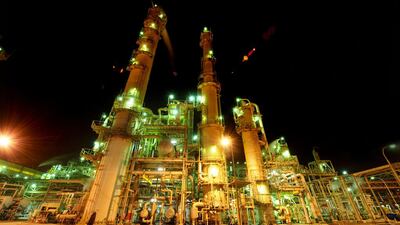
An Adnoc plant in Abu Dhabi's downstream centre of Ruwais. Adnoc is an early pioneer in the emerging hydrogen market. All photos: Adnoc -

An artist's impression of hydrogen-powered lorry. Gulf oil exporters such as Adnoc are looking to capitalise on their oil trading relationships with buyers in Asia to sell hydrogen. -

Fertiglobe, the joint venture between Adnoc and Amsterdam-listed OCI, is developing a large blue ammonia plant in Ruwais that will have a production capacity of 1,000 kilotonnes a year. -

Ruwais, Abu Dhabi. Adnoc formed a hydrogen alliance with ADQ and investment company Mubadala for the development of the hydrogen economy in the UAE. -

The ammonia market was valued at about $48.65 billion in 2016, according to Grand View Research. -
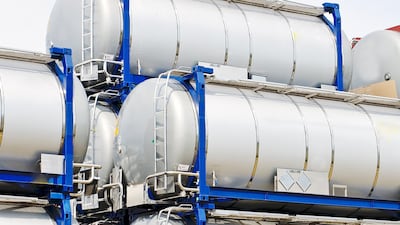
Blue ammonia is a chemical compound produced using hydrogen that is manufactured through steam methane reformation. -
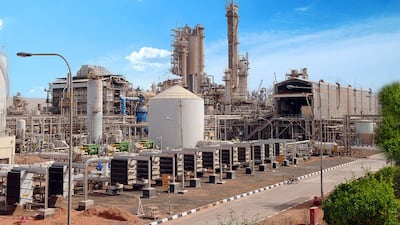
A fertiliser plant in Ruwais. Ammonia, which is used in fertiliser production, allows for the easy transport of hydrogen. -
Adnoc already produces 300,000 tonnes of hydrogen on an annual basis for its downstream operations and plans to increase its output significantly. -

Adnoc and ADQ signed an agreement with Japan's Mitsui and South Korea's GS Energy to help develop a blue ammonia project in Ruwais, in partnership with Ta’ziz and Fertiglobe.


Another benefit of such partnerships is that they drive growth opportunities and can spur job creation and economic expansion.
Taqa plays a critical role in safeguarding global energy security and advancing climate action targets.
By engaging in more cross-sector collaboration, we will ensure our expertise is leveraged to accelerate decarbonisation efforts, achieve emission reductions and upscale investments, while inching closer to the goal of reaching global net zero.
Farid Al Awlaqi is executive director of Generation and Omar Al Hashmi is executive director of Transmission and Distribution at Taqa Group

