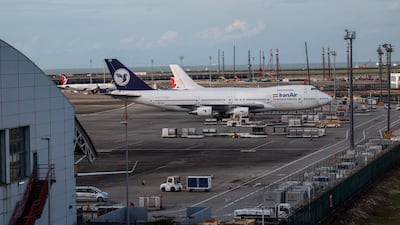

US Treasury Secretary Scott Bessent on Monday threatened to impose secondary sanctions on global air services providers who deal with Iranian airlines as part of its economic pressure campaign on Tehran.
Mr Bessent told CNBC all Iranian airlines would be "shut down” on September 23 by the threat of the secondary sanctions. He was speaking after concluding talks on Sunday night with Chinese Vice Premier He Lifeng.
When Iranian airlines land at an airport, “you cannot provide them with fuel, you cannot provide them with landing services, you cannot sell them tickets, or you will be knocked out of the dollar system”, he was quoted as saying.

He said the US was having positive discussions with Chinese financial authorities on compliance with US sanctions on Iran.
Iran has several airlines, including Iran Air, Mahan Air and Qeshm Air, which fly internationally.
However, Saj Ahmad, chief analyst at StrategicAero Research, said there was limited scope for impact because Iranian airlines have a small footprint globally.
“In addition, where Iranian airlines fly and pay for services, are airports really going to decline that money? And how would that be policed and enforced?” he said.
The big ticket items are fuel, landing fees, parking fees and ground services for water, toilets, cargo, passenger handling – usually, several companies are involved on the ground.
“Getting all these pieces of the puzzle to do what the US demands is tricky because places like neighbouring Pakistan and China, both of whom have strong ties to Iran, are simply not going to fold like a deck of cards on matters like this,” Mr Ahmad said. “Therefore it's hard to see who will play ball and just how the US will enforce this if people simply ignore these demands.”
The move is not surprising “as the Trump administration still believes it can force Iran to 'capitulate', to use Steve Witkoff’s words”, said Alex Vatanka, senior fellow at the Middle East Institute.
“The big question now is how strongly will US insist on enforcement and what will countries around the world decide in terms of implanting these new demands or not,” he added.
The latest move comes as the US continues to carry out Operation Economic Outcast, which is focused on cutting off Iranian sources of funding around the world.
“Under Operation Economic Outcast, Treasury will continue to target and disrupt those who provide material, technological or financial support that allows the Iranian regime to sustain its terrorist enterprise,” Mr Bessent said last week.
Last month, the Treasury Department said it was also broadening the scope of its secondary sanctions campaign, threatening to cut off US dollar access to institutions that continue to do business with Iran.
For Iran, if aviation services are affected, “it will of course hamper Iranian airline operations despite how small their footprint is already”, Mr Ahmad said. “Ultimately, that would leave Iran isolated from air travel and heavily reliant on other airlines for air services,” he added.