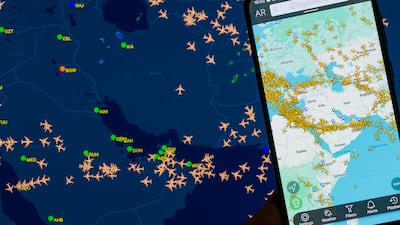

Flydubai has started operating limited flights through eastern Iranian airspace this week.
The Dubai-based airline told The National on Wednesday it has resumed operations on select flights through the eastern corridor after completing the necessary safety assessments.
“There is no change as of today,” a flydubai representative said in an emailed statement.

“Flydubai operates in accordance with internationally recognised and approved flight paths. After completing the necessary assessments, select flights have resumed operations via the eastern corridor,” the representative said, describing the situation as “dynamic” and subject to “constant review”.
The move allows airlines to skip longer detours and is seen by airline and aviation analysts as a cautious, safety-led test of reduced flight times amid the Iran war.
“The eastern corridor refers to flights over Iran’s borders with Afghanistan, Pakistan and Turkmenistan, which, I suspect, carries less risk given that it’s easier to transit out of Iran mid-flight, if needed, and that the current theatre of war has not featured this area, given where Tehran is located,” said Saj Ahmad, chief analyst at Strategic Aero Research.
Flydubai said that it was using the eastern corridor for a few flights.
“We aren’t using the whole airspace, it is a restricted, approved corridor on the eastern side for now, and it is for very few flights,” the airline representative said.
Other UAE airlines as well as the country’s aviation regulator, the General Civil Aviation Authority (GCAA), did not respond to The National's requests for comment. However, these moves to transit Iran would not happen without the GCAA’s blessing, said Mr Ahmad.
“Given that full-service carriers operate longer-haul jets carrying more passengers, it would make sense for them to avoid Iranian airspace for the moment,” he explained. He added that Sharjah’s Air Arabia and flydubai have less range on their A320neo and 737 Max jets versus the wide-body aircraft such as Boeing 777s and Airbus A350s and A380s operated by full-service carriers like Emirates and Etihad Airways.
A partial reopening of eastern Iranian airspace in June offers airlines a shorter alternative to the lengthier detours imposed since the conflict upended regional flight paths, the immediate gains being reduced block times, lower fuel consumption and better on-time performance. However, it has not led to a broad return of global operators, as Western regulators are still advising against it.
The differing approaches also highlight how airlines are operating under separate regulatory frameworks as they assess whether, and where, to resume flights across the region.
“Despite this, the European Union Aviation Safety Agency’s (Easa) current advisory still tells European operators not to fly in the Tehran FIR at any altitude (Saferoutes), and that guidance extends to Iraq, Lebanon, Bahrain, Kuwait, Qatar, as well as the UAE,” said Mr Ahmad.
“Easa’s Gulf guidance currently runs through August 31 as a review date, not a guaranteed reopening.”
So while individual Gulf carriers are starting to route back over parts of Iranian airspace, it’s not a blanket “approved” situation, but a carrier-by-carrier, corridor-by-corridor call, Mr Ahmad said.