


British Library gathers antique Ramayana into one virtual location. Nobody else has seen it together for more than 150 years. The original folios ending up in the British Library, the CSMVS Museum in Mumbai, the Baroda Museum and Picture Gallery in Gujarat, the Rajasthan Oriental Research Institute in Jodhpur and a private collection, also in Mumbai. The chance to see the striking Ramayana seemed lost forever. Until now. All photos courtesy of British Library.
-
-

Rāvana has a brother, the giant Kumbhakarna, whom Brahmā had cursed to spend most of his life asleep. Rāvana decides that he needs him to fight Rāma and sends an army of his demons to waken the monster. The demons try to rouse the prostrate Kumbhakarna by making the most enormous din, and when that fails, they hit him with weapons and clubs and shout in his ear. Women play musical instruments, a donkey brays and elephants trumpet. Piles of food, dead animals and monkeys, and jars of liquid, blood and wine and fat, lie waiting his wakening. -
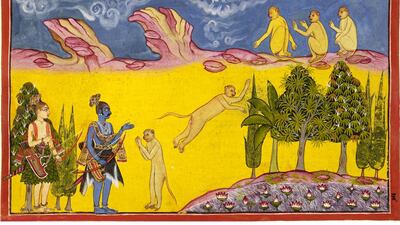
Sugrīva is at first frightened, thinking that these armed warriors have been sent by his usurping brother Bāli to destroy him. He sends his sagacious minister Hanumān to find out more about the two strangers. Hanumān introduces himself, finds out that the two brothers are looking for his master to help recover Rāma’s abducted wife, decides that their alliance would be of mutual benefit, and then bounds back to the crag where the others await him. -
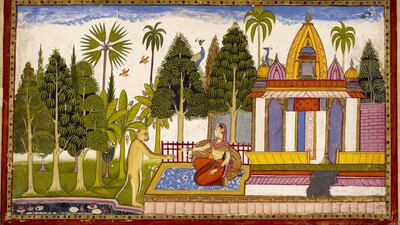
Hanuman was perplexed as to how he could speak to Sita, surrounded as she was by demon guardians. Perched in his tree, he began to recite Rama’s praises. Sita was at first confused by him and thought he might be Ravana in one of his disguises. But she is then comforted by Hanuman, when he reveals himself to her as Rama’s messenger and gives her Rama’s ring. -
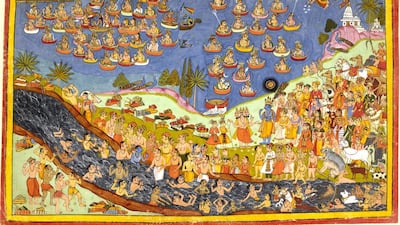
As Rāma and the procession reach the banks of the river Sarayū, Brahmā and the gods appear to witness Rāma’s ascent and light the sky with an effulgent glow. Accompanied by chants of ‘Hail Viṣṇu’, Rāma enters the waters and ascends to heaven. He is accompanied by Sugrīva, his brothers, monkeys, bears and other humans. They willingly sacrifice their lives in order to ascend to heaven with him. The entire populace of Ayodhyā witnesses the heavenly event, some plunging into the waters in order to attain mokṣa (release from rebirth). They are shown ascending to the celestial realm with Rāma. -
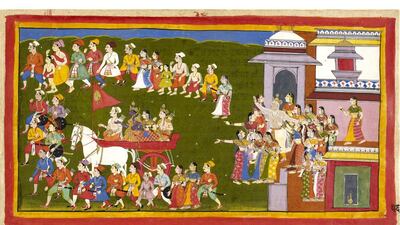
Rāma, his wife and brother ride off in a chariot driven by Sumantra and are surrounded by the grieving townspeople, whose tears lay the dust raised by the chariot’s progress. Daśaratha hurries from his palace and goes through the gate of the city surrounded by his queens, their agony expressed in their outstretched arms, begging them to linger for a little.
In pictures: Hindu epic Ramayana goes online
Most popular today

