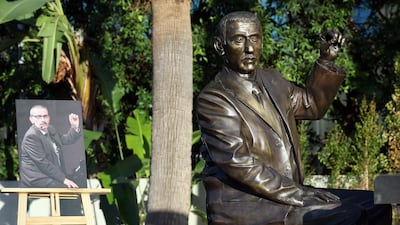

A statue honouring the late Lebanese composer, pianist and playwright Ziad Rahbani has been unveiled in the gardens of the National Library in Beirut.
Lebanese Minister of Culture Ghassan Salameh and Beiteddine Art Festival president Nora Jumblatt unveiled the sculpture on Wednesday, 16 months after Rahbani's death aged 69.
Created by Lebanese sculptor Mansour Assaf, of the Assaf Brothers' studio in the Chouf region, the statue depicts Rahbani seated at his piano, with one hand raised in greeting.
The tribute was conceived by Lebanese Druze leader Walid Joumblatt and developed by the Beiteddine Art Festival committee in collaboration with the Ministry of Culture.
Speaking at the ceremony, Mr Salameh highlighted Rahbani's ability to transcend Lebanon's political and sectarian divisions through his work. He also spoke of his correspondence with Rahbani's mother, singer Fairuz, and his sister Rima Rahbani, who expressed her appreciation for the tribute.

Born in 1956 to Fairuz and composer Assi Rahbani, the musician was part of one of the Arab world's most celebrated artistic families, establishing a distinctive creative identity that challenged many of the conventions of Lebanese music and theatre. He died on July 26 last year.
His compositions brought together Arabic melodies, jazz, funk and western classical influences, while his collaborations with Fairuz marked a new chapter in her career, yielding enduring works such as Wahdon and Kifak Inta.
Rahbani was equally influential as a playwright. Productions such as Nazl El Sourour, Bennesbeh Labokra Chou? and Film Ameriki Tawil employed dark humour, political satire and colloquial Lebanese dialogue to confront sectarianism, social inequality and the absurdities of life during the Lebanese Civil War.

His outspoken political commentary and irreverent humour made him a distinctive voice in Lebanese public life, while his songs and theatrical dialogue became familiar cultural references across generations.
Beirut was central to Rahbani's artistic output. Its neighbourhoods, inhabitants, contradictions and political divisions informed much of his writing, making the city both a setting and a subject of his work.
The statue in the National Library's gardens is a lasting tribute in the capital to an artist who helped to articulate the capital's collective experiences through decades of upheaval.