

Assala Nasri’s return to Damascus this week was never going to be just another concert.
The Syrian singer, mononymously known as Assala, performed in the capital on Thursday for the first time since 2010; she had remained away since publicly supporting the uprising against Bashar Al Assad’s government the following year.
In the lead-up to the show at Al Fayhaa Sports Hall, religious clerics called for it to be cancelled, while videos showed promotional posters being torn down in Damascus.

The concert went ahead, however, with support from Syria’s Ministry of Culture and came on the back of Assala’s latest release, The Syrian Album. The album is a love letter to her homeland through its musical heritage and geography, and she performed several of its songs in Damascus.
Assala announced in February that she was working on a project that brings together traditional Syrian folk songs for a new generation.
“This is the first time in my life that I’ve brought this number of Syrian songs together on one album,” she told ET bel Arabi. “We didn’t play around with them too much, just made some changes in the musical arrangements so that the new generation could connect with them.”
Here is what to know about the album.
The songs and regions on record
The album is, in a way, a sonic map of Syria, with each song dedicated to or inspired by the musical traditions of one of the country’s 14 official governorates.
Damascus is represented by Tawalo, a particularly personal inclusion because it was formerly sung by Assala's father, Mustafa Nasri. Its accompanying video is steeped in nostalgia, evoking the singer's early life.
Aleppo is represented by Aal Rozana, one of the most recognisable songs in Syrian and wider Levantine repertoire. It has been performed by generations of singers, including Sabah Fakhri, and has become closely associated with Aleppo’s tradition of tarab.
-

Syrian singer Assala Nasri in Damascus on September 17, her first performance there in more than 16 years. All photos: AFP -
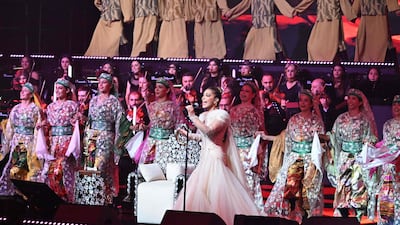
The concert at Al Fayhaa Sports Hall in the Syrian capital -

The performance, titled The Return of Assala, has the backing of the country's Ministry of Culture -
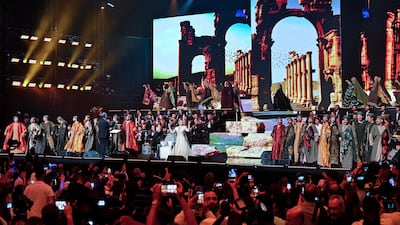
Assala opens the night with Syria Janna (Syria is Heaven), a song she released after the Assad regime was toppled in December 2024 -
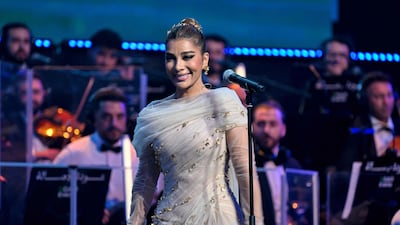
In 2012, she released Ah Law Hal Korsy Byehki (If This Chair Could Talk), a song expressing solidarity with Syrian protesters -
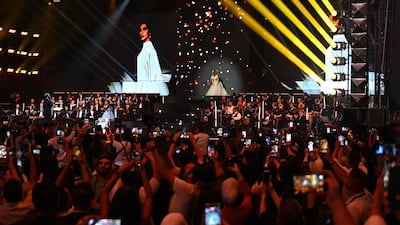
Thousands attend the concert in Damascus -
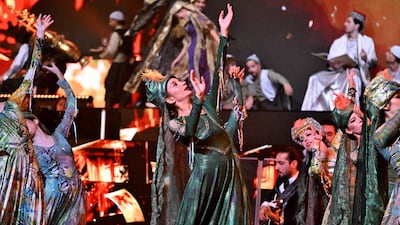
Assala's catalogue spans more than three decades and includes more than 25 albums -
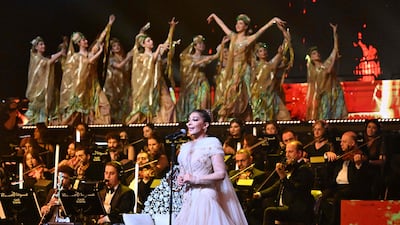
Assala is a regular performer in the UAE, as well as on stages across the Arab world and overseas


Further south, Daraa is represented by Om El Arais, drawing on the wedding repertoire of the wider Hauran region. Hama’s Wallah L Aaby El Jarra invokes the Orontes River, which runs through the city, while Homs is represented by Arab El Sharqia and the dabke traditions of its eastern countryside.
Along the Euphrates, Raqqa’s Yama Moweel El Hawa evokes the river and regional singing traditions, while Deir Ezzor is represented by Aamda.
Other regions evoked across the album include Tartous, Hasakah and Quneitra.
“All the songs are inspired by heritage, the lyrics are old and the melodies are folkloric,” Assala said at a press conference ahead of her Sharjah show in February. “We have developed them musically in a thoughtful way so that they are close to the new generation, without losing their identity.”
Melody and cultural identity
The Syrian Album also carries its themes visually, with each song released with its own video that embodies the heritage of each governorate, with clothing, jewellery, and styling drawing on local traditions.
For the Homs song, Assala’s look references Queen Zenobia, Palmyra and its statuary. The Daraa outfit reworks elements of traditional dress into a corset and narrow contemporary skirt, while the Hasakah look for Helwa W Taltk Dalal uses embroidery and gold thread.
For the Damascus anthem, Tawalo, Assala wears a dress inspired by the city’s renowned mosaic woodwork.
“We completely broke with convention in the Damascus look. The design of the dress evokes the renowned Damascus mosaic woodwork,” stylist Lucy Moussan told Annahar. “The bodice stood out, entirely encrusted with delicate geometric pieces crafted from lustrous natural mother-of-pearl, interspersed with intricate, dark embroidery that closely resembles the luxurious hand-carving on walnut wood.”
Will there be another Syrian album?

Assala has already suggested that The Syrian Album may be a one-off, owing to the level of detail required across the songs, arrangements and accompanying videos.
“I’m determined to pay attention to all the details because this could be my first and last Syrian album,” she told Billboard Arabia. “This is the first time in my life that I’ve brought this number of Syrian songs together on one album.”