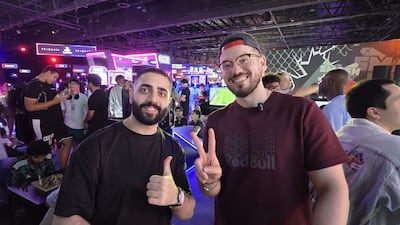

A police officer once stopped Adel “Big Bird” Anouche in Japan, but not because Anouche had done anything wrong; the officer had simply recognised him.
Amjad “AngryBird” Al Shalabi has become used to similar encounters. On trips to Japan, strangers have stopped him in metro stations to talk about matches he played years earlier.
That recognition was apparent again at Tokyo Game Show 2026, where the Abu Dhabi-raised Street Fighter players met fans at the booth of Abu Dhabi studio Red Dunes Games.

Both compete as part of Red Dunes Esports.
“We announced the meet-and-greet at the last minute, but a lot of people showed up,” Anouche says. “I was amazed to see that so many people responded in such a short time.”
Al Shalabi says Japanese fans often surprise him with how closely they have followed his career. “They watch everything, they remember everything, and they treat their players as true professionals,” he says.
The pair, known collectively as The Birds, developed their skills in Abu Dhabi before establishing themselves on the international fighting game circuit.
Their 2026 seasons have taken different paths. Anouche entered Capcom Cup believing he had a genuine opportunity to win. He qualified from his group in first place before facing Japanese veteran Fuudo in the top 16.

The matchup proved difficult, with Anouche saying Fuudo's choice of character put him at a disadvantage in a first-to-five contest.
After difficult outings at Evo Japan and the Esports World Cup, Anouche found better form at Ultimate Fighting Arena in France, where he reached the top eight before helping Red Dunes Esports finish second in SFL and qualify for the playoffs.
Al Shalabi’s year has required a different kind of recovery. Personal issues meant he competed less than usual earlier in the year, before returning to Japan to rebuild his form.
“I knew that one trip to Japan would be enough to get back my confidence and get back my level in the game,” he says.
Al Shalabi says he played against more than 100 opponents and trained for more than nine hours a day while concentrating on a single character.
Red Dunes Esports then finished second in SFL EMEA 2026 to qualify for the playoffs, and Al Shalabi reached the top three at Ultimate Fighting Arena in France.
“This year, I’m trying to get back on my feet,” he says. “So I was really happy to get that top-three performance to help me out.”

Both players believe the overall standard of competition has risen. Anouche says the player base has grown considerably, particularly in Japan, while the average level has improved compared with the Street Fighter IV and Street Fighter V eras.
“The average player is a lot better now,” he says. “That alone makes the competition harder.”
It also means difficult matches can come long before the later stages of a tournament.
“Now you don’t only have to get through the top players,” Anouche says. “You also have to get through the mid-level players, the high-level players and then the top players.”
Al Shalabi points to the changing make-up of the top eight at major tournaments as a sign of that depth. He says the challenge is maintaining a high level across a packed international calendar.
“One of the biggest challenges is staying sharp for all of those events,” he says.
The picture in the Middle East is more mixed. Anouche says he has seen greater interest in esports in Saudi Arabia, which he links partly to the Esports World Cup, although he believes the regional scene still has room to grow.
Al Shalabi is more cautious about progress in the UAE fighting game community. “I don’t think it has improved a lot since I won Evo,” he says. “I thought me winning Evo would have a big impact.”

Red Dunes is now looking at ways to help the next generation of players, who are entering a very different environment from the one The Birds encountered when they started.
“For us, it was way harder because we didn’t have resources back then,” Al Shalabi says. “We didn’t know that we could make this a living. We just did it for the love of the game and to challenge ourselves.
“But now when you look around, you can see a lot of resources and a lot of opportunities.”
Their reception at TGS offered a reminder of where that path can lead. “Street Fighter is very, very big here,” Anouche says. “It’s maybe the biggest game they have. So it feels amazing being here.”