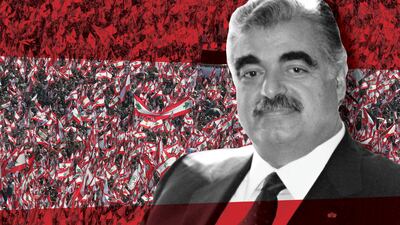

I recall the day Rafic Hariri was assassinated 20 years ago as if it were yesterday. Few people have shaped the destiny of their countries like Hariri did for Lebanon. His impact extended far beyond the country, influencing the broader region, and his assassination marked a pivotal moment – a clear demarcation between the pre-Hariri and post-Hariri eras.
Reflecting on the former prime minister’s legacy is a daunting and complex task, especially at a time when opinions diverge sharply. Some blame him for Lebanon’s enduring problems, while others mourn the missed opportunity for a true saviour. A balanced appraisal, however, must weigh his achievements and shortcomings against the backdrop of Lebanon’s deep-rooted political and economic dysfunctions and the volatile geopolitics of the Middle East.
Even before assuming the role of prime minister, Mr Hariri was already instrumental in shaping Lebanon’s future – engaging in critical civil war negotiations, supporting relief efforts after the 1982 Israeli invasion, and establishing scholarship programmes for more than 40,000 Lebanese students.
As prime minister, Mr Hariri pursued an ambitious vision to transform Lebanon into a regional financial hub reminiscent of its pre-war glory. Moreover, his international and regional contacts were unrivalled, affording him unmatched access to influential figures and cementing his role as a key mediator in global diplomacy.
Mr Hariri championed large-scale reconstruction projects, most notably through the creation of Solidere – a master-planned urban redevelopment company that modernised Beirut – and attracted significant international investment. His policies positioned Lebanon as a centre for banking, tourism and services, bolstering the country’s international financial credibility and economic liberalisation.
Yet, this rapid development came at a price. Investment was heavily concentrated in the Greater Beirut area at the expense of the peripheral regions, and the economy became overly reliant on the financial, banking and real estate sectors, while overlooking more productive sectors such as manufacturing and agriculture.
Furthermore, the currency peg to the dollar, initially a necessary and temporary stabilising force, eventually proved unsustainable. Much of Lebanon’s rebuilding was financed by high-interest borrowing, leading to structural debt vulnerabilities. The aggressive financialisation of the economy – marked by high interest rates and an expanding banking sector financing the fiscal deficit – laid the groundwork for a financial crisis decades later. A pivotal moment occurred in 1998 when Lebanon began borrowing in US dollars through Eurobonds, a measure rushed through Parliament with the assistance of Speaker Nabih Berri. This decision increased Lebanon’s dependence on a currency it could not print and sowed the seeds for the default in March 2020.
Most of Mr Hariri’s critics, however, have either attacked him on political and personal grounds or failed to address the core issues. First, Mr Hariri’s most significant misstep was the inability to fully account for Lebanon’s – and the region’s – complex realities. He operated within a deeply entrenched sectarian and clientelist system, where post-Taif governments were populated by people chosen more for loyalty than competence. The pervasive influence of Syria further constrained his policy options.
Second, Mr Hariri’s economic vision was anchored in a broader political bet on regional peace following the Oslo Accords, with the hope that Lebanon would emerge as a stable investment hub in a peaceful Middle East. This optimistic expectation was first dashed by the assassination of then Israeli prime minister Yitzhak Rabin and further undermined by subsequent turmoil, including 9/11 and the Iraq War. Rather than pivoting when circumstances changed, Mr Hariri persisted with his strategy – a course that his political opponents were unwilling to challenge with decisive reforms, as shown by the 1998-2000 government led by prime minister Salim Al Hoss government.
Third, the core of Lebanon’s economic problem lay not merely in the accumulation of debt but in the misallocation of funds. Investments were funnelled into projects with low economic multiplier effects. The promise of post-war reconstruction was originally based on the pledge by Arab countries to disburse $2 billion (equal to $5 billion in today’s dollars) as part of the Taif Agreement’s broader framework for reconstruction and relief – this was not fully realised. Even the lavish development of Solidere – which was meant to revive the centre of Lebanon’s capital after 15 years of being divided by the civil war – was transformed into an exclusive banking and commercial centre that starkly contrasted with its neglected residential surroundings and excluded its original residents.
Fourth, countries recovering from war typically avoid slashing taxes because they need revenue to finance reconstruction. In defiance of both economic theory and natural experiments, Mr Hariri reduced income taxes, further straining limited resources and hindering recovery.
Finally, Mr Hariri’s reluctance to dismantle exclusive commercial agencies or advance progressive legislation such as the Civil Marriage law under pressure from powerful economic groups and religious authorities meant that he did not challenge dominant political blocs that resisted reforms weakening their control.
Today, as Lebanon faces a profound crisis, the collapse of Mr Hariri’s economic model – exacerbated by years of bad policies, mismanagement and institutional decay after his assassination – serves as a stark reminder that economic policy cannot be separated from politics. Although a full return to his model is unrealistic and undesirable, selective lessons remain vital.
Pragmatic diplomacy, investment attraction and international engagement are crucial, but current Prime Minister Nawaf Salam must also confront the persistent perils of political patronage that has long hindered the development of a robust, merit-based public sector.
Moving forward, Lebanon urgently requires a sustainable and diversified economic model anchored in structural reforms, industrial development and a revamped financial system. Yet, the path to meaningful reform is complicated by a legislative environment where MPs often prioritise populist strategies and short-term gains over transformative, long-term change. It is, therefore, imperative for the current Cabinet to secure a limited-time legislative mandate on specific issues.
Ultimately, while Mr Hariri’s vision did help modernise Lebanon and position it as a regional hub, policies under his tenure cannot be divorced from the political context that both enabled and constrained them. The current crisis is not solely a failure of economic strategy but reflects a broader systemic collapse within Lebanon’s governance structures.