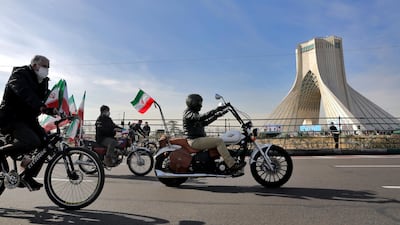

All of the early indications from US President Joe Biden suggest that, in his desire to revive a nuclear deal with Iran, he intends to adopt a far more robust approach to dealing with Tehran than his Democratic Party predecessor, Barack Obama.
One of the more pertinent criticisms of the original deal that Mr Obama helped to negotiate in 2015 is that, in his haste to secure his legacy as a peacemaker, the former president was prepared to make too many concessions to Tehran, such as allowing it to continue work on developing missiles capable of carrying nuclear weapons and failing to curb the malign influence of its proxies on the region.
Iranian negotiators are extremely adept at spotting any weakness in their opponent’s bargaining position, and invariably succeed in exploiting the situation to their advantage, which is what happened with the Obama-era deal. That is one of the reasons that the administration of former president Donald Trump took its controversial decision to withdraw from the agreement in 2018.
Consequently, Mr Biden’s comments last weekend that Washington will not lift its economic sanctions on Iran unless the regime first ceased its controversial nuclear enrichment activities suggest the new US President is preparing to take a tougher line.
In an interview with CBS news on the eve of the Super Bowl, Mr Biden, when asked if the US intended to lift sanctions first in order to get Iran back to the negotiating table, replied with a simple “No”.
Since the end of last year, when Iran’s leading nuclear scientist, Mohsen Fakhrizadeh, was assassinated in a sophisticated plot suspected to be the work of Israel’s intelligence service, Iran has been seeking to intensify the pressure on Washington by increasing its nuclear activities in breach of its nuclear deal commitments. Earlier this week, the International Atomic Energy Agency head, Rafael Grossi, told UN member states that inspectors have confirmed that Iran produced 3.6 grams of uranium metal at its Isfahan plant, once again in violation of the 2015 nuclear deal. This follows Tehran’s recent announcement that it is aiming to enrich uranium close to the level required for production of weapons-grade material.
Many observers believe that Iran’s increasingly defiant conduct on the nuclear front is a blatant attempt to blackmail the new Biden administration into rejoining the nuclear deal, which makes Mr Biden’s suggestion that he intends to take a hard line with Tehran all the more laudable. After all, as Mr Obama’s vice president, Mr Biden had a ringside view of the dubious negotiating tactics Iran deployed during the tortuous process that resulted in the 2015 deal.
-
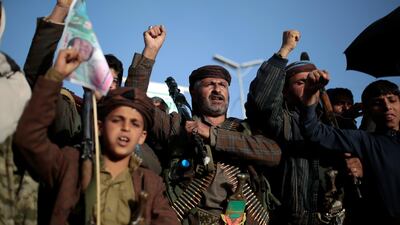
Houthi supporters chant slogans as they attend a demonstration against the United States over its decision to designate the Houthis a foreign terrorist organization in Sanaa, Yemen. AP Photo -
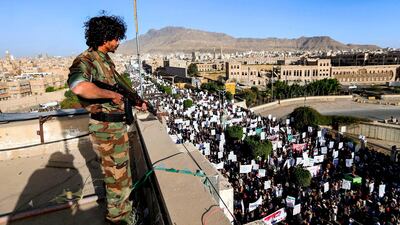
A member of security forces loyal to Yemen's Houthi rebels stands guard as supporters attend a rally denouncing the United States and the Trump administration's decision to apply the "terrorist" designation to the Iran-backed movement. AFP -

A Houthi supporter holds his weapon during a demonstration against the United States over its decision to designate the Houthis a foreign terrorist organization in Sanaa, Yemen. AP -

Opposers of Yemen's Houthi rebels shout slogans during a rally in support of the United States and the Trump administration's decision to apply the "terrorist" designation to the Iran-backed movement, in Yemen's third city of Taez. AFP -

Opposers of Yemen's Houthi rebels shout slogans during a rally in support of the United States and the outgoing Trump administration's decision to apply the "terrorist" designation to the Iran-backed movement, in Yemen's third city of Taez. AFP -
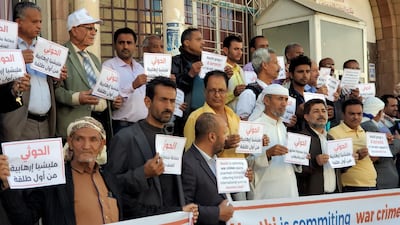
Yemenis opposed to the country's Houthi rebels take part in a rally in support of a recent decision by the United States' outgoing administration blacklisting the Houthi group as a "terrorist" organisation in Yemen's third city of Taez. AFP -
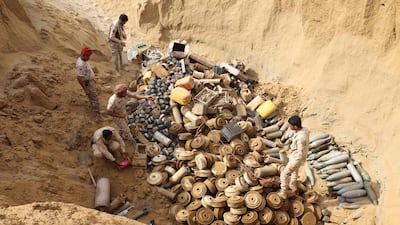
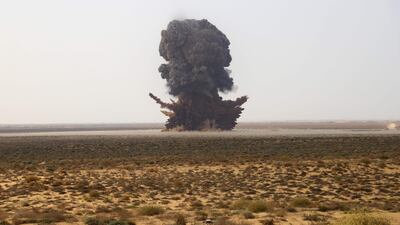
A joint Saudi-backed Sudanese-Yemeni force removes landmines, which they said were planted by the Iran-aligned Houthi rebels in Yemen's northern coastal town of Midi, in the Hajjah governorate. AFP -
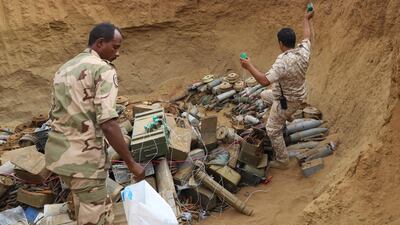
The Saudi-backed Sudanese-Yemeni force removes and de-activates landmines in the Hajjah governorate near the border with Saudi Arabia on the Red Sea. AFP -
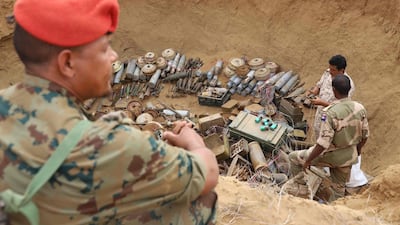
The force collected some 5,000 landmines. AFP -
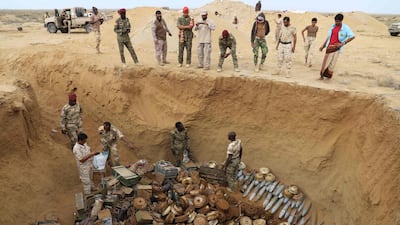
A shot shows landmines collected by the Sudanese-Yemeni force. AFP -
An expAFP


But while Mr Biden is adopting a firm stance on Iran’s blatant violations of that agreement, some of the President’s other policy decisions relating to the Middle East, in particular the speedy announcement that Washington is ending “all American support for offensive operations in the war in Yemen”, runs the risk of sending mixed messages to Tehran, as does his decision to rescind the Trump administration’s designation of the Iranian-backed Houthi rebels, who now hold much of the country, as a terrorist organisation.
Ever since the Houthi rebels, with Iran’s backing, launched their campaign to overthrow Yemen’s internationally recognised government in 2014, the US, together with other Western powers such as Britain, have given their backing to the Saudi-led coalition’s effort to halt the illegal takeover of the country.
Iran’s support for the Houthis, which has included providing the rebels with sophisticated weaponry such as drones and medium-range missiles, is a classic example of Iran relying on proxies to extend its influence in the Middle East through conflict and political destabilisation.
Moreover, the Houthis have deliberately sought to broaden the conflict by targeting civilian areas in neighbouring Saudi Arabia.
In the most recent Houthi attack, a civilian aircraft was set alight after a drone attack on Abha International Airport, in the southern Saudi province of Asir. The Houthis have even been accused of firing Iranian-made missiles at Makkah.
It is acts like these that prompted former US Secretary of State Mike Pompeo, in the dying days of the Trump administration, to designate the Houthis as a terrorist organisation.
The US State Department, responding to claims by human rights groups that imposing sanctions against the Houthis will have an adverse impact on humanitarian aid supplies, has now reversed the decision, which many will find hard to understand because the Houthis have primarily been responsible for preventing the much-needed supplies from reaching Yemen’s war-ravaged population.
Given that Yemen’s long-running civil war has become the world’s worst humanitarian disaster, it is perfectly understandable that the new Biden administration should want to distance itself from the conflict, which most observers now believe can only be resolved through fresh negotiations.
But by rushing publicly to withdraw support for the Saudi-led coalition, as well as ending the Houthis’ terrorist designation, Mr Biden runs the risk of signalling that Washington is sympathetic to Tehran’s regional ambitions.
The other key factor Mr Biden appears to have overlooked is that Washington’s new policy on Yemen could undermine the US-led effort to tackle the terrorist infrastructure of Al Qaeda in the Arabian Peninsula, which poses a threat to both Yemen and Saudi Arabia, as well as the wider region.
But in terms of the key issue of tackling Iran’s nuclear ambitions, Mr Biden and his officials need to understand that tackling the pernicious influence that Iranian proxies such as the Houthi rebels have on the Middle East is just as important as limiting Tehran’s ability to acquire a nuclear weapons arsenal.
Consequently, if the President is to succeed in his quest for a new deal with Iran, he needs to formulate a comprehensive policy that covers all of Iran’s misdeeds, instead of repeating Mr Obama’s mistake and concentrating solely on the nuclear issue.
Con Coughlin is a defence and foreign affairs columnist for The National