From 2013 to 2017, I served as a White House appointee to the US Commission on International Religious Freedom. Annually, we would review how the practices of countries around the world affected the ability of their citizens and residents to freely follow their faiths. We would identify countries that violated religious freedom, together with our recommendations for actions the US government could take to bring these countries into compliance.
Early on, I could see there was deep resistance to any examination of Israel by some commissioners, both Republican and Democratic appointees. In my first month as a commissioner, I was dragged into a bizarre battle over a Christmas op-ed the Commission wanted to publish expressing concern that “in the land where Jesus was born, Christians feared celebrating Christmas”. As examples of places where Christians might face persecution, the article cited a few Arab countries (weirdly, including Lebanon and Syria) and added Pakistan and Nigeria for good measure. When I asked about Palestinian Christians, the response was a near hysterical rejection – more like a “How dare you?”.
And when, a year later, the Commission received a visit from the Roman Catholic Patriarch of Jerusalem seeking our support for a few rather small requests he had of Israeli authorities – like visas for priests and unimpeded passage for Christians between Israel and the West Bank at Christmas and Easter – he was startled when two of my colleagues not only rejected his appeal, but insisted that his priority ought to be demanding that Hamas disarm.
Knowing it would be an uphill battle, I wanted to make the best case possible before proposing that the Commission investigate Israel. I asked a team of attorneys to prepare an extensive brief on Israel’s repressive actions that affected Palestinian Christians and Muslims, as well as Israeli non-Orthodox Jews. The study was modelled on the Commission’s studies of cases of hostile occupations in other countries.
When I submitted the report, together with another Democratic appointee (who was Jewish and was deeply concerned with the treatment of non-Orthodox Jews in Israel), we were greeted with a firestorm of abuse. Our report was not discussed (or even read). Instead, I was subjected to the charge of being anti-Semitic, because two Commissioners claimed I was “singling Israel out for criticism”. This accusation is a hallmark of the International Holocaust Remembrance Alliance’s definition of anti-Semitism, which equates many forms of criticism of Israel with anti-Semitism. It is used to silence critics of the state.
My response to my colleagues on the Commission was to remind them that I had voted with them every year to criticise the practices of two dozen countries and therefore it wasn’t I who was singling Israel out for criticism. It was they who were singling Israel out as the one country that could not be criticised.
This is the “Israel exception” in many American circles. Israel can violate religious freedom, international law, humanitarian law, US laws regarding the use of aid to violate human rights and the lives of civilians, and yet never be criticised. And if it is criticised, those who do so are deemed anti-Semites. This insidious situation has allowed Israel to operate with impunity. Its impact has not only taken a toll on the lives and fortunes of Palestinians, Lebanese, Syrians and others – it is now being weaponised in the US, putting at risk Americans’ basic freedoms.
This acceptance of the IHRA definition has been with us since the first Trump administration’s Department of Education formally adopted it. A dozen states have also legislated its use. After several failed efforts to have it passed by Congress, it may very well pass this year.
Most concerning has been the way the current Trump administration has weaponised the Department of Education’s use of the IHRA definition to threaten universities into taking measures that violate academic freedom and free speech on campuses, the firing of some faculty members, the cancelling of courses and gutting of departments of Middle East Studies. This same IHRA definition is also being used by the State Department and the Department of Homeland Security to cancel visas and green cards, resulting in deportations or cancelling of visas for hundreds of pro-Palestinian advocates. The individuals being deported, university programmes being cancelled, and students being threatened with expulsion are denounced for their anti-Semitism that is creating a hostile environment for Jews on campuses. On examination, however, their “crimes” are nothing more than being critical of Israel or supportive of Palestinians.
-

Activists and students take part in an encampment protest at George Washington University, in Washington. AFP -
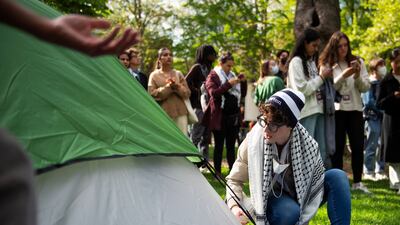
Students and faculty of Drexel University and University of Pennsylvania erect an encapment to protest against the war in Gaza, at the University of Pennsylvania campus, in Philadelphia. AFP -
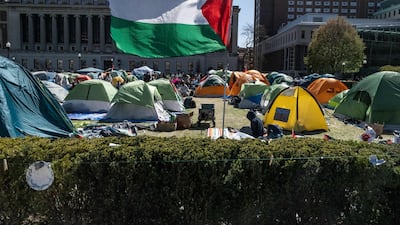
Columbia University students continue their demonstration on campus afterlast week's arrest of more than 100 protesters, in New York City. Getty Images -
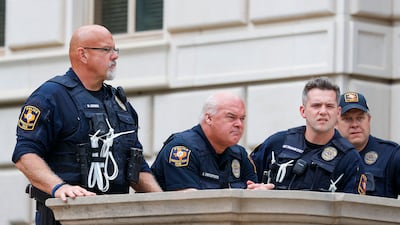
Police watch as students and faculty show support at a Protect Palestine Rally at the University of Texas, in Austin. EPA -
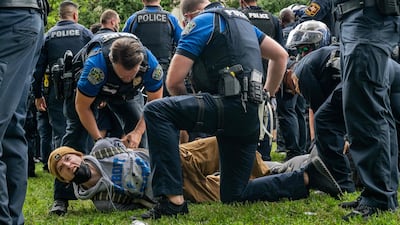
A student is arrested during a pro-Palestine demonstration at the University of Texas at Austin. Getty Images -
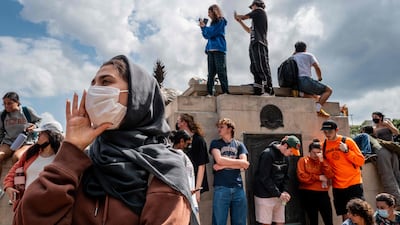
Students rally at the University of Texas at Austin, where police arrested scores of protesters. Getty images -
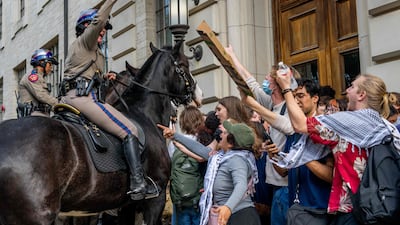
Mounted police confront students protesting against the war in Gaza, at the University of Texas at Austin. Getty Images -
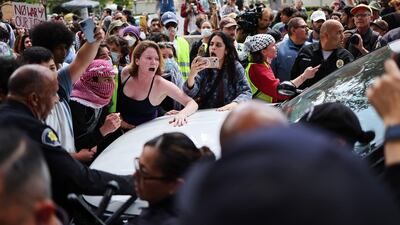
Pro-Palestine demonstrators argue with University of Southern California officials, who attempted to take down an encampment set up in support of Gaza, at the institution in Los Angeles. Getty images -
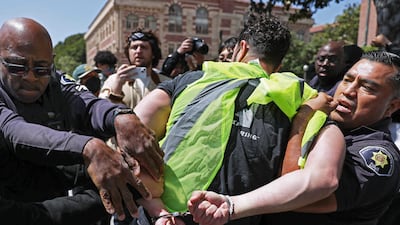
University of Southern California police officers detain a pro-Palestine demonstrator. Getty Images -
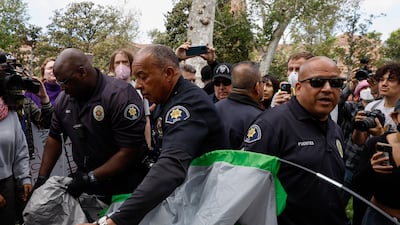
University of Southern California officers dismantle protesters' tents. EPA -
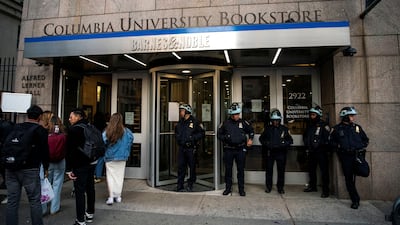
Police stand guard at an entrance to Columbia University, in New York City, where students continue to protest in support of Palestinians, amid the war in Gaza. Reuters -
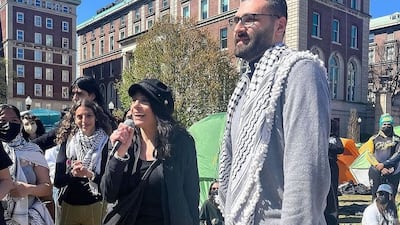
Najla Said, daughter of Palestinian-American academic and literary critic Edward Said, and Motaz Azaiza, a Palestinian photojournalist from Gaza, join the Gaza solidarity encampment at Columbia University. Photo: Columbia Students for Justice in Palestine -
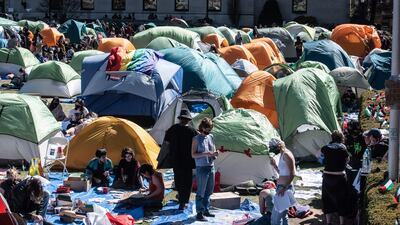
As the campus protests continue, Columbia has moved its classes online. AFP -
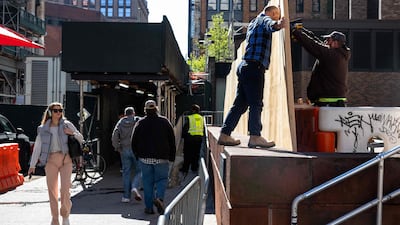
Workers erect a wooden barrier at New York University Stern School of Business after an encampment set up by students was cleared out on Monday night. Getty Images -
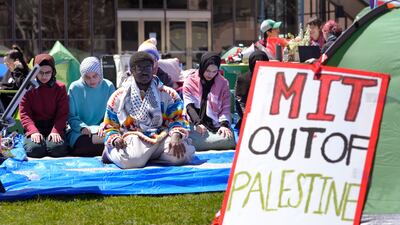
Massachusetts Institute of Technology student Isa Liggans, front left, takes part in Muslim prayer with others, at an encampment of tents at the college, in Cambridge, Massachusetts. AP -
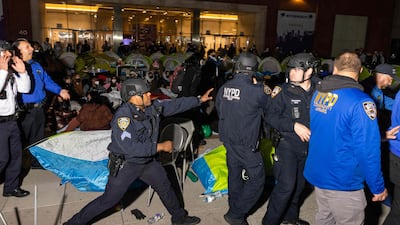
Police officers disperse pro-Palestinian students and protesters who set up an encampment on the campus of New York University. AFP -
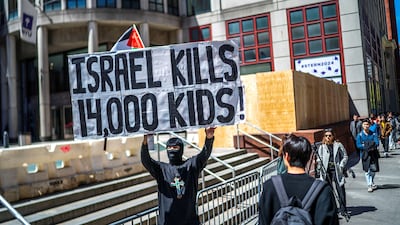
A protester outside New York University. Reuters -
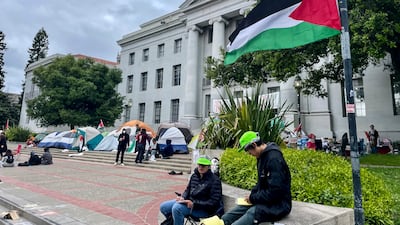
Pro-Palestinian protesters gather in front of Sproul Hall on the campus of the University of California, Berkeley. AP -
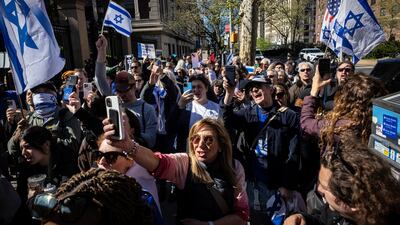
Pro-Israeli demonstrators chant 'shame' after Columbia University assistant professor Shai Davidai was denied access to the main campus. AP -
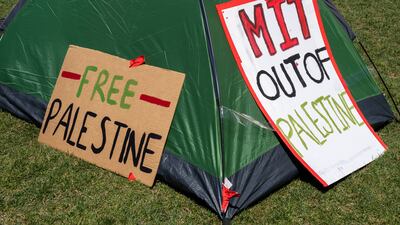
A tent used by pro-Palestinian demonstrators at MIT. Bloomberg -
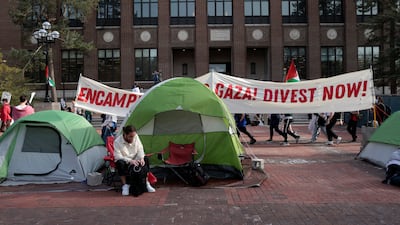
A coalition of University of Michigan students rally to pressure the university to divest its endowment from companies that support Israel. Reuters -
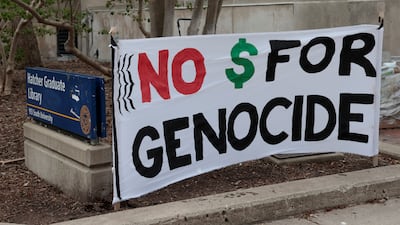
A sign at the University of Michigan. Reuters -
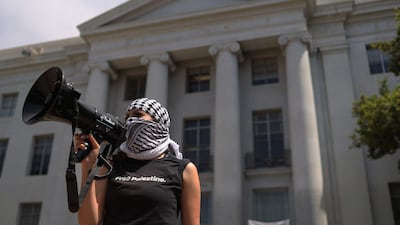
A pro-Palestinian protester in front of Sproul Hall in Berkeley, California. Getty Images / AP -
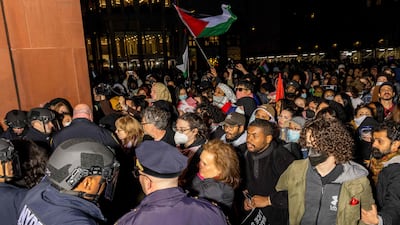
Police officers detain pro-Palestinian students and protesters at New York University. AFP -
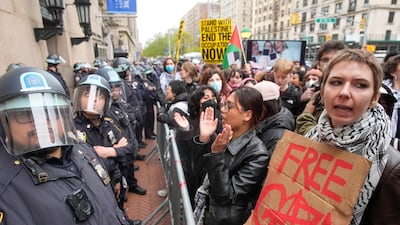
Police in Riot gear stand guard as demonstrators chant slogans outside the Columbia University campus. AP -
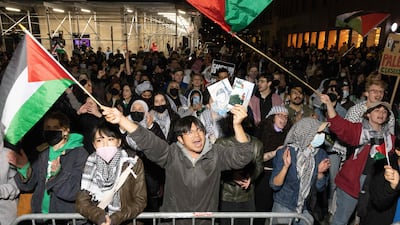
Pro-Palestinian students and activists protest against the Israel-Gaza war on the campus of New York University. AFP


Disturbing is the silence of too many liberals in Congress and academia who, out of fear, have allowed this to continue. They have permitted the “Israel exception” to morph into the “Palestine exception”. In this situation, any state (even the US itself) can be criticised. But not Israel. Victims of human rights violations and genocide must be supported. But not Palestinians. Even US policies can be protested or condemned. But not Israel’s policies.
This implementation and expansion of the “Israel/Palestine exception” by the Trump administration and the enabling silence of too many liberals in Congress and civil society have left many in my community feeling vulnerable and powerless. They are witnessing Israel acting with impunity as it devastates and imposes itself on Lebanon and Syria and accelerates what is increasingly being described by experts as a genocide in Gaza and new levels of repression and ethnic cleansing in the West Bank.
Many in the US are afraid to speak out or become engaged in political protest. Not only visa holders, but citizens, are concerned about travel not knowing how they will be treated on re-entry and, in the case of visa holders, whether they’ll be allowed to return.
We have reached the point where the “Israel/Palestine exception” not only distorts American foreign policy and erodes our stated commitments to international law and covenants but also compromises our right to free speech and assembly and the right to petition our government. As we have witnessed in recent weeks, it is threatening academic freedom and the very idea of the university in American life.
What is heartening is that the coalition that has come together to meet this challenge to Americans’ rights is broad and diverse, encompassing not only Arab Americans, but also an array of civil and human rights organisations, ethnic and faith-based groups, and students and professors. They are coming together to demand an end to the “Israel/Palestine exception”.