The ceasefire between Israel and Lebanon is to be extended by three weeks and the countries' leaders will meet soon in Washington, US President Donald Trump said on Thursday.
He said a second round of talks had gone "very well" and that the US would work with Lebanon to help it protect itself from Hezbollah.
"I look forward in the near future to hosting the Prime Minister of Israel, [Benjamin] Netanyahu, and the President of Lebanon, Joseph Aoun," Mr Trump said in a post on Truth Social.

There was no immediate public response from Hezbollah. The Iran-backed group has mostly honoured the current ceasefire, which had been due to expire on Sunday. "It'll be a wonderful thing to get this worked out simultaneously with what we're doing in Iran," Mr Trump said in the Oval Office.
It was the second time ambassadors for Lebanon and Israel held talks in Washington aimed at cementing peace and tackling disputes along their border. The talks were initially set to be hosted at the State Department but were moved at the last minute to the White House.
Israel and Lebanon began a 10-day ceasefire on April 16, with the caveat that it could be extended by "mutual agreement" depending on progress made during talks and if Beirut “effectively demonstrates its ability to assert its sovereignty”, the State Department said.
Although there has been a reduction in violence, Israeli strikes killed at least five people, including a journalist, on Wednesday and Hezbollah said it had launched an attack drone at Israeli troops in the south.
Before the ceasefire, Israel had been heavily bombing what it says are Hezbollah targets in Lebanon, razing villages and killing thousands of people. It has also invaded the south of the country as it fights against the Iran-backed militia. Hezbollah, meanwhile, has fired drones and missiles into Israel.
Thursday's talks were led by US Secretary of State Marco Rubio along with several officials including Mike Huckabee, the US envoy to Israel. A department representative told The National that the US and other nations intend to support Lebanon as it works to restore state authority and fix the economy.
“The time has come to treat Lebanon as a sovereign state and to finally empower it to act like one, rather than letting an Iran-backed terrorist organisation have a veto on its future or block peace,” the official said. “We are encouraged by a Lebanese leadership that is realistic about its challenges and willing to work towards a sovereign, stable Lebanon.”
-

Smoke rises after an Israeli air strike on Beirut's southern suburbs. Reuters -
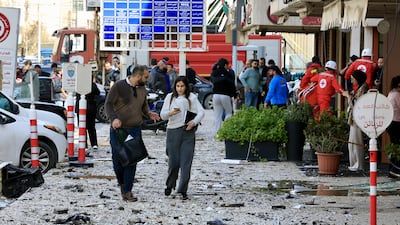
Rescue workers and security officers at the site of an Israeli air strike in the southern coastal city of Sidon, Lebanon. EPA -
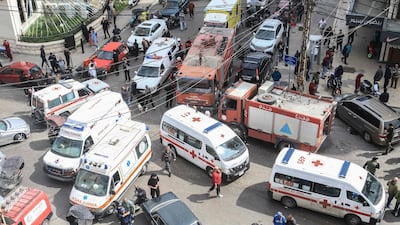
First aid responders work near a struck building in Sidon. AFP -
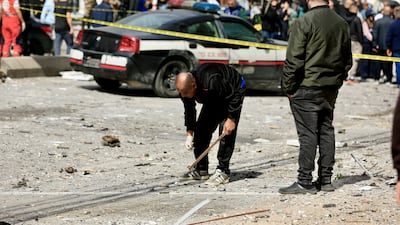
Security officers examine the site of an Israeli strike in Sidon. EPA -
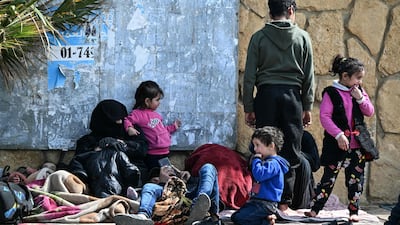
Residents shelter along Beirut's corniche after fleeing the southern suburbs. AFP -
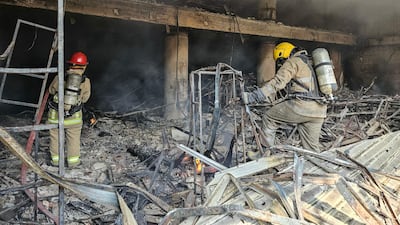
Firefighters tackle a blaze at the site of an Israeli air strike in Beirut’s southern suburbs. AFP -
People stand on the rubble of a building in the southern suburbs of the Lebanese capital. Reuters -
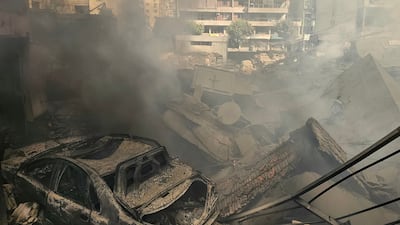
Smoke billows from the site of overnight air strikes, which came after the Israeli army ordered hundreds of thousands of residents to leave the southern suburbs. AFP -
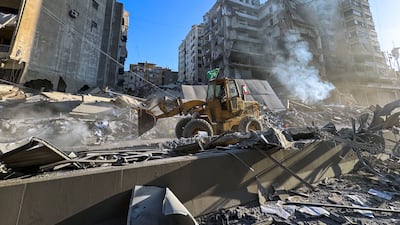
A bulldozer drives along a damaged street in Beirut's southern suburbs. Reuters -
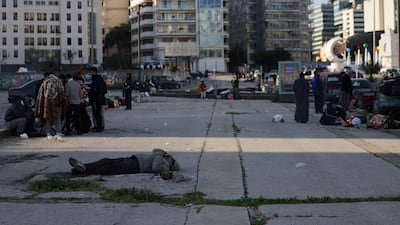
A man lies on the ground, as displaced people gather at Martyrs' Square in Beirut. Reuters


The US ambassador to Lebanon, Michel Issa, Lebanon's ambassador to the US, Nada Moawad, and the Israeli ambassador to Washington, Yechiel Leiter, were also at the meeting, along with Vice President JD Vance.
In a statement, Ms Moawad called for "full respect of the cessation of hostilities announcement and underscored that the protection of civilians – including members of the press corps and humanitarian relief workers – as well as infrastructure and religious sites, remains paramount".
Notably absent was any representative from Hezbollah, which the US and many other nations consider a terrorist group.
On Wednesday, Mr Aoun said negotiations should centre on a “complete halt to Israeli aggressions” and the withdrawal of Israeli troops from southern Lebanon. Other Lebanese demands include the return of detainees and the "commencement of reconstruction for all that has been destroyed during this war”. He also wants displaced Lebanese civilians to return to their villages in the south.

Mr Aoun received Prince Yazid bin Farhan, adviser to the Saudi Foreign Minister, Prince Faisal bin Farhan, on Thursday. They held a “wide-ranging discussion" on the situation, the Lebanese Presidency said.
Hezbollah has condemned Beirut for seeking talks with Israel, reflecting wider splits with the government that has sought the group's disarmament for a year. Israel is demanding the full and rapid disarmament of Hezbollah and it has levelled Lebanese villages as it pushes a “buffer zone” several kilometres into Lebanese territory.
The talks are the first major high-level engagement between the governments of Israel and Lebanon in decades. Israeli Foreign Minister Gideon Saar said on Wednesday that Israel had taken a “historic decision to negotiate directly with Lebanon after more than 40 years”, while also calling it a “failed state” that is controlled by Iran through Hezbollah.
“I call on the government of Lebanon: let's work together against the terror state that Hezbollah built in your territory," Mr Saar said. "This co-operation is needed by you even more than by us.”
Michel Moawad, a member of the Lebanese Parliament representing the Zgharta district, said Lebanon was at a crossroads and faced an “existential threat”.
“We need to choose either we stay as a proxy battleground … or to say, once and for all, stop. We need to change, and Lebanon needs to become a model, not a problem,” he said at a Middle East Institute event in Washington.
Israel and Hezbollah agreed to the pause after fighting a devastating war for more than a year, after Hamas’s attacks on Israel on October 7, 2023. Fighting resumed on March 2 this year after Hezbollah launched rockets at Israel. The Tehran-backed group said it was responding to the killing of Iranian supreme leader Ayatollah Ali Khamenei and more than a year of ceasefire breaches by Israel.
Israel retaliated with force that was described as “disproportionate” by EU and western officials, and civilians in Lebanon have paid the heaviest price. At least 2,165 people, including more than 170 children, have been killed since then, Lebanese authorities said.