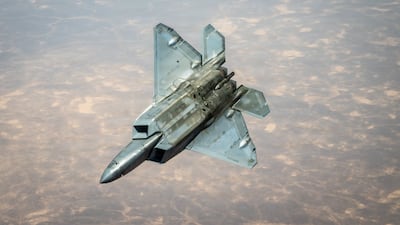
The US military said it intercepted five Iranian drones that posed a threat to American forces and commercial shipping in the Strait of Hormuz early on Thursday, and attacked a ground control station in the port city of Bandar Abbas that was about to launch a sixth.
The strikes came hours after President Donald Trump dismissed an Iranian report of a deal to restore traffic through the strategic waterway and threatened to carry out new strikes.
“These actions were measured, purely defensive and intended to maintain the ceasefire,” a US official told Reuters.

The Iranian Tasnim news agency quoted a military source as saying that Iran's Islamic Revolutionary Guard Corps' navy had fired at a US oil tanker that was trying to transit the strait, forcing it to turn back.
The IRGC said there were no casualties or damage from the US strikes and that it had retaliated by attacking a US base, without saying where.
The US Central Command said Iran launched a missile at Kuwait hours after its interceptions of the Iranian drones, and that it was successfully intercepted by Kuwaiti forces.
Kuwait's army reported intercepting hostile missile and drone threats, but did not say where the attacks came from.
The exchange of fire is the second this week and comes amid mediated negotiations between the US and Iran for a deal to end the war.
At a cabinet meeting attended by media on Wednesday, Mr Trump dismissed an Iranian state TV report that it had obtained an unofficial draft of an agreement to restore commercial shipping through the strait to prewar levels within a month, with Iran and Oman jointly managing traffic.
Mr Trump said no single country would have control over the waterway, and appeared to threaten Oman, a country with which the US has decades-long military and economic ties.
“It's international waters and Oman will behave just like everybody else or we'll have to blow them up. They understand that, they'll be fine,” he said.
The White House and Oman's embassy in Washington did not immediately respond to a request for comment.
Mr Trump has also asked Saudi Arabia, Qatar, Pakistan, Turkey, Egypt and Jordan to join the Abraham Accords, normalising relations with Israel as part of a deal to end the war, which they have declined to do.
The US Treasury Department has added Iran's so-called Strait Authority, the body it set up to manage passage through the strait, to a list of people and entities under sanctions for posing threats to American national security.
Countries around the world have made it clear that Iran does not have the authority to control the strait.
The sanctions are the latest in a series of economic measures by the Trump administration to exert pressure on Iran and push its leaders into an agreement to end the war
The Iranian TV report of a framework deal said the US would also lift its blockade of Iranian ports and withdraw military forces from the vicinity of the country. But Mr Trump's comments and reports of renewed military action showed that the two countries remain far apart despite suggestions from the White House in recent days that a deal to end the war was imminent.

The war has killed thousands of people and sent global energy prices sharply higher since it began on February 28 with US and Israeli strikes. Mr Trump has repeatedly said that a deal was close. The strait, which handled a fifth of the world's oil and liquefied natural gas traffic before the war, the dismantling of Iran's nuclear capacity and sanctions are the sticking points in talks.
The waterway is covered by international law that guarantees foreign vessels the right to pass.
The IRGC Navy said on Wednesday that 23 ships including oil tankers, container ships and other commercial vessels passed through the strait with its permission in the previous 24 hours. Prewar traffic ranged from 125 to 140 ships a day.