China's Tencent Cloud, which recently announced its first Middle East cloud region in Saudi Arabia, expects gaming and its super app-as-a-service offering to drive its business growth in the region, a senior executive said.
The company – the cloud business unit of technology major Tencent – plans to invest $150 million in the kingdom and expects the Saudi cloud data centre business to be up and running by the end of this year.
The new cloud operation will “better serve the region's requirement”, Dan Hu, vice president, Tencent Cloud International, Middle East and North Africa, told The National in an interview on the sidelines of the FinTech Forward event in Bahrain.
“Tencent, as our own ecosystem, we have been in the market for years … we are the largest mobile game developer and publisher. Our flagship game PUBG mobile is ranking number one in the kingdom, in the region and also in [other] international markets.”
Even before the launch of the Saudi cloud data centre, the company deployed some edge nodes – computing devices of servers which serve as gateways to local networks – providing services such as video streaming, live streaming and real-time communication, he said.
The gaming and esports industry is a key element of Saudi Arabia's Vision 2030, which seeks to diversify the kingdom's economy from oil into new economy sectors. The national gaming and esports strategy aims to position Saudi Arabia as a global hub for the industry.
The country hosted the Esports World Cup in Riyadh in August and is expected to stage the first Olympic Esports Games in 2027.

Games by Tencent and its partner studios, including PUBG Mobile, League of Legends, Honour of Kings and Valorant, are popular in Saudi Arabia and elsewhere in the Middle East, Mr Hu said.
Gamers' needs are distinct so being close to them is key for the company, he added.
“The latency is so important, for example, for some of our game customers, especially for some highly interactive customers, they may demand 50 to 70 milliseconds, that is 0.05 to 0.07 seconds. So, if we are not local, we cannot provide that kind of user experience and they will feel some lagging,” he said.
Beyond gaming, the adoption of cloud services has grown consistently in the Middle East amid an expanding young consumer base as well as continuing government efforts to boost technology offerings and develop the future economy.
Growth potential
Global cloud providers are keen to capitalise on growth opportunities offered by the broader region. Tech majors Oracle, Microsoft, Amazon, IBM and Alibaba Cloud have all opened cloud and data centres in the Middle East.
On Tuesday, China's Alibaba Cloud announced the launch of its second data centre in Dubai in response to growing demand for cloud computing and AI services from local businesses.
The move follows the company's first data centre in 2016, and is part of its $53 billion global investment plan in AI and cloud infrastructure over the next three years, the company said.
In the boarder UAE market, data centre capacity will grow 165 per cent to 950 megawatts by 2028, led by Khazna and major projects such as G42-Stargate, Emirates NBD said in research note on Tuesday.
The Emirates ranks among the top global AI and digital infrastructure hubs, powered by 188,000 AI chips and 6.4 gigawatt computing capacity. The scale of investment is equally vast, with $46.1 billion going into data centre and $28 billion being allocated to power an energy pipeline that will drive expansion through 2030, the report says.
“In addition to the online gaming and entertainment, we also want to work with the local enterprises and with local government in terms of their cloud and AI requirements,” Mr Hu said.
-

Gitex Global Dubai 2025 at Dubai World Trade Centre. All photos: Victor Besa / The National -

The major technology and artificial intelligence conference brings together more than 6,800 exhibitors from 170 countries -

The Abu Dhabi Civil Defence display -
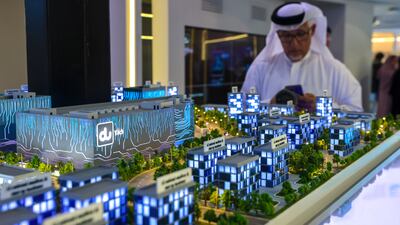
A rendering of du's AI park planned for the Warsan area of Dubai. The telecoms operator says it aims to host local and international artificial intelligence organisations -
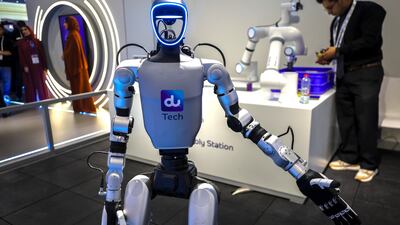
Robotic technology at the du display -

Visitors and exhibitors at the conference, where policymakers and industry leaders emphasised the need for global co-operation to ensure AI is deployed responsibly -

A visitor photographs du's display at Gitex -

Enrique Caballero, head of international sales with Identt, a Polish digital identity firm -
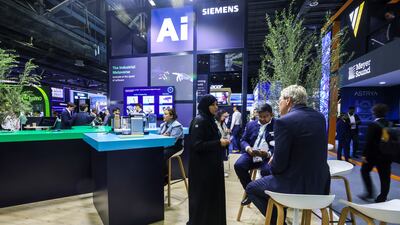
The Siemens display at Gitex


The company has also recently introduced a solution called Super App as a Service, which runs on the Tencent Cloud. Those buying the solution can build a super app with their own marketplace, bring third-party merchants or developers on board and offer users a “seamless” experience.
“It's plug and play, and we already have some customers [in places like Dubai],” he said.
Partnerships
The company on Wednesday also announced a partnership at Gitex with UAE-based Tawasal Information Technology, to create gaming and cloud services. The collaboration will integrate localised mini games to the Tawasal SuperApp, which currently offers video and voice calls, messaging with chats, channels and media sharing, video conferencing, AI integration and other lifestyle services.

Tencent Cloud also announced a partnership at Gitex with Klickl, a UAE-based regulated Web3 financial infrastructure platform. Under the pact, Klickl aims to boost its digital finance capabilities with mini-app system solutions from Tencent Cloud to support digital wallets and cross-border payment functionalities.
In March, Tencent Cloud teamed up with Smiles, the loyalty programme of e&, for the super app offering. The integration allows partner brands to integrate as “mini apps” within Smiles, mirroring the WeChat model that Tencent runs in China.
"I think we offer you another alternative. Instead of building everything by yourself, competing with all the market in each and every sector, you share the business, the business benefit," Mr Hu said.
"You don't have to compete, build this obsolete, heavy stack. You can work with others, and make your app more inclusive ... everybody is talking about partnerships, this is one of the best ways."